




| Aliases | Cibinetide |
| Class | IRR agonist (EPO mimetic) |
| Molecular weight (Da) | 1257.4 |
| Half-life (indicative) | ~2 h † |
| Research status | In clinical research |
Research context (RUO): ARA-290 (cibinetide) is a synthetic peptide of eleven amino acids, derived from erythropoietin (EPO). It is supplied exclusively for in-vitro laboratory research and not for human or animal use.
ARA-290 (Cibinetide) research: the EPO-derived peptide
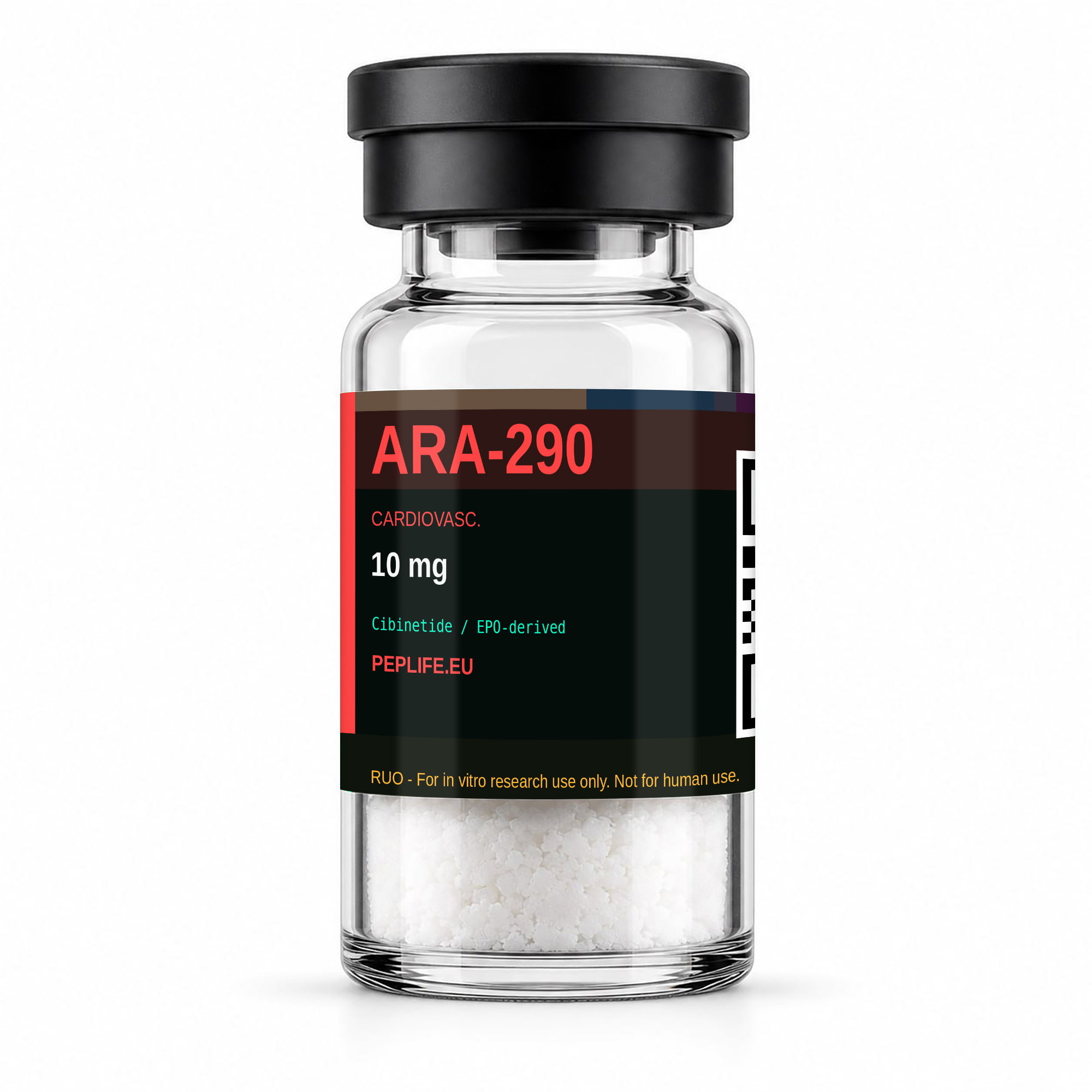
ARA-290 research addresses a striking question: can you harness the tissue-repairing and anti-inflammatory side of erythropoietin (EPO) without the blood-forming activity? ARA-290, also known as cibinetide, is a short peptide designed for precisely that purpose. Over the past fifteen years it has grown into one of the most studied “non-erythropoietic” EPO derivatives, with clinical pilots into neuropathy and inflammation. This pillar sets out what ARA-290 is, how researchers believe it works, and which studies make it interesting for laboratory applications.
What is ARA-290?
ARA-290 is a linear peptide of eleven amino acids that mimics the structure of a specific loop region of the EPO molecule. EPO is best known as the hormone that drives the production of red blood cells, but researchers discovered that EPO also plays a second, tissue-protective role. These two functions run via different receptors. ARA-290 is engineered so that it addresses only the tissue-protective signal and leaves the blood-forming (erythropoietic) pathway untouched. As a result it lacks the classic EPO side effects such as a rise in red blood cell mass. In chemical databases cibinetide is registered with molecular formula C51H84N16O21 (PubChem CID 91810664).
How does ARA-290 work? — the mechanism
The central term in ARA-290 research is the innate repair receptor (IRR). According to the model of Brines and colleagues this is a receptor complex that forms when the EPO receptor couples to the so-called beta-common receptor (CD131). This complex is expressed only in tissue that is under stress or damage. ARA-290 binds selectively to this innate repair receptor and thereby sets in motion a cascade that in preclinical models was associated with less inflammation, inhibition of programmed cell death (apoptosis) and stimulation of tissue repair. Because the receptor only appears upon tissue damage, ARA-290 is described in the literature as a peptide that would be active mainly “where it is needed” — a property that researchers find attractive from a safety point of view. Important: this is a research model, not a proven treatment.
What is ARA-290 studied for?
The focus of clinical ARA-290 research lies with small fiber neuropathy (damage to the thin nerve fibres) and the associated neuropathic pain, plus broader inflammation models. Researchers study, among other things:
- Sarcoidosis-associated neuropathy: in a randomised, double-blind pilot by Heij and colleagues (Molecular Medicine, 2012), sarcoidosis patients with symptoms of small fiber neuropathy received ARA-290 or placebo; the researchers reported a significant improvement in the neuropathy symptom score after four weeks, without safety signals.
- Regeneration of nerve fibres: in a follow-up study, researchers described that cibinetide was associated with an increase in the amount of corneal nerve fibres (measured with corneal confocal microscopy) and a decrease in neuropathic pain in sarcoidosis patients.
- Diabetic neuropathy: Brines and colleagues studied ARA-290 as a non-erythropoietic peptide in patients with type 2 diabetes, with interest in both neuropathic complaints and metabolic parameters.
- Inflammation & tissue protection broadly: preclinical models explore ARA-290 in the context of ischaemia, wound healing and autoimmune inflammation, each time via the innate repair receptor.
All these findings come from research settings; they say nothing about use outside the laboratory.
ARA-290 in laboratory research: handling & dissolving
ARA-290 is supplied as a freeze-dried (lyophilised) powder that must be reconstituted before use in a research setup. In practice, laboratories usually work with bacteriostatic or sterile water, whereby the liquid is introduced gently against the vial wall instead of sprayed directly onto the powder. Which liquid and concentration are suitable depends on the protocol; our pillar reconstitute peptides goes into this in more depth. Reconstituted peptide is sensitive and is stored refrigerated and protected from light.
Quality & purity
Every relevant batch is independently HPLC-tested by an external laboratory; the certificate of analysis (CoA) is publicly verifiable per batch. For peptides like ARA-290, which in research revolve precisely around a selective receptor signal, purity is no minor matter: contaminants or incomplete sequences can cloud research results. That is why we link a verifiable CoA to every batch, so that the identity and purity of the material remain transparent. Also read why we rejected a batch.
Frequently asked questions about ARA-290
What exactly is ARA-290 (cibinetide)?
It is a synthetic peptide of eleven amino acids derived from part of the erythropoietin molecule. It is designed to address only the tissue-protective pathway of EPO via the innate repair receptor, without the blood-forming activity. It is solely a research substance (RUO).
Does ARA-290 increase the production of red blood cells like EPO?
No — that is precisely the starting point of the design. In the literature, ARA-290 is described as “non-erythropoietic”: in studies, no relevant increase in red blood cell mass was reported, in contrast to EPO itself.
What is ARA-290 most studied for in research?
Mainly for small fiber neuropathy and neuropathic pain (including in sarcoidosis and diabetes) and for broader inflammation and tissue-repair models. The innate repair receptor is always central.
Is ARA-290 approved as a drug?
No. ARA-290 has the status of a research molecule and is not approved by the EMA, NVWA or FDA. It is supplied by Peplife exclusively for in-vitro laboratory research.
What should you look for when buying ARA-290 for research?
On verifiable purity. Ask for a batch-specific HPLC certificate of analysis (CoA), so that the identity and purity of the peptide are independently confirmed.
How does ARA-290 compare to repair peptides such as BPC-157?
They are studied for different things. ARA-290 revolves around the innate repair receptor and inflammation/neuropathy, whereas BPC-157 research focuses mainly on tissue and tendon repair. They work via very different mechanisms.
Read more & research at Peplife
- Research ARA-290 (Cibinetide) at Peplife
- View all metabolism peptides
- BPC-157 research: the repair peptide under the microscope
- Research BPC-157 at Peplife
- Research KPV at Peplife
Sources: Heij et al., Mol Med 2012 — ARA 290 in sarcoidosis (pilot) · Cibinetide & corneal nerve fibres (IOVS 2017) · Brines et al., Mol Med 2015 — non-erythropoietic ARA 290 · PubChem: Cibinetide (CID 91810664)
Research Use Only. All products are supplied exclusively for in vitro laboratory research. Not intended for diagnostic or therapeutic use in humans or animals, and not approved by the EMA or FDA.
HPLC-tested with a batch-specific CoA and discreet EU shipping — ready for your laboratory research.