




| Class | GH fragment (lipolytic) |
| Molecular weight (Da) | 1815.1 |
| Half-life (indicative) | short (<1 h) † |
| Research status | In clinical research |
Research context (RUO): AOD-9604 is a modified fragment of human growth hormone (HGH) that is studied in science for fat metabolism and lipolysis. It is supplied exclusively for in-vitro laboratory research and not for human or animal use.
AOD-9604 research: the HGH fragment and fat metabolism
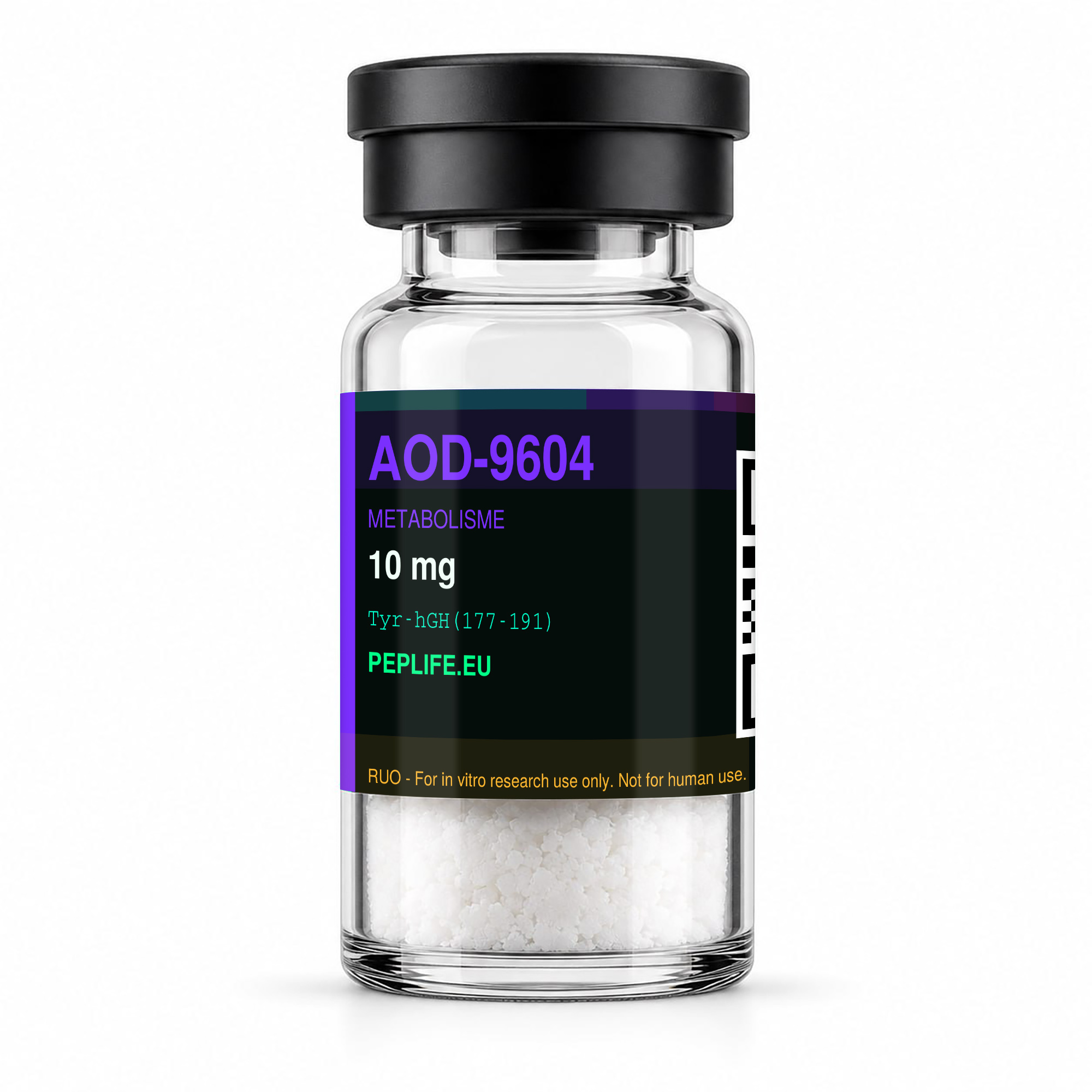
AOD-9604 research revolves around one central question: can you isolate the fat-burning part of growth hormone without the side effects of full HGH? AOD-9604 (the abbreviation stands for “Anti-Obesity Drug 9604”) is a synthetic fragment 16 amino acids long, derived from the C-terminal end of human growth hormone — the region 176-191. It was precisely this piece of the HGH molecule that was associated in animal research with the breakdown of adipose tissue, while the rest of the hormone is responsible for growth and IGF-1 effects. Researchers isolated this domain to study whether lipolysis can be decoupled from growth.
What is AOD-9604?
AOD-9604 is a so-called analogue: a slightly modified copy of the natural HGH fragment 176-191. The modification consists of an additional tyrosine residue at the N-terminal end, which makes the molecule more stable for research purposes. It was developed in the 1990s and 2000s by the Australian company Metabolic Pharmaceuticals, originally as an experimental candidate against obesity. Unlike full growth hormone, AOD-9604 contains only the “lipolytic domain” — the part that researchers suspected drives fat metabolism.
The core of the idea: HGH stimulates fat breakdown, but at the same time raises blood sugar and IGF-1, which can be undesirable. By using only fragment 176-191, researchers hoped to preserve fat burning without those broader hormonal effects. In several preclinical studies, IGF-1 indeed remained unchanged with AOD-9604 — an important difference from intact growth hormone.
How does AOD-9604 work? — the mechanism
In AOD-9604 research, the mechanism is described mainly in two directions: lipolysis (the breakdown of stored fat) and lipogenesis inhibition (the slowing of new fat storage). In animal models, AOD-9604 was associated with an increased fat oxidation without food intake increasing.
A much-discussed question is the role of the beta-3 adrenergic receptor (β3-AR), a receptor on fat cells involved in fat burning. In a study by Heffernan and colleagues (Endocrinology, 2001), both HGH and AOD-9604 increased the expression of this receptor in adipose tissue of obese mice — the previously suppressed levels were brought back to those of lean mice. Notably, according to that study, the lipolytic effect did not run exclusively via the β3-AR: in knockout mice lacking this receptor, an acute AOD-9604 administration continued to increase energy expenditure and fat oxidation. Researchers concluded that the mechanism is more complex than a single receptor pathway.
What is AOD-9604 studied for?
Within laboratory research on metabolism peptides, AOD-9604 is known mainly as a model compound for fat metabolism. The main research areas:
- Lipolysis and fat oxidation: in obese rodent models, chronic administration was associated with weight loss and an increase in fat burning, while muscle mass was spared.
- Metabolic health without IGF-1 increase: in preclinical studies, AOD-9604 showed lipolytic effects without negatively affecting insulin sensitivity — a contrast with full HGH.
- Cartilage and regeneration research: later studies explored whether AOD-9604 plays a role in repair processes in joint tissue, although this research is preliminary.
- Comparative metabolism research: AOD-9604 is studied alongside related fragments to understand which part of the growth hormone drives which metabolic effect.
Important: although early human phase 2 studies (including a 12-week trial in obese adults) showed a modest additional weight loss compared with placebo, AOD-9604 did not reach a significant endpoint in a later, longer trial. Its development as a medicine was therefore discontinued. For researchers, the compound remains interesting precisely for that reason as a study object around the question of how lipolysis works mechanistically.
AOD-9604 in laboratory research: handling & dissolving
AOD-9604 is supplied as a freeze-dried (lyophilised) powder and reconstituted in a research protocol with a suitable liquid before it is used in vitro. Which liquid researchers choose and why is explained in our pillar dissolve peptide: which liquid and the broader reconstitution guide. After reconstitution, the peptide is sensitive to temperature and light; cool and dark storage is standard in most research setups.
Quality & purity
Every relevant batch is independently HPLC-tested by an external laboratory; the certificate of analysis (CoA) is publicly verifiable per batch. For a fragment like AOD-9604, purity is crucial, because contaminants or degradation products can distort the measurability of lipolysis outcomes in the lab. Our product page states per batch which purity and which peptide content have been determined, so that results remain reproducible. Why we sometimes reject batches is explained in why we rejected a batch.
Frequently asked questions about AOD-9604
What is the difference between AOD-9604 and HGH Fragment 176-191?
Both are derived from the same HGH region (176-191). AOD-9604 is a stabilised analogue with an additional tyrosine at the N-terminal end; “HGH Fragment 176-191” usually refers to the unaltered fragment. In research they are often studied side by side. See our HGH fragment 176-191page.
Does AOD-9604 increase IGF-1 like growth hormone?
Not in preclinical studies: that was precisely the reason to isolate only this fragment. The lipolytic domain was associated with fat breakdown without the IGF-1 increase that intact HGH causes.
Why is AOD-9604 called an “anti-obesity drug”?
The name refers to the original development as an experimental obesity candidate by Metabolic Pharmaceuticals. That clinical development has since been discontinued; within Peplife, AOD-9604 is exclusively an RUO research compound.
Does AOD-9604 act via the beta-3 receptor?
Partly. Research showed that AOD-9604 increases the expression of the β3-adrenergic receptor in adipose tissue, but that the lipolytic action is not fully dependent on that receptor.
Which peptides is AOD-9604 compared with in research?
Often with other metabolism peptides such as MOTS-c and with related GH fragments. Our pillar on fat-loss peptides sets the different research directions side by side.
Is AOD-9604 approved for use?
No. It is not approved as a medicine and is supplied exclusively for in-vitro laboratory research (RUO).
Read more & research at Peplife
- Research AOD-9604 at Peplife
- View all metabolism peptides
- Fat-loss peptides: what the research shows
- Research HGH Fragment 176-191
- Research MOTS-c
- AOD-9604 vs HGH fragment 176-191
Sources: Ng et al., Metabolic studies of a synthetic lipolytic domain (AOD9604), Horm Res 2000 · Heffernan et al., Effects of GH and AOD9604 on lipid metabolism, Endocrinology 2001 · PubChem: AOD-9604 (CID 71300630) · AOD9604 — overview
Research Use Only. All products are supplied exclusively for in vitro laboratory research. Not intended for diagnostic or therapeutic use in humans or animals, and not approved by the EMA or FDA.
HPLC-tested, CoA per batch and discreet EU shipping — AOD-9604 for reproducible laboratory research.