




| Aliases | Acadesine |
| Class | AMPK activator |
| Molecular weight (Da) | 258.2 |
| Half-life (indicative) | ~1.4 h |
| Research status | Preclinical / RUO |
Research context (RUO): AICAR (acadesine, AICA-ribonucleotide) is an AMPK-activating nucleoside that is known in research as an “exercise-mimetic”. It is supplied by Peplife exclusively for in-vitro laboratory research and is not intended for use in humans or animals.
AICAR research: the AMPK activator and exercise-mimetic
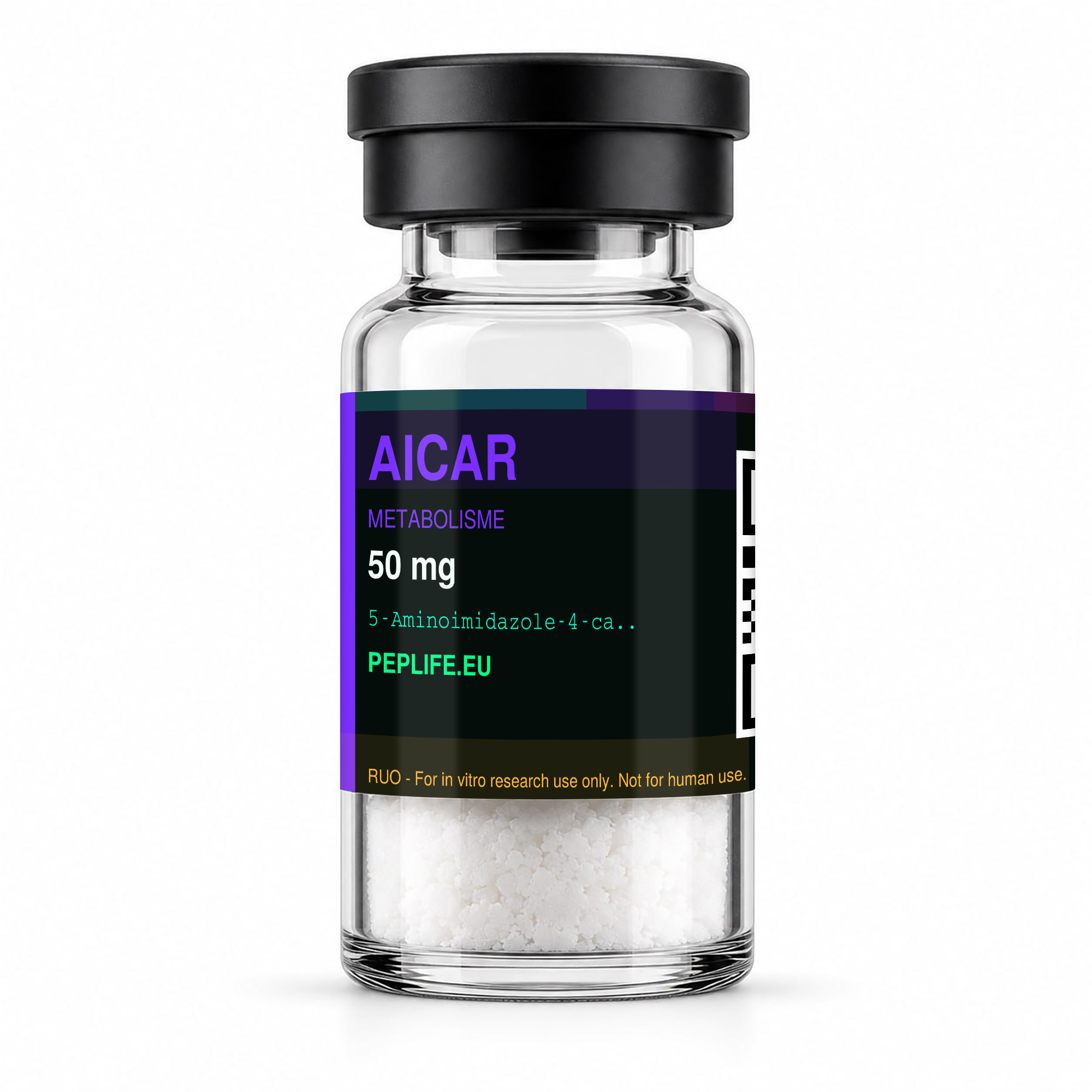
AICAR research revolves around one central question: can a molecule mimic the metabolic signals of exercise without actually training? AICAR — in full 5-aminoimidazole-4-carboxamide ribonucleotide — received worldwide attention when researchers discovered that it activates the energy sensor AMPK in the cell and thereby sets off a cascade that strongly resembles what happens during endurance training. Since then, AICAR has been one of the most studied substances in research on metabolism, glucose uptake and endurance.
What is AICAR?
AICAR is a nucleoside that occurs naturally as an intermediate in the production of purines (building blocks of DNA and RNA). In the cell it is converted into ZMP, a molecule that strongly resembles AMP — the signal that the cell emits when its energy reserve drops. Because of this resemblance, AICAR is described in the literature as an “AMP-mimetic”. In laboratory studies, AICAR is therefore used as a reliable, pharmacological way to switch on AMPK in a targeted manner, independent of actual exercise or energy shortage. According to PubChem (CID 65110), AICA-ribonucleotide has the molecular formula C9H15N4O8P.
How does AICAR work? — the mechanism
The key is AMPK (AMP-activated protein kinase), often described as the cell's “energy thermostat”. When the energy status drops — for example during exercise — AMPK switches on catabolic processes that produce ATP and inhibits processes that cost energy. In studies, AICAR increases the phosphorylation of the AMPK-α subunit and of acetyl-CoA carboxylase (ACC), two classic markers of AMPK activation. Researchers established that the transcriptional effects of AICAR on oxidative genes depend on the nuclear receptor PPARδ: in PPARδ-negative cells, gene expression failed to occur. This AMPK-PPARδ axis forms the core of why AICAR is called an “exercise-mimetic” in research.
Important for scientific accuracy: a systematic review from 2021 in Cells emphasises that AICAR (AICAr), in addition to AMPK, also has a range of AMPK-independent effects. Researchers therefore rarely use AICAR as the sole line of evidence for an AMPK hypothesis, but combine it with genetic or other pharmacological approaches.
What is AICAR studied for?
In AICAR research, a few clear themes recur consistently. Effects are consistently attributed below to the studies and models in question.
- Endurance (exercise mimetic): in the much-cited study by Narkar and colleagues (2008, Cell) in sedentary mice AICAR increased the running time by approximately 23% and the running distance by approximately 44% compared with control animals, at a dose of 500 mg/kg/day for four weeks.
- Glucose uptake: researchers reported that AMPK activation is essential for the AICAR-stimulated glucose uptake in skeletal muscle, whereas this was not the case in fat cells — a finding that illustrates the tissue-specific character of the mechanism.
- Insulin sensitivity and ageing: in isolated skeletal muscle of 24-month-old rats, prior AICAR treatment showed increased glucose uptake, which feeds the interest in AICAR as a model for metabolic ageing.
- Oxidative metabolism: In animal models, AICAR upregulated dozens of genes associated with fatty acid oxidation and mitochondrial function, including Ppargc1a (PGC-1α) and Pdk4.
AICAR in laboratory research: handling & dissolving
AICAR is usually supplied as a freeze-dried (lyophilised) powder in a vial and reconstituted before in-vitro use. Which liquid and which concentration are suitable depends on the research protocol; for this, researchers consult our pillar on reconstituting peptides and about which liquid you use to dissolve a peptide. Careful handling, cool storage and sterile working are standard in every laboratory protocol.
Quality & purity
Every relevant batch is independently HPLC-tested by an external laboratory; the certificate of analysis (CoA) is publicly verifiable per batch. For research on a substance like AICAR — where dosage and effect are highly sensitive in studies — a verified purity is not a luxury but a prerequisite for reproducible results. Those who want to see how seriously we take purity can read our case on why we rejected a batch.
Frequently asked questions about AICAR research
What exactly is AICAR?
AICAR is an AMP-mimetic nucleoside that is converted in the cell into ZMP and thereby activates AMPK. In research it is used as a pharmacological tool to switch on the energy sensor AMPK in a targeted manner. It is supplied exclusively for in-vitro laboratory research.
Why is AICAR called an “exercise-mimetic”?
Because AICAR, in animal models, evokes metabolic and genetic changes that resemble the effects of endurance training — including an increase in endurance in mice that did not train, as reported by Narkar et al. (2008). The term refers to the mimicking of exercise signals in research, not to an application for the reader.
How is AICAR related to AMPK and glucose uptake?
AICAR activates AMPK, and researchers demonstrated that this AMPK activation is necessary for the AICAR-stimulated glucose uptake in skeletal muscle. In fat cells this connection turned out not to be present, which points to a tissue-specific mechanism.
What is the difference between AICAR and MOTS-C or 5-Amino-1MQ?
All three are studied in metabolism research, but via different pathways: AICAR and MOTS-C both touch the AMPK signal (MOTS-C as a mitochondria-derived peptide), while 5-Amino-1MQ is studied as an inhibitor of the enzyme NNMT. A comparative overview is in our pillar on MOTS-C research.
May AICAR be used in humans or animals?
No. Peplife's AICAR is Research Use Only and intended exclusively for in-vitro laboratory research. It is not approved as a medicine and not intended for diagnostic or therapeutic use.
Can all effects of AICAR be attributed to AMPK?
No. A systematic review from 2021 warns that AICAR also has AMPK-independent effects. Researchers therefore usually combine AICAR with additional methods to substantiate AMPK-specific conclusions.
Read more & research at Peplife
- Research AICAR at Peplife
- View all metabolism peptides
- MOTS-C research: the mitochondrial exercise-mimetic peptide
- Fat-loss peptides: what the research shows
- Research 5-Amino-1MQ at Peplife
- Research MOTS-C at Peplife
- 5-Amino-1MQ vs SLU-PP-332 vs AICAR
Sources: Narkar et al., AMPK and PPARδ Agonists Are Exercise Mimetics, Cell 2008 · Activation of AMPK is essential for AICAR-induced glucose uptake by skeletal muscle, PubMed · AICAR and increased glucose uptake in muscle of old rats, PMC · AICAr, a Widely Used AMPK Activator with AMPK-Independent Effects, Cells 2021 · PubChem CID 65110 (AICA ribonucleotide)
Research Use Only. All products are supplied exclusively for in vitro laboratory research. Not intended for diagnostic or therapeutic use in humans or animals, and not approved by the EMA or FDA.
Research-grade AICAR — HPLC-tested by an external laboratory, CoA per batch and discreet EU shipping.