




| Aliases | FTPP |
| Class | Pro-apoptotic (fat-targeting) |
| Molecular weight (Da) | ~2611 † |
| Half-life (indicative) | short † |
| Research status | Preclinical / RUO |
Research context (RUO): Adipotide (FTPP) is a pro-apoptotic peptidomimetic that in preclinical research targets the blood vessels of white adipose tissue. It is supplied exclusively for in-vitro laboratory research and is not intended for human or animal use.
Adipotide research: the adipose-tissue-targeted peptide
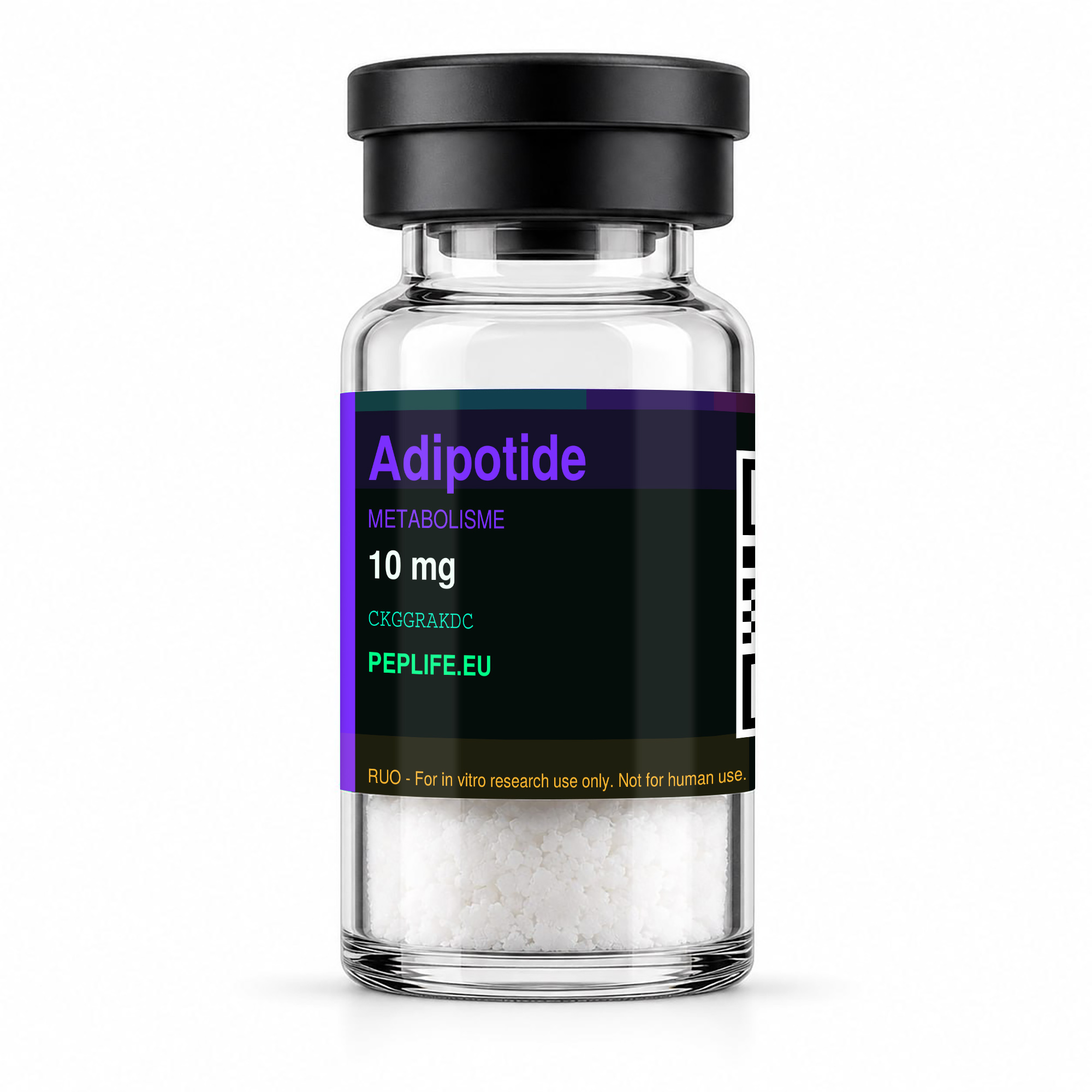
Het adipotide research takes a strikingly different route than most metabolic peptides: where GLP-1-like substances act on appetite and blood sugar regulation, adipotide targets directly the infrastructure of white adipose tissue. In animal models, it is studied how this peptide selectively shuts down the blood vessels that feed fat depots, causing the underlying adipose tissue to decline in models. This unusual mode of action makes adipotide (also known as FTPP, “fat-targeting proapoptotic peptide”, or prohibitin-targeting peptide 1) a recurring topic in the preclinical metabolic literature.
What is adipotide (FTPP)?
Adipotide is a synthetic peptidomimetic with the sequence CKGGRAKDC-GG-D(KLAKLAK)2. It consists of two linked functional parts. The first part, a small “homing” peptide (CKGGRAKDC), functions as an address label: it binds to a protein that occurs mainly on the inner wall of blood vessels in white adipose tissue. The second part, D(KLAKLAK)2, is a pro-apoptotic fragment that only becomes active once it enters the cell. The combination ensures that the “harmful payload” largely ends up in one place: the vessel lining of fat depots. Adipotide was originally developed in the laboratory of Kolonin, Arap and Pasqualini, and has since been a model compound for vascular-targeted fat research.
How does adipotide work? — the mechanism
The target is prohibitin, a protein found on the outside of endothelial cells (the cells that line blood vessels from within) in white adipose tissue. Researchers used prohibitin as a kind of postal code: it occurs relatively specifically at this location, so that a targeted peptide can recognise the small vessels of adipose tissue. As soon as the homing part of adipotide binds to prohibitin, the peptide is taken up by the endothelial cell. Inside, the D(KLAKLAK)2 fragment disrupts the mitochondria — the cell's power plants — which in models triggers apoptosis (programmed cell death).
The consequence in animal models: the blood vessels that feed a fat depot fall away, causing the adipose tissue to lose its supply and shrink in size. Researchers describe this as “starving” fat via the blood vessels instead of via appetite. In later mechanistic studies, a role was also described for the interaction between prohibitin and annexin A2 in fat transport, which further filled in the picture of prohibitin as a functional surface protein in adipose tissue.
What is adipotide studied for?
Adipotide research concentrates around a few recurring themes, all in a preclinical (cell and animal) context:
- Fat reduction: in an early study in Nature Medicine (Kolonin et al., 2004) researchers reported that the peptide led to weight loss and a decrease in adipose tissue in obese mouse models.
- Metabolic parameters: in a follow-up study in obese primates (Barnhart et al., Science Translational Medicine, 2011), in addition to weight loss (on average approximately 10.6%), an improved insulin sensitivity and a decrease in insulin levels were also described.
- Imaging of adipose tissue: in the same primate study, the decrease of white adipose tissue was confirmed with imaging techniques, which makes the model useful for tracking vascular-targeted fat reduction.
- Reversibility and safety: the reported effects were dose-dependent (approximately 0.10–0.75 mg/kg) and reversed after discontinuation. Researchers also described a mild, dose-dependent and reversible renal burden — one of the reasons why adipotide remains a study object and not a clinically approved substance.
Adipotide in laboratory research: handling & dissolving
Adipotide is usually supplied as a freeze-dried (lyophilised) powder and reconstituted in a laboratory setting before it is used in in-vitro models. The choice of solvent and correct handling partly determine the stability of the peptide. Background on reconstitution and solvents is in our pillars reconstitute peptides and which liquid you use to dissolve a peptide. This information is intended solely for research applications, not as instructions for use.
Adipotide versus other metabolic research peptides
Within the metabolism peptides adipotide occupies a unique place due to its vascular point of attack. Peptides such as AOD-9604 are studied for lipolysis (fat breakdown) via a fragment of growth hormone, while incretin-like substances such as retatrutide act on receptors for appetite and glucose regulation. Adipotide distinguishes itself in that it does not adjust the metabolism of a fat cell, but targets the blood supply to the depot itself. A broader overview of this research field is in our pillar fat-loss peptides in research.
Quality & purity
Every relevant batch is independently HPLC-tested by an external laboratory; the certificate of analysis (CoA) is publicly verifiable per batch. For a peptidomimetic such as adipotide, with two linked functional domains, a verified identity and purity is extra important: reproducible research stands or falls with a well-characterised starting material. Peplife supplies adipotide exclusively for in-vitro laboratory research.
Frequently asked questions about adipotide
What exactly is adipotide?
Adipotide (FTPP) is a synthetic pro-apoptotic peptidomimetic that in preclinical research targets prohibitin on the blood vessels of white adipose tissue. Within adipotide research it is studied as a vascular-targeted approach to fat reduction in animal models.
How does adipotide differ from GLP-1 peptides?
GLP-1-like substances act on receptors that regulate appetite and blood sugar. Adipotide, in models, instead acts on the blood vessels that feed fat depots, via the protein prohibitin — a fundamentally different mechanism.
Has adipotide been confirmed by research in humans?
No. The published data come from animal models (mice and obese primates). Adipotide is not approved for human or animal use and is studied exclusively as a research substance.
What does “prohibitin targeting” mean?
Prohibitin is a protein that occurs on the vessel wall of white adipose tissue. Adipotide uses it as a recognition point (“address”) to make its pro-apoptotic fragment act mainly at that location.
Why are renal parameters mentioned in adipotide research?
In the primate study, researchers described a mild, dose-dependent and reversible renal burden. This is one of the most important safety observations from preclinical adipotide research and a reason why it remains a study object.
What is adipotide used for in the lab?
In in-vitro and preclinical models, adipotide is used to study vascular-targeted apoptosis in adipose tissue, metabolic parameters and imaging of fat reduction. It is not intended for application outside laboratory research.
Read more & research at Peplife
- Research Adipotide at Peplife
- View all metabolism peptides
- Fat-loss peptides in research
- Research AOD-9604 at Peplife
- Research Retatrutide at Peplife
Sources: Barnhart et al., Science Translational Medicine (2011) — PubMed 22072637 · Kolonin et al., Nature Medicine (2004) — PubMed 15133506 · PubChem — Adipotide (CID 163360068) · Prohibitin-targeting peptide 1 — overview
Research Use Only. All products are supplied exclusively for in vitro laboratory research. Not intended for diagnostic or therapeutic use in humans or animals, and not approved by the EMA or FDA.
HPLC-tested by an external laboratory, CoA verifiable per batch and discreet EU shipping.