




| Aliases | Semax-related, N-modified |
| Class | Nootropic peptide (melanocortin family) |
| Molecular weight (Da) | not published |
| Half-life (indicative) | not published |
| Research status | Preclinical / RUO |
Research context (RUO): Adamax is a synthetic, N-modified research peptide related to the Semax/melanocortin family, studied in the context of cognition and neuroprotection. It is supplied exclusively for in-vitro laboratory research and is not intended for human or animal use.
Adamax research: the nootropic research peptide
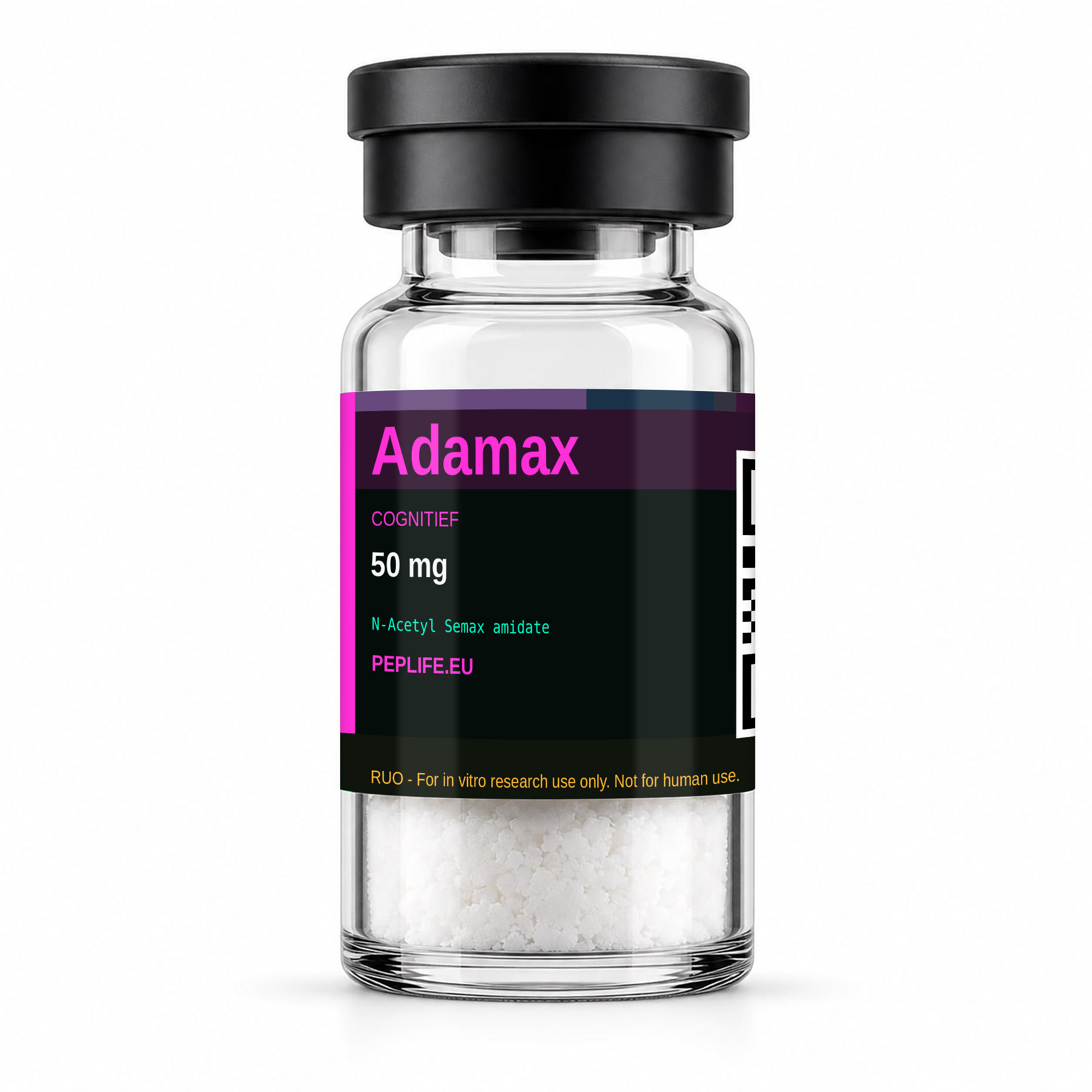
Adamax research focuses on a relatively new, nootropic research peptide that structurally builds on Semax, a well-known analogue of the ACTH(4-10) fragment. Where Semax has been studied for decades in Eastern European laboratories for cognition and neuroprotection, Adamax is an N-modified variant in which chemical adjustments to the ends of the peptide chain are used to make the molecule more stable against enzymatic degradation. Important upfront: the scientific literature specifically about “Adamax” is limited and largely indirect — most evidence comes from research into the broader Semax/melanocortin family to which this substance belongs. In this article we honestly maintain that distinction.
What is Adamax?
Adamax is described as a synthetic peptide derived from the Semax structure — the heptapeptide Met-Glu-His-Phe-Pro-Gly-Pro (MEHFPGP), itself an analogue of the ACTH(4-10) fragment of the hormone ACTH. In Adamax, terminal modifications are added, usually described as N-terminal acetylation (and in some sources an additional hydrophobic group at the C-terminus). The idea behind these modifications is classical in peptide chemistry: unprotected peptides are rapidly broken down in biological systems by peptidases, whereas shielded ends keep the molecule intact longer. In a research context, Adamax is therefore presented as a more stable cousin of Semax, with a longer presumed duration of action.
It is wise to stay level-headed here: different suppliers and information pages give mutually differing descriptions of the exact structure and molecular mass of Adamax. That is a sign that the substance is still in an early, poorly standardised stage of characterisation. For laboratories, this means that an independent certificate of analysis (CoA) is extra important to know what is actually in the vial.
How does Adamax work? — the mechanism
Because Adamax originates from the Semax family, the presumed mechanism of action leans heavily on what has been published about Semax and ACTH(4-10) analogues. Three pathways recur consistently in research on this peptide family. Firstly, the neurotrophins: in rats, Semax showed a rapid increase in BDNF (brain-derived neurotrophic factor) and its receptor TrkB in the hippocampus, a brain region central to memory and learning. Secondly, the neurotransmitter systems: in animal models, Semax activates the serotonergic and dopaminergic systems relatively quickly. Thirdly, the melanocortin receptors (such as MC4R), through which ACTH fragments are thought to exert their influence on attention, motivation and stress response.
Specifically for Adamax: researchers assume that the modified molecule works via the same pathways, but direct, published confirmation of this is scarce. The hypothesis is that the terminal protections keep the molecule available longer, so that the same mechanism can possibly be studied over a longer period. This remains emphatically a working hypothesis and not a proven fact.
What is Adamax studied for?
In the literature around Semax and related ACTH(4-10) analogues, a few research areas recur consistently. For Adamax, the same themes are taken as a starting point, with the caveat that most evidence comes from the broader family:
- Cognition and memory: in preclinical research, Semax was associated with effects on learning and memory retention, linked to BDNF/TrkB signalling in the hippocampus.
- Neuroprotection: ACTH(4-10) analogues are studied for their possible protective role in ischemia and neurological stress in animal models; Semax is even studied in Russia in the context of recovery after a stroke.
- Mental fatigue and attention: researchers examine whether these peptides influence attention regulation and cognitive fatigue.
- Mood and stress: in a model of chronic, unpredictable stress, the ACTH(4-10) analogues Semax and Melanotan II showed antidepressant-like and antistress effects in rats.
As far as Adamax is concerned, the honest conclusion is: there are as yet no robust, widely replicated and peer-reviewed publications dealing exclusively with Adamax. It is therefore mainly an exploratory research peptide, interesting precisely because the family around it does have a decent research tradition.
Adamax in laboratory research: handling & dissolving
Adamax is supplied as a freeze-dried (lyophilised) powder that is reconstituted before in-vitro use, usually with bacteriostatic or sterile water. The choice of solvent and adding it gently along the vial wall without vigorous shaking are standard points of attention to spare the peptide structure. For the practical steps and the consideration of which liquid is suitable, see the knowledge-base pillars reconstitute peptides and dissolve peptide: which liquid. Reconstituted peptides are stored refrigerated and the lyophilised powder remains most stable in the freezer.
Quality & purity
Every relevant batch is independently HPLC-tested by an external laboratory; the certificate of analysis (CoA) is publicly verifiable per batch. Precisely with a young, still moderately characterised research peptide such as Adamax, this verification is not a formality but the core of reliable research: the CoA makes clear which identity and purity are actually present in the vial, so that laboratory results remain reproducible and interpretable.
Frequently asked questions about Adamax research
Is Adamax the same as Semax?
No. Adamax is related to Semax and builds on the same ACTH(4-10)-derived structure, but it is an N-modified variant with terminal modifications intended to make the molecule more stable. Semax itself has been studied much more extensively. Anyone wishing to research the parent compound can turn to Semax. How Semax and Selank differ from each other is covered in Selank vs Semax.
Is there much scientific evidence specifically about Adamax?
Honestly, no. Published, peer-reviewed research dealing exclusively with Adamax is scarce. Most of the substantiation comes from research into Semax and other ACTH(4-10) analogues, after which it is assumed that Adamax works via comparable pathways.
What is Adamax studied for?
In the context of the Semax/melanocortin family, cognition, memory, neuroprotection, attention and stress response are examined — via mechanisms such as BDNF/TrkB signalling and melanocortin receptors. Effects are always attributed to the research, not to users.
How does Adamax relate to Selank?
Both are Russian research peptides placed in the nootropic corner, but they stem from different families: Adamax comes from the ACTH/Semax line, while Selank is an analogue of the immune peptide tuftsin and is studied more in anxiety and stress models.
How is Adamax stored and handled in the lab?
The lyophilised powder is preferably stored in the freezer and reconstituted only shortly before in-vitro use; the dissolved form is kept refrigerated. See the reconstitution pillars for the details.
May I use Adamax?
No. Adamax is supplied exclusively as Research Use Only material for in-vitro laboratory research. It is not intended for human or animal consumption, and not for diagnostic or therapeutic use.
Read more & research at Peplife
- Research Adamax at Peplife
- View all anti-aging peptides
- Cognitive peptides: the research overview
- Semax — research the parent compound
- Selank — related nootropic research peptide
Sources: Semax — Wikipedia (structure & mechanism) · Dolotov et al., 2006 — Semax regulates BDNF/trkB in the rat hippocampus (PubMed 16996037) · Antidepressant and antistress effects of the ACTH(4-10) analogues Semax and Melanotan II (PubMed 39442746) · Exploring Peptides — Adamax overview
Research Use Only. All products are supplied exclusively for in vitro laboratory research. Not intended for diagnostic or therapeutic use in humans or animals, and not approved by the EMA or FDA.
HPLC-tested by an external laboratory, CoA publicly verifiable per batch and discreet shipping within the EU.