




| Class | NNMT inhibitor (small molecule) |
| Molecular weight (Da) | 159.2 |
| Half-life (indicative) | not published |
| Research status | Preclinical / RUO |
Research context (RUO): 5-Amino-1MQ is a small molecule that is studied in science as an inhibitor of the enzyme NNMT (nicotinamide N-methyltransferase), with a focus on fat cells, metabolism and NAD+ balance. It is supplied exclusively for in-vitro laboratory research.
5-Amino-1MQ research: NNMT inhibition and fat metabolism
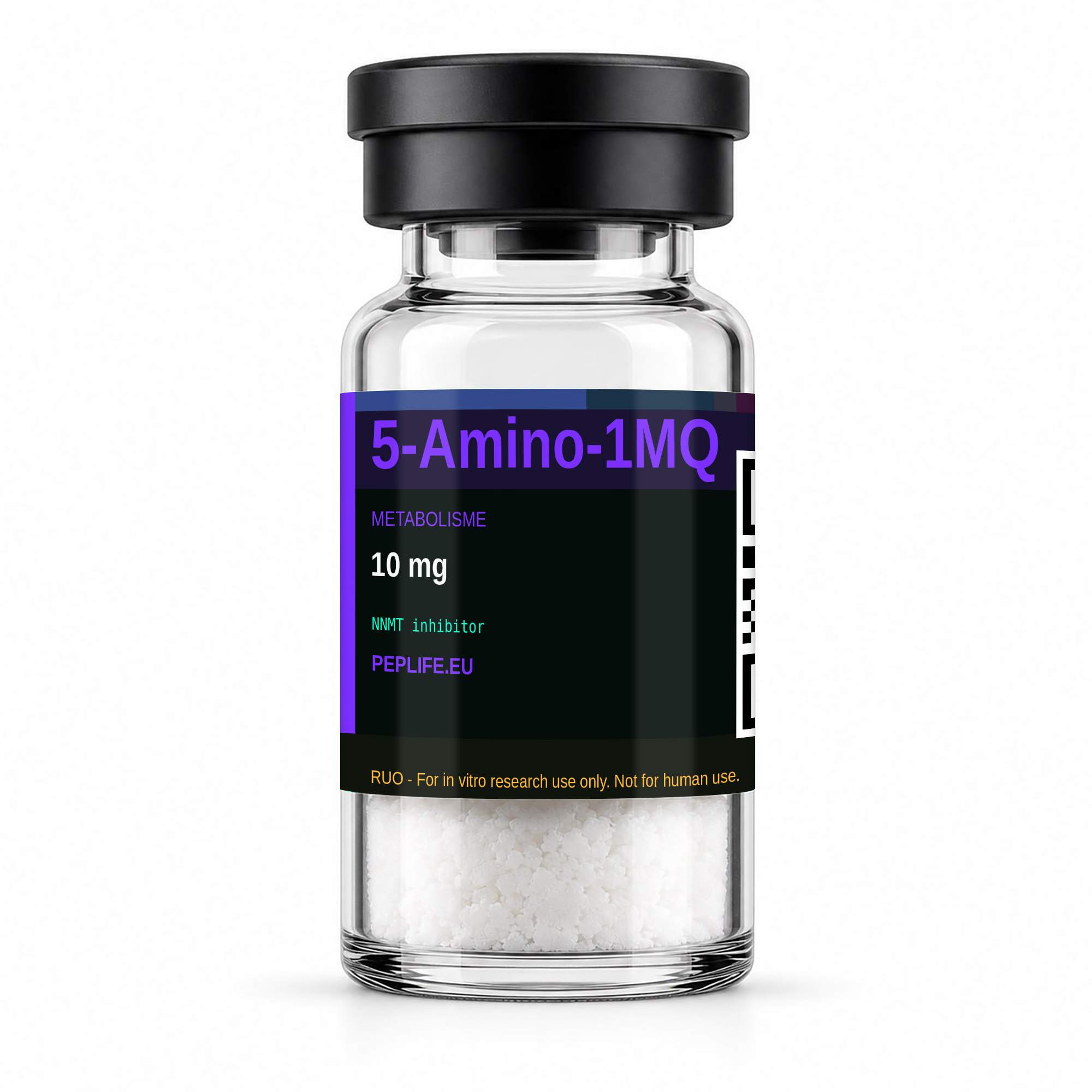
Het 5-Amino-1MQ research revolves around a simple but interesting question: what happens in fat cells when you inhibit one specific enzyme? That molecule — 5-amino-1-methylquinolinium — is not a peptide but a compact, cell-penetrating compound that is used in preclinical studies to unravel the role of NNMT in energy metabolism. Because NNMT is strongly elevated in the adipose tissue of obese and diabetic models, this inhibitor has become a popular tool in metabolism research.
What is 5-Amino-1MQ?
5-Amino-1MQ (PubChem CID 950107, molecular formula C10H11N2+) is a small synthetic molecule from the quinoline family. Unlike most research compounds that circulate as peptides in this market, this is a classical small molecule: small enough to pass through cell membranes and thus reach the enzyme NNMT inside the cell. In laboratory studies, 5-Amino-1MQ is used as a selective, membrane-permeable NNMT inhibitor to map the consequences of reduced NNMT activity on fat cells and metabolic pathways.
How does 5-Amino-1MQ work? — the mechanism
To understand the mechanism, you first need to understand NNMT. Nicotinamide N-methyltransferase attaches a methyl group to nicotinamide (a form of vitamin B3). As a methyl donor, the enzyme uses SAM (S-adenosylmethionine) for this, producing 1-methylnicotinamide and SAH. This has two consequences that intrigue researchers. Firstly, nicotinamide is “captured”: normally, nicotinamide can be recycled via the salvage pathway into NAD+, the central cofactor for energy production and for enzymes such as the sirtuins. Secondly, the reaction consumes SAM, the cell's most important methyl donor.
By inhibiting NNMT it attempts to 5-Amino-1MQ research to turn off these two taps: more nicotinamide remains available for NAD+ synthesis and the SAM levels are maintained. Studies look at whether this supports sirtuin activity (particularly SIRT1) and thereby influences lipolysis — the breakdown of stored fat — and energy expenditure in adipocytes. In short: inhibiting NNMT to shift the NAD+/SAM balance in the fat cell.
What is 5-Amino-1MQ studied for?
The research concentrates around metabolism, adipose tissue and NAD+ biology. The main research areas:
- Fat-cell metabolism: in the pioneering work of Kraus and colleagues (Nature, 2014), knockdown of NNMT in white adipose tissue and liver protected mice against diet-induced obesity; the animals used more energy despite the same diet. This formed the rationale to also inhibit NNMT pharmacologically.
- Obesity models: Neelakantan and colleagues (Biochemical Pharmacology, 2018) reported that selective, membrane-permeable NNMT inhibitors — including 5-Amino-1MQ — were associated in mice on a high-fat diet with a decrease in body weight and fat mass, without food intake changing.
- NAD+ homeostasis: researchers study whether NNMT inhibition helps preserve the cellular NAD+ pool and the SAM levels, which is relevant for mitochondrial function, sirtuin activity and longevity research.
- Metabolic dysfunction: reviews on the role of NNMT in obesity and type 2 diabetes place this inhibitor in a broader framework of insulin sensitivity and energy homeostasis.
5-Amino-1MQ in laboratory research: handling & dissolving
As a small molecule, 5-Amino-1MQ differs in handling from classical peptides. Researchers pay attention to the right solvent choice and concentration for their in-vitro protocol; which liquid is suitable depends on the experiment. More background on reconstitution and solvents is in our pillar dissolve peptide: which liquid and in the reconstitution guide. All handling takes place exclusively in a laboratory setting.
Quality & purity
Every relevant batch is independently HPLC-tested by an external laboratory; the certificate of analysis (CoA) is publicly verifiable per batch. For a small molecule like 5-Amino-1MQ, this purity control is at least as important as with peptides: reproducible research stands or falls with a defined, verified raw material. We publish the CoA so that researchers can check identity and purity before an experiment begins.
Frequently asked questions about 5-Amino-1MQ
Is 5-Amino-1MQ a peptide?
No. It is a small synthetic molecule (5-amino-1-methylquinolinium), not an amino acid chain. It is often offered alongside peptides because it appears in the same metabolism research, but chemically it is a small molecule.
What does NNMT do and why would you inhibit it?
NNMT methylates nicotinamide with SAM as donor. Studies investigate whether inhibiting this enzyme preserves NAD+ and SAM levels and thereby influences fat metabolism in adipocytes. NNMT is elevated in obese adipose tissue, which makes it an attractive research target.
What did the key studies show?
In animal models, NNMT inhibition (via knockdown or via small-molecule inhibitors such as 5-Amino-1MQ) was associated with less fat storage and more energy expenditure. These are preclinical findings in mice and cell models, not results in humans.
How does 5-Amino-1MQ compare to MOTS-c and AICAR?
All three are studied in the metabolism domain, but via different pathways: 5-Amino-1MQ inhibits NNMT, MOTS-c is a mitochondrial peptide that acts on the AMPK pathway, and AICAR is an AMPK activator. See also our pillar MOTS-c research.
Is 5-Amino-1MQ approved for use in humans?
No. It is not approved by the EMA, NVWA or FDA and is supplied exclusively for in-vitro laboratory research. It is not intended for diagnostic or therapeutic use in humans or animals.
Where can I buy 5-Amino-1MQ for research?
Via the product page of 5-Amino-1MQ, with HPLC CoA per batch and discreet EU shipping — for research purposes only.
Read more & research at Peplife
- Research 5-Amino-1MQ at Peplife
- View all metabolism peptides
- Research MOTS-c at Peplife
- Research AICAR at Peplife
- Fat-loss peptides: the research at a glance
- MOTS-c research: mitochondrial metabolism
- 5-Amino-1MQ vs SLU-PP-332 vs AICAR
Sources: PubChem — 5-Amino-1-methylquinolinium (CID 950107) · Kraus et al., Nature 2014 — NNMT knockdown protects against diet-induced obesity · Neelakantan et al., Biochem Pharmacol 2018 — Membrane-permeable NNMT inhibitors reverse HFD-induced obesity in mice · Review — Roles of NNMT in Obesity and Type 2 Diabetes
Research Use Only. All products are supplied exclusively for in vitro laboratory research. Not intended for diagnostic or therapeutic use in humans or animals, and not approved by the EMA or FDA.
HPLC-tested 5-Amino-1MQ with a publicly verifiable CoA per batch and discreet EU shipping — for laboratory research only.