




| Aliases | KP-10 |
| Class | Kisspeptin (KISS1R) |
| Molecular weight (Da) | 1302.5 |
| Half-life (indicative) | ~4 min |
| Research status | In clinical research |
Research context (RUO): Kisspeptin-10 is a short signalling peptide derived from the KISS1 gene that in research is regarded as a central switch of the reproductive axis. It is supplied exclusively for in-vitro laboratory research and is not intended for human or animal use.
Kisspeptin-10 research: the switch of the reproductive axis
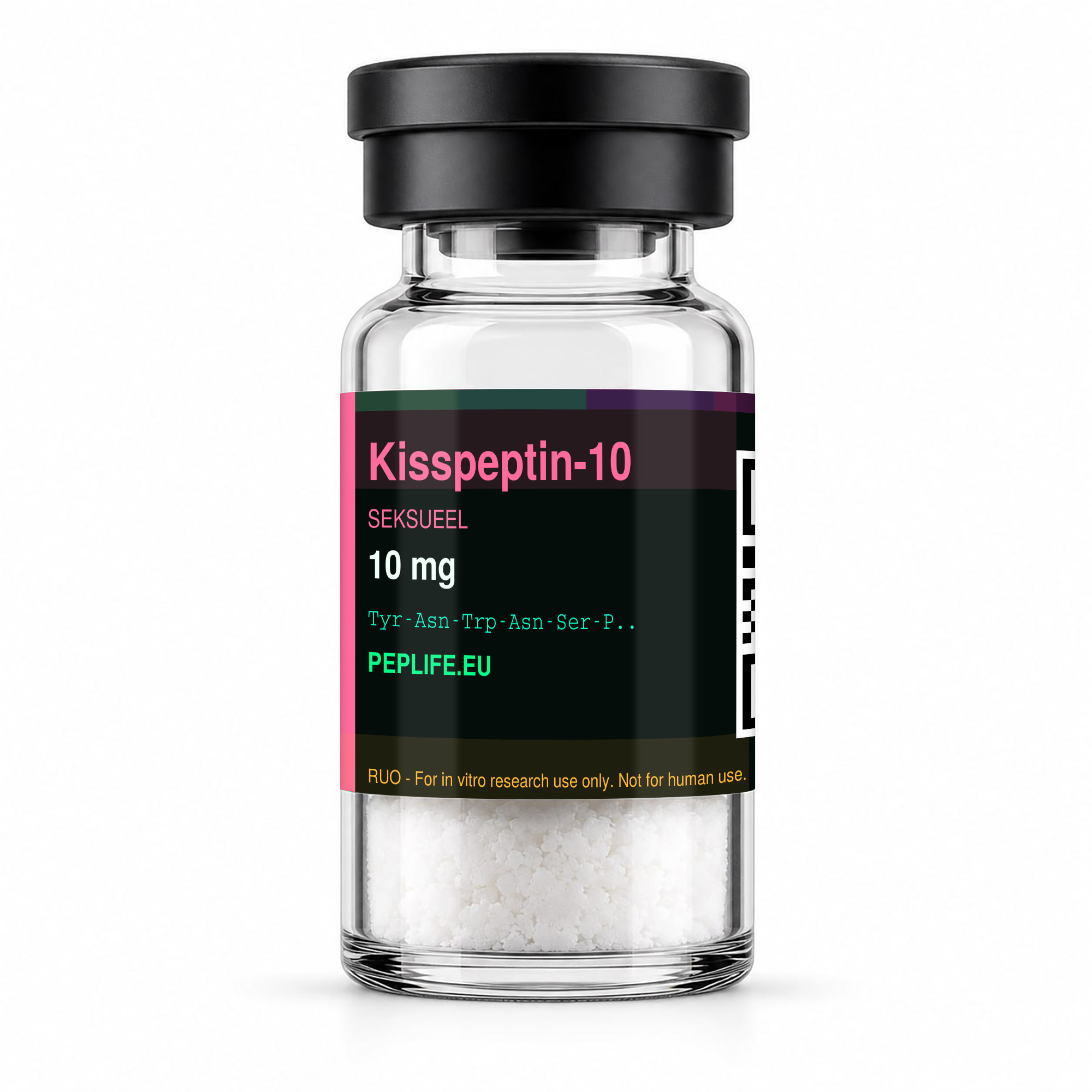
Het kisspeptin-10 research revolves around one striking idea: that a small peptide of just ten amino acids sits at the top of the entire hormonal reproductive chain. Where many peptides intervene somewhere halfway along a signalling pathway, kisspeptin sits right at the top — it gives the starting signal that sets the rest of the axis in motion. It is precisely for this reason that this molecule has, over the past fifteen years, grown into one of the most studied topics within reproductive neuroendocrinology.
What is kisspeptin-10?
Kisspeptin-10 (also known as metastin 45-54 or Kp-10) is the shortest active fragment of the kisspeptin family, proteins that are encoded by the KISS1gene. The complete kisspeptin proteins are cut in the body into shorter, biologically active pieces; Kp-10 is the compact end fragment of these and retains almost all binding activity of the longer forms. It binds to the receptor KISS1R (formerly GPR54), a G-protein-coupled receptor that is expressed mainly on the GnRH neurons in the hypothalamus. In the laboratory, the peptide is studied as the natural ligand that activates this receptor.
How does kisspeptin work? — the mechanism
The core of the mechanism is a top-down cascade. When kisspeptin binds to KISS1R, the receptor activates the enzyme phospholipase C via the Gαq/11 protein, which leads to a rise in intracellular calcium and the depolarisation (activation) of GnRH neurons. Those GnRH neurons then release gonadotropin-releasing hormone (GnRH) towards the pituitary. The pituitary responds with the release of the two gonadotropins: luteinising hormone (LH) and follicle-stimulating hormone (FSH). These two in turn drive the gonads — testes and ovaries — which produce sex hormones such as testosterone and oestradiol.
Interesting in kisspeptin-10 research is that not only the quantity, but especially the rhythm of the GnRH release that counts. In a study by George and colleagues (2011, published in the Journal of Clinical Endocrinology & Metabolism) a continuous infusion of kisspeptin-10 in men increased the LH pulse frequency from approximately 0.7 to 1.0 pulses per hour, while bolus doses gave a rapid, dose-dependent LH increase. Researchers therefore regard kisspeptin not as a simple “on button”, but as a fine-tuner of the pulsatile clock that drives the entire axis.
What is kisspeptin-10 studied for?
Because kisspeptin sits so high in the hierarchy, the research touches on several areas at once. Some directions that recur in the literature:
- Reproductive axis & fertility: in clinical studies, kisspeptin stimulated the release of LH and FSH, whereby researchers study whether it can play a role in mapping hypothalamic and gonadal function.
- Sexual signalling in the brain: in a randomised study (JAMA Network Open, 2023) in men and women with reduced sexual desire, administration of kisspeptin was associated with increased activity in sexual brain regions.
- Sexual dimorphism: studies reported that the hormonal response to kisspeptin-10 differs between men and women, which researchers use to study sex-specific regulation of the axis.
- Puberty & development: mutations in KISS1R have been linked in genetics to a disturbed onset of puberty, which makes kisspeptin a model molecule for research into the hormonal start of reproductive maturation.
Important: all these findings are research results, attributed to the studies in question. They say nothing about use by individuals and do not constitute application outside the laboratory.
Kisspeptin versus related peptides
Within the reproductive and signalling angle, kisspeptin is often studied alongside other molecules. Gonadorelin is for example synthetic GnRH itself — it intervenes one step lower in the chain than kisspeptin, which precisely drives GnRH release upstream. On the behavioural and signalling side, PT-141 (bremelanotide) and Oxytocin are mentioned in the literature alongside kisspeptin, because through other pathways they have points of contact with sexual signalling. A broader comparison is in our pillar PT-141, kisspeptin and oxytocin compared.
Kisspeptin-10 in laboratory research: handling & dissolving
Kisspeptin-10 is supplied as a freeze-dried (lyophilised) powder and is usually reconstituted in research protocols with bacteriostatic or sterile water before it is used in vitro. As with many short peptides, the correct choice of solvent, gentle swirling instead of shaking, and cold storage are decisive for stability. A full explanation is in our knowledge-base pillar reconstituting a peptide. Storage in lyophilised form keeps longest at -20 °C, with protection against repeated freeze-thaw cycles.
Quality & purity
Every relevant batch is independently HPLC-tested by an external laboratory; the certificate of analysis (CoA) is publicly verifiable per batch. For reproducible kisspeptin-10 research, this is crucial: peptide identity and purity determine whether laboratory results are comparable with each other. Peplife states the measured purity per batch, so that research data remain traceable to a verified source.
Frequently asked questions about kisspeptin-10 research
What does kisspeptin do in the reproductive axis?
In research, kisspeptin activates the GnRH neurons in the hypothalamus via the KISS1R receptor, after which the pituitary releases LH and FSH. It is therefore described as an upstream regulator — the switch that sets the axis in motion.
What is the difference between kisspeptin-10 and the longer kisspeptin forms?
Kisspeptin-10 is the shortest active fragment (ten amino acids) of the kisspeptin family. In studies it retains almost the full receptor-binding activity of the longer forms, which makes it popular as a research ligand.
Why is kisspeptin associated with sexual signalling?
In a randomised study from 2023, administration of kisspeptin was associated in imaging research with increased activity in brain regions involved in sexual processing. This concerns research findings in study participants, not application outside that framework.
How does kisspeptin differ from gonadorelin?
Gonadorelin is synthetic GnRH and intervenes at the level of the pituitary. Kisspeptin sits one step higher and drives precisely the GnRH neurons that release that GnRH.
How is kisspeptin-10 stored in the lab?
Lyophilised powder is usually stored cold and dark in research protocols (long-term at -20 °C) and reconstituted only shortly before use, avoiding repeated freeze-thaw cycles.
Is Peplife's kisspeptin-10 intended for human use?
No. All products are supplied exclusively for in-vitro laboratory research (Research Use Only) and are not intended for diagnostic or therapeutic use.
Read more & research at Peplife
- Research Kisspeptin-10 at Peplife
- View all sexual-signalling peptides
- Research PT-141 (bremelanotide)
- Research oxytocin
- Research Gonadorelin
- PT-141, kisspeptin and oxytocin compared
- Reconstituting a peptide: step by step
Sources: PubChem — Kisspeptin-10 (CID 25240297) · George et al., J Clin Endocrinol Metab (2011) · Frontiers in Endocrinology — Kisspeptin & the HPG axis (2022) · Mills et al., JAMA Network Open (2023)
Research Use Only. All products are supplied exclusively for in vitro laboratory research. Not intended for diagnostic or therapeutic use in humans or animals, and not approved by the EMA or FDA.
Kisspeptin-10, independently HPLC-tested by an external laboratory, with a CoA per batch and discreet EU shipping.