




| Aliases | Elamipretide, MTP-131 |
| Class | Mitochondrial (cardiolipin) |
| Molecular weight (Da) | 639.8 |
| Half-life (indicative) | ~2–4 h |
| Research status | In clinical research |
Research context (RUO): SS-31 (elamipretide) is a mitochondria-targeted tetrapeptide that in research binds selectively to cardiolipin in the inner mitochondrial membrane. It is supplied exclusively for in-vitro laboratory research and is not intended for human or animal use.
❯ Recent research from our research hub
New studies and publications discussing SS-31 (elamipretide) (discussing research, not usage advice):
All research updates in the Research & News hub · latest bulletin.
SS-31 research: the mitochondria-targeted peptide elamipretide
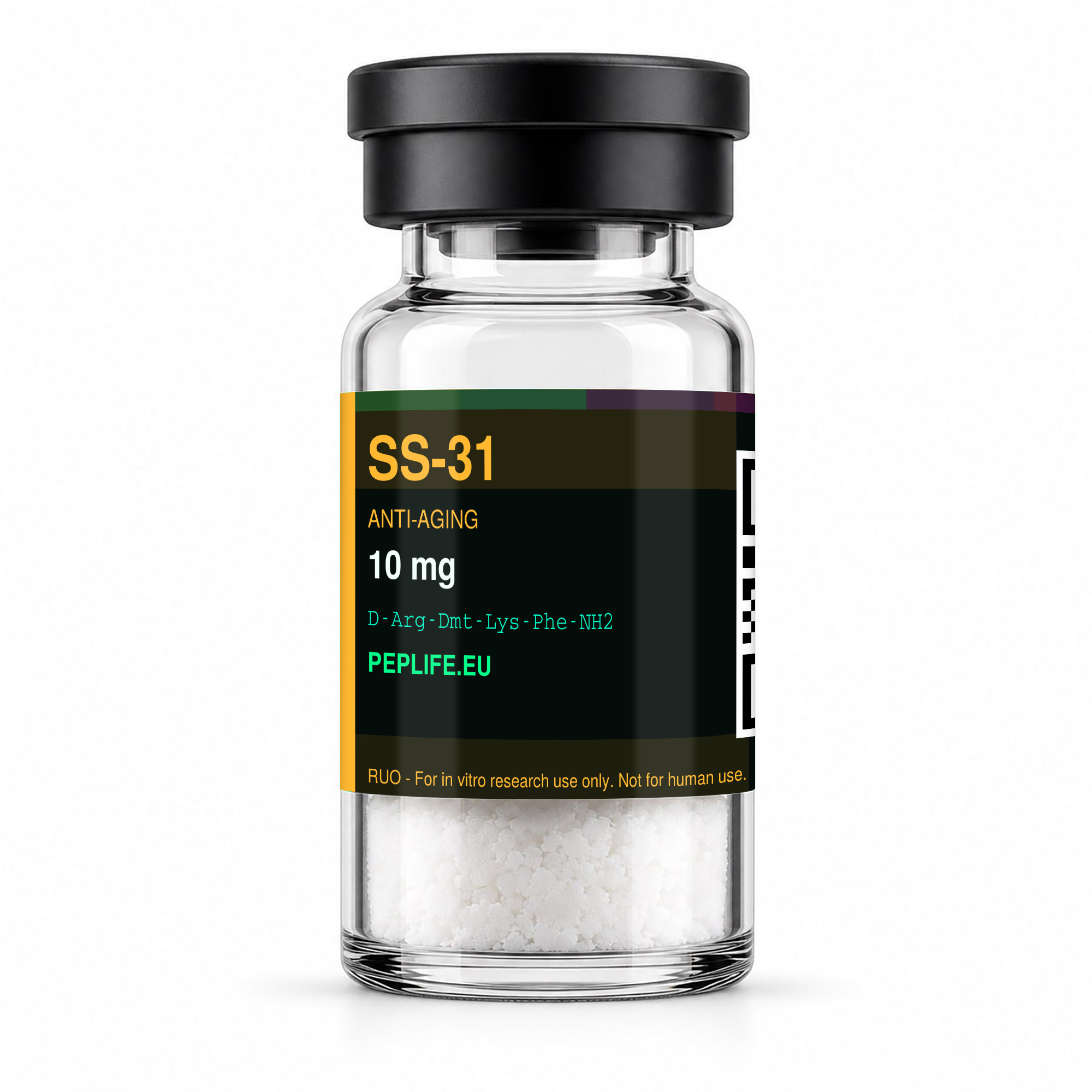
SS-31 research focuses on one of the most targeted peptides in mitochondrial biology: elamipretide, a small synthetic tetrapeptide that in studies travels directly to the inner mitochondrial membrane. Where many longevity peptides act indirectly on metabolic pathways, SS-31 aims at the place where the cell makes its energy. This makes it a rewarding model for researchers mapping mitochondrial function, oxidative stress and energy production.
What is SS-31 (elamipretide)?
SS-31 is a synthetic tetrapeptide — four amino acids long — with the sequence D-Arg-Dmt-Lys-Phe-NH₂, where “Dmt” stands for 2′,6′-dimethyltyrosine. It also carries the names elamipretide, Bendavia and MTP-131 and has the molecular formula C₃₂H₄₉N₉O₅ (PubChem CID 11764719). The structure is clever: two positively charged amino acids (D-Arg and Lys) direct the molecule towards the negatively charged inner membrane of the mitochondria, while the aromatic parts (Phe and Dmt) help to pass through cell membranes. In this way the peptide reaches the mitochondrial interior without active transport — the rare property that makes SS-31 so interesting in laboratory research.
How does SS-31 work in research? — the mechanism
The central theme in SS-31 research is the binding to cardiolipin, a unique phospholipid that occurs almost exclusively in the inner mitochondrial membrane. Cardiolipin holds the tightly folded membrane folds (the cristae) in place and organises the protein complexes of the electron transport chain — the “assembly line” that produces ATP, the cell's energy currency. When cardiolipin is damaged by oxidative stress, those complexes fall apart and energy production declines.
In research, SS-31 binds selectively to cardiolipin and is associated with more stable cristae, less production of reactive oxygen species (ROS) and more efficient ATP synthesis. A much-cited study in PNAS (2020) mapped the interaction landscape of SS-31 and described how the peptide influences the organisation of the electron transport chain on the membrane rather than inhibiting a single enzyme. Researchers often summarise this as “restoring” the membrane environment in which energy production takes place — a fundamentally different approach from classical antioxidants.
What is SS-31 studied for?
Because mitochondrial dysfunction plays a role in many tissues, elamipretide has been studied in diverse preclinical and clinical research settings. Effects are always attributed here to the study, not to the reader.
- Heart & energy metabolism: in animal models, chronic administration was associated with preservation of left ventricular function; the clinical PROGRESS-HF study investigated heart failure with reduced ejection fraction.
- Mitochondrial myopathy: the phase 3 study MMPOWER-3 investigated elamipretide in genetically confirmed primary mitochondrial myopathy, with post-hoc signals in subgroups with mtDNA maintenance defects.
- Eye / dry AMD: the ReCLAIM study investigated the peptide in dry age-related macular degeneration; researchers reported an association with slower degradation of the mitochondria-rich photoreceptor layer.
- Skeletal muscle & ageing: in older mice, late administration in an eLife study (2020) was associated with restoration of mitochondrial and cardiac function; other preclinical work looked at muscle-fibre composition and fatigue.
- Barth syndrome: in this rare cardiolipin condition (TAZPOWER), the approach was developed furthest; elamipretide received a first approval for Barth syndrome in 2024, which underlines the cardiolipin mechanism.
SS-31 in laboratory research: handling & dissolving
SS-31 is supplied as a lyophilised (freeze-dried) powder and is usually reconstituted in research protocols with bacteriostatic or sterile water. As a small, relatively soluble peptide, it usually goes into solution readily, but as with all peptides, the choice of solvent and storage determine the stability of your research material. Those who want to go through the basics will find the details in our pillar on reconstituting peptides and which liquid you choose to dissolve a peptide. For mitochondria-targeted research, labs often conceptually combine SS-31 with related compounds such as MOTS-c, another mitochondrial peptide.
Quality & purity
Every relevant batch is independently HPLC-tested by an external laboratory; the certificate of analysis (CoA) is publicly verifiable per batch. For a tetrapeptide like SS-31, that verification is important: identity, purity and the absence of degradation products determine whether research results are reproducible. A verified CoA shows that the supplied material is actually elamipretide at the stated purity, so that lab data retain their meaning.
Frequently asked questions about SS-31 research
What exactly is SS-31?
SS-31 (elamipretide) is a synthetic tetrapeptide with the sequence D-Arg-Dmt-Lys-Phe-NH₂ that in research binds selectively to cardiolipin in the inner mitochondrial membrane. It is offered exclusively for in-vitro laboratory research.
How does SS-31 differ from an ordinary antioxidant?
In research, SS-31 works not by wandering around loosely and catching radicals, but by targeting cardiolipin in the membrane. Studies associate this with more stable cristae and more efficient ATP synthesis rather than solely ROS neutralisation.
What is SS-31 studied for?
Preclinical and clinical studies have studied elamipretide in, among others, heart failure, primary mitochondrial myopathy, dry macular degeneration, ageing of skeletal muscle and the cardiolipin-linked Barth syndrome.
Why do sources call it “mitochondria-targeted”?
Due to its charge and structure, the peptide accumulates in research in the inner mitochondrial membrane, close to the energy-producing protein complexes — hence the term mitochondria-targeted.
How is SS-31 stored in a lab?
As a freeze-dried powder it is usually stored cool and dry; after reconstitution, refrigerated storage applies. Concrete protocols fall outside RUO dosing advice and belong to the research design.
Is SS-31 the same as elamipretide and Bendavia?
Yes. SS-31, elamipretide, Bendavia and MTP-131 refer to the same tetrapeptide (PubChem CID 11764719).
Read more & research at Peplife
- Research SS-31 (elamipretide) at Peplife
- View all anti-aging peptides
- Longevity peptides: the overview
- MOTS-c research: the mitochondrial exercise peptide
- NAD+ and glutathione research
- Research MOTS-c at Peplife
Sources: Elamipretide: A Review of Its Structure, Mechanism of Action, and Therapeutic Potential (Int. J. Mol. Sci., 2025) · Mitochondrial protein interaction landscape of SS-31 (PNAS, 2020) · PubChem — Elamipretide (CID 11764719) · FDA approves elamipretide for Barth syndrome (Johns Hopkins Hub)
Research Use Only. All products are supplied exclusively for in vitro laboratory research. Not intended for diagnostic or therapeutic use in humans or animals, and not approved by the EMA or FDA.
SS-31 (elamipretide): HPLC-tested by an external laboratory, CoA per batch publicly verifiable, discreet EU shipping.