




| Aliases | Thymalfasin, Tα1 |
| Class | Immunomodulator |
| Molecular weight (Da) | 3108.3 |
| Half-life (indicative) | ~2 h |
| Research status | Approved drug |
Research context (RUO): Thymosin Alpha-1 is a naturally occurring thymus peptide that is studied in science for its immunomodulatory action. It is supplied by Peplife exclusively for in-vitro laboratory research and is not intended for human or animal use.
❯ Recent research from our research hub
New studies and publications discussing thymosin α1 (discussing research, not usage advice):
All research updates in the Research & News hub · latest bulletin.
Thymosin Alpha-1 research: the immunomodulatory thymus peptide
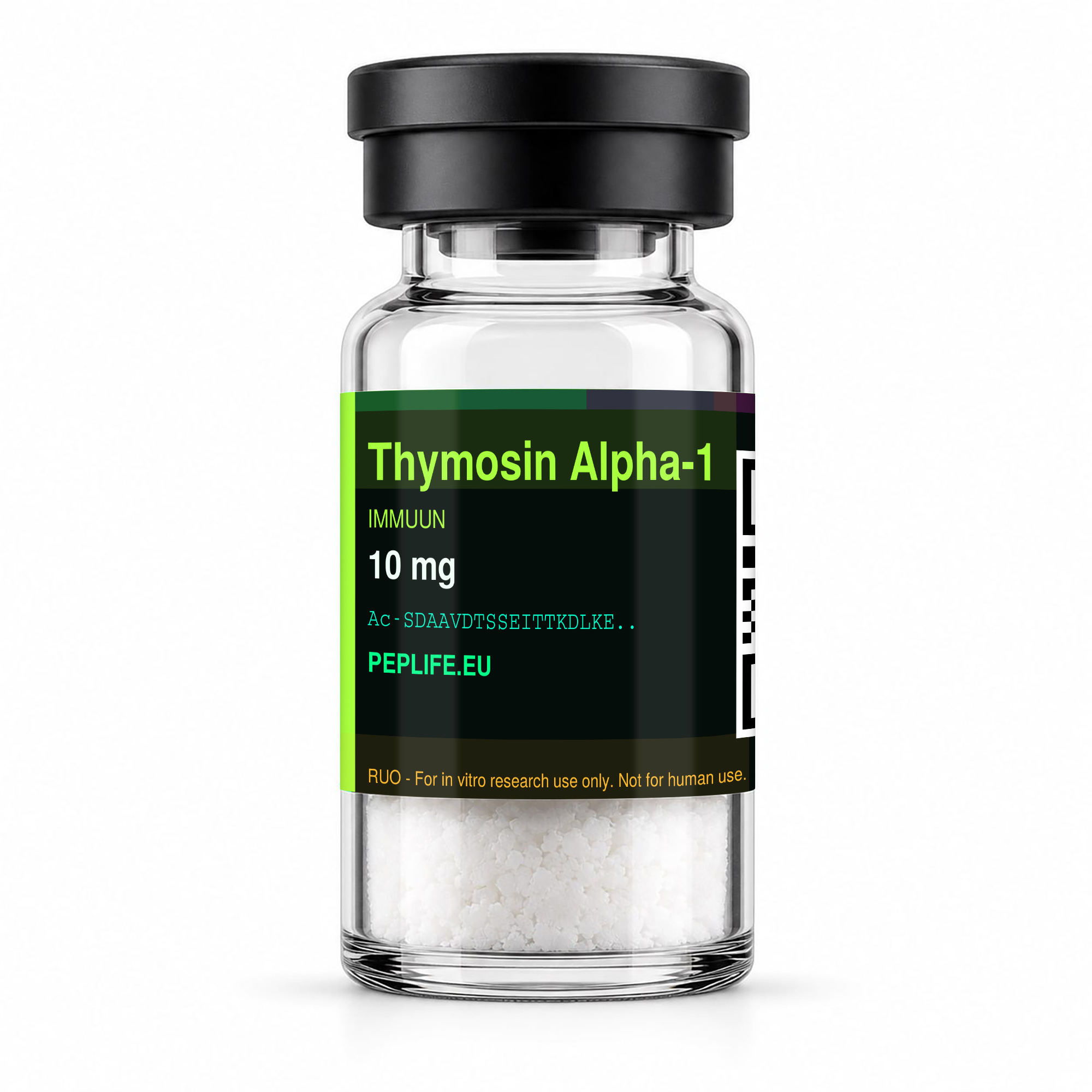
Het thymosin alpha-1 research focuses on a small but much-studied peptide that appears to play a central role in the way the immune system regulates itself. Thymosin Alpha-1 (Tα1, also known as thymalfasin) is a fragment that originates from the thymus — the organ where T cells mature. In numerous preclinical and clinical studies, it is investigated how this peptide can adjust the immune response, both with a too-weak and with a dysregulated defence. Below, researchers summarise what is known about the structure, the mechanism and the research areas of this peptide.
What is Thymosin Alpha-1?
Thymosin Alpha-1 is a peptide of 28 amino acids that was originally isolated from thymus tissue, as a derivative of the larger protein prothymosin alpha. It is part of the so-called thymosin family: signalling molecules involved in directing immune cells. Because the thymus shrinks with ageing (thymic involution) and produces fewer and fewer of these kinds of factors, Tα1 is an interesting model molecule for research into immune ageing. The synthetic form, used in laboratories, is chemically identical to the natural sequence and has the molecular formula C129H215N33O55. In a research context it is often compared with other thymus peptides such as Thymalin, which is likewise studied from the thymus for immunomodulatory properties.
How does Thymosin Alpha-1 work? — the mechanism
The most studied mechanism of action of Thymosin Alpha-1 revolves around the Toll-like receptors (TLRs) — the sensors with which immune cells recognise foreign patterns. Studies describe that Tα1 can bind to, among others, TLR2, TLR3, TLR4, TLR7 and TLR9, after which signalling pathways such as MyD88, NF-κB, p38-MAPK and IRF3 are activated. These pathways drive the production of cytokines — the messenger molecules of the immune system.
In addition, thymosin alpha-1 research describes that the peptide promotes the maturation and differentiation of T cells, including the formation of cytotoxic CD8+ T lymphocytes, and that it helps to keep the ratio between CD4+ and CD8+ cells in balance. Researchers further report an effect on dendritic cells, macrophages and natural killer (NK) cells, and an increased production of cytokines such as IL-2, IL-10 and interferon-gamma (IFN-γ). What is special about this profile is that Tα1, in various models, appears both to strengthen a too-weak defence and to temper an overactive, inflamed response — a two-sided, modulating action.
What is Thymosin Alpha-1 studied for?
The research literature around Tα1 is broad. The main areas in which this peptide is studied:
- Viral infections: In clinical studies, Tα1 (as thymalfasin) has been studied in chronic hepatitis B and C, often in combination with interferon, with researchers reporting improved outcomes compared with interferon alone.
- Immune reconstitution: Researchers study whether Tα1 can restore immune defence in immunocompromised models, for example after transplantation or with an exhausted T-cell response.
- Sepsis and inflammation: Systematic reviews and meta-analyses have investigated whether Tα1 can adjust the immune balance in sepsis and severe inflammatory conditions; the results are mixed but a reason for further research.
- COVID-19: During the pandemic, Tα1 was studied as a means of modulating excessive T-cell activation and lymphopenia in critically ill patients; the findings were mixed and are still being evaluated.
- Vaccine response and oncology: In preclinical work, it is studied whether Tα1 can enhance the response to vaccines and whether it is relevant as an immunoregulatory adjuvant in tumour models.
Those who want to explore the broader field of immune-focused peptides will find in the category immune peptides related molecules such as VIP (Vasoactive Intestinal Peptide) and the antimicrobial LL-37, each of which is studied from a different mechanism.
Thymosin Alpha-1 in laboratory research: handling & dissolving
Thymosin Alpha-1 is supplied as a freeze-dried (lyophilised) powder in a vial. For in-vitro work, researchers usually reconstitute the peptide with bacteriostatic or sterile water; the exact concentration depends on the research protocol. After reconstitution, the solution is usually stored refrigerated to preserve stability. A detailed explanation of choosing the right liquid and dissolving correctly can be found in our knowledge base under reconstitute peptides and which liquid you use to dissolve a peptide.
Quality & purity
Every relevant batch of Thymosin Alpha-1 is independently HPLC-tested by an external laboratory; the certificate of analysis (CoA) is publicly verifiable per batch. For reliable research, the purity of the peptide is crucial: contaminants or deviating sequences can undermine the reproducibility of experiments. Peplife therefore publishes the identity, purity and net weight per batch, so that researchers know exactly what they are working with.
Frequently asked questions about Thymosin Alpha-1 research
What exactly is Thymosin Alpha-1?
It is a synthetic peptide of 28 amino acids that is identical to a fragment naturally occurring in the thymus. In research it is known for its immunomodulatory properties and is used exclusively for laboratory purposes.
How does Thymosin Alpha-1 differ from Thymosin Beta-4 (TB-500)?
Despite the similar name, they are different molecules with different research directions. Tα1 is mainly studied for immune modulation and T-cell maturation, whereas Thymosin Beta-4 (the basis of TB-500) is mainly studied in the context of tissue repair and actin binding — see also our TB-500 research.
Through which mechanism does Thymosin Alpha-1 work in studies?
Researchers describe binding to several Toll-like receptors (including TLR2, TLR4 and TLR9) and the directing of T cells, dendritic cells and NK cells, with an effect on cytokines such as IL-2 and IFN-γ.
What is Thymosin Alpha-1 studied for?
Among others, in viral infections (hepatitis B and C), sepsis, immune reconstitution and vaccine response. The effects are always attributed to the research, not to human use.
Is Thymosin Alpha-1 approved for use?
No. At Peplife it is supplied exclusively as Research Use Only material and is not approved by the EMA, NVWA or FDA for diagnostic or therapeutic use.
How is Thymosin Alpha-1 stored?
As a freeze-dried powder it is stored cool and dark; after reconstitution, researchers usually keep the solution refrigerated to limit degradation.
Read more & research at Peplife
- Research Thymosin Alpha-1 at Peplife
- View all immune peptides
- Thymalin — a related thymus peptide
- VIP (Vasoactive Intestinal Peptide)
- LL-37 — antimicrobial defence peptide
- Longevity peptides and immune ageing
- Thymosin alpha-1 vs thymalin
Sources: Dominari et al., Thymosin alpha 1: A comprehensive review of the literature, World Journal of Virology (2020) · Thymosin α1 and Its Role in Viral Infectious Diseases, Molecules (2023) · Thymosin alpha 1 in severe acute pancreatitis: systematic review & meta-analysis, Frontiers in Immunology (2025) · PubChem — Thymalfasin (CID 16130571)
Research Use Only. All products are supplied exclusively for in vitro laboratory research. Not intended for diagnostic or therapeutic use in humans or animals, and not approved by the EMA or FDA.
HPLC-tested by an external laboratory, CoA publicly verifiable per batch and discreet shipping within the EU.