




| Aliases | GSH |
| Class | Antioxidant tripeptide |
| Molecular weight (Da) | 307.3 |
| Half-life (indicative) | very short (IV ~10 min) |
| Research status | Supplement / cofactor |
Research context (RUO): Glutathione (GSH) is an endogenous tripeptide known in cell biology as the “master antioxidant”. It is supplied by Peplife exclusively for in-vitro laboratory research and is not intended for human or animal use.
Glutathione research: the master antioxidant under the microscope
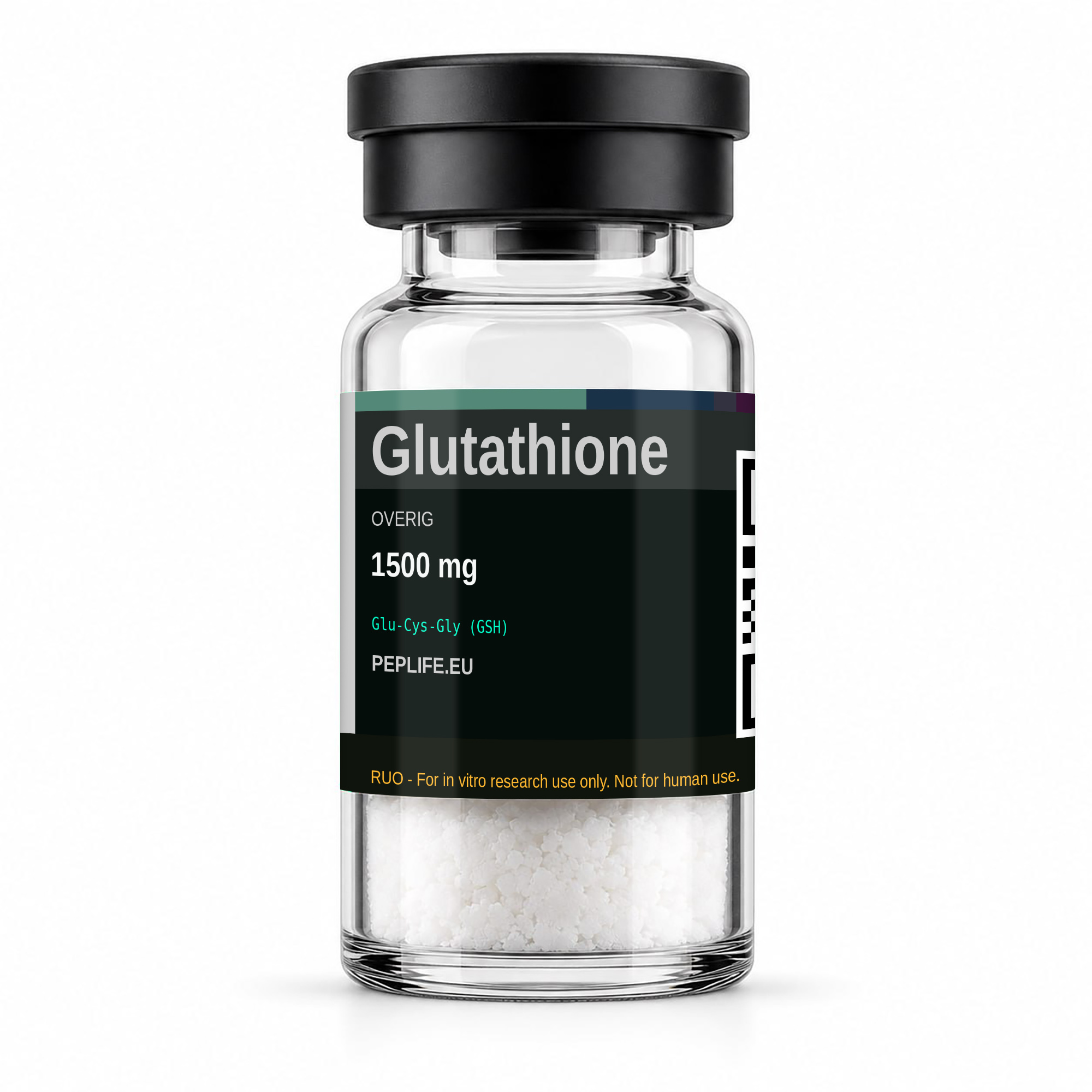
Glutathione research has for decades been central to the study of oxidative stress, redox balance and cellular detoxification. Glutathione, GSH for short, is a small tripeptide that occurs in virtually every cell and that researchers often describe as the body's most important antioxidant. In this knowledge-base pillar we set out what glutathione exactly is, how the mechanism is described in laboratory studies and for which research areas GSH is most studied — always from a strict research perspective (RUO).
What is glutathione (GSH)?
Glutathione is a tripeptide, built from three amino acids: glutamic acid, cysteine and glycine. The full biochemical name is γ-glutamyl-cysteinyl-glycine. What makes glutathione special is the unusual gamma peptide bond between glutamate and cysteine, which makes the molecule more resistant to breakdown by most peptidases. The sulphur atom (thiol group) in the cysteine part is the reactive core: it gives glutathione its antioxidant properties. In the scientific literature (PubChem CID 124886), GSH is described with the molecular formula C10H17N3O6S.
Within the cell, glutathione occurs in two forms: the reduced form (GSH) and the oxidised form (GSSG), in which two GSH molecules are linked together. Under normal conditions, the reduced form is strongly in the majority — studies report a GSH/GSSG ratio that is 10 to 100 times in favour of GSH. That ratio is a widely used measure of the redox state of a cell.
How does glutathione work? — the mechanism
The mechanism central to glutathione research revolves around electron transfer. The thiol group of GSH donates an electron to reactive oxygen species (ROS) and free radicals, neutralising them before they can damage proteins, lipids or DNA. In doing so, GSH itself is oxidised to GSSG. The enzyme glutathione reductase then converts GSSG back into GSH, so that the antioxidant supply is continuously replenished — a cycle that researchers call the glutathione redox cycle.
Glutathione rarely works alone. It functions as a co-substrate for a whole family of enzymes. Glutathione peroxidases (GPx) use GSH to neutralise hydrogen peroxide and lipid peroxides, while glutathione S-transferases (GST) link glutathione to foreign substances. That last process — conjugation — is the basis of so-called phase II detoxification: by attaching a GSH group to a toxin, the substance becomes more water-soluble and easier to excrete. In review research, the GSH/GSSG ratio is also described as a fine-tuner of signal transduction, even under mild oxidative stress.
What is glutathione studied for?
Because glutathione plays a central role in the redox balance, it recurs in diverse research fields. Some areas that glutathione research focuses on:
- Oxidative stress: in numerous studies, a declining GSH level is associated with increasing oxidative damage; researchers use the GSH/GSSG ratio as a biomarker for the redox state of cells and tissues.
- Detoxification and liver function: the liver naturally contains high concentrations of glutathione. A 2023 review (Frontiers in Medicine) described how reduced GSH levels accompany the progression of non-alcoholic fatty liver disease (NAFLD/NASH), and discussed several small pilot studies with oral GSH.
- Redox balance and cell signalling: preclinical research studies how shifts in the GSH/GSSG ratio influence processes such as cell division, differentiation and programmed cell death (apoptosis).
- Ageing and chronic conditions: researchers study whether a disturbed glutathione balance plays a role in ageing processes and in the development of various chronic conditions.
Important: all these insights come from in-vitro models, animal models and small-scale studies. They describe what researchers observe — not application in humans.
Glutathione in laboratory research: handling & dissolving
Glutathione is usually supplied as a freeze-dried (lyophilised) powder and reconstituted in the laboratory with a suitable liquid, such as bacteriostatic or sterile water. Because the reactive thiol group is sensitive to oxidation by air and light, researchers pay attention to cool, dark storage and fresh preparation of solutions. Those who delve into reconstitution protocols can consult our pillars on reconstituting peptides and which liquid you use to dissolve a peptide . This information is intended solely for laboratory applications.
Quality & purity
Every relevant batch is independently HPLC-tested by an external laboratory; the certificate of analysis (CoA) is publicly verifiable per batch. For glutathione research, this is extra relevant: because the molecule is sensitive to oxidation, an up-to-date purity report gives researchers certainty about the identity and integrity of the material before it is included in a research protocol. Read more about our rejection criteria in the article why we rejected a batch.
Frequently asked questions about glutathione
What exactly is glutathione?
Glutathione (GSH) is an endogenous tripeptide of glutamic acid, cysteine and glycine that is known in cell biology as the master antioxidant. In laboratory research it is studied for its role in the redox balance and detoxification.
Why is glutathione called the “master antioxidant”?
Because GSH not only neutralises reactive oxygen species itself, but also supports other antioxidants and a whole family of enzymes (such as glutathione peroxidase). It is therefore central to the cell's antioxidant network.
What is the difference between GSH and GSSG?
GSH is the reduced, active form; GSSG is the oxidised form that arises after GSH has neutralised a radical. The ratio between the two (GSH/GSSG) is used in studies as an indicator of oxidative stress.
What is glutathione studied for?
Glutathione research focuses, among other things, on oxidative stress, detoxification and liver function, redox balance, cell signalling and ageing — always in in-vitro models, animal models or small-scale studies.
Is glutathione suitable for human use?
No. At Peplife, glutathione is supplied exclusively for in-vitro laboratory research (Research Use Only). It is not intended for diagnostic or therapeutic use in humans or animals.
How is the quality of glutathione checked?
Every relevant batch is independently tested via HPLC by an external laboratory, with a certificate of analysis (CoA) publicly verifiable per batch.
Read more & research at Peplife
- Research Glutathione at Peplife
- View all other research peptides
- NAD+ and glutathione: research into redox and energy
- Longevity peptides: research into ageing
- Research NAD+ at Peplife
- Research Lipo-C at Peplife
Sources: PubChem — Glutathione (CID 124886) · Aquilano et al., 2014, Frontiers in Pharmacology · Glutathione & NAFLD, 2023, Frontiers in Medicine · The Key Role of GSH in Redox Balance, 2023, PMC
Research Use Only. All products are supplied exclusively for in vitro laboratory research. Not intended for diagnostic or therapeutic use in humans or animals, and not approved by the EMA or FDA.
HPLC-tested glutathione with a CoA verifiable per batch, discreetly shipped within the EU.