




| Aliases | Egrifta, TH9507 |
| Class | GHRH analogue |
| Molecular weight (Da) | 5135.9 |
| Half-life (indicative) | ~26–38 min |
| Research status | Approved drug |
Research context (RUO): Tesamorelin is a stabilised GHRH analogue that in studies stimulates the growth hormone and IGF-1 axis. It is supplied exclusively for in-vitro laboratory research and is not intended for human or animal use.
Tesamorelin research: the stabilised GHRH analogue and visceral fat
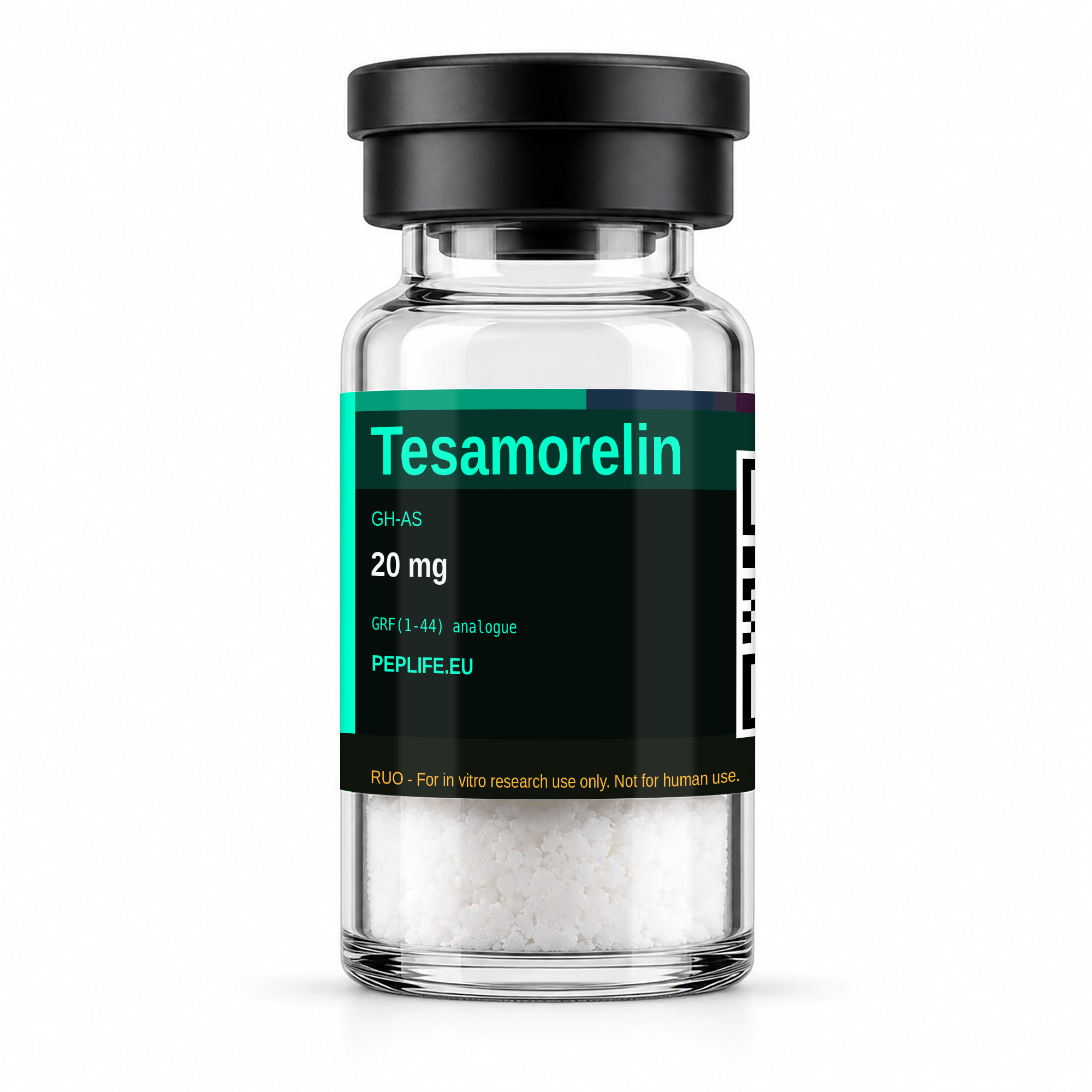
Het Tesamorelin research revolves around a central question: can you make the body release its own growth hormone in a natural, pulsatile way and thereby specifically target the deep abdominal fat (visceral fat)? Tesamorelin is a synthetic analogue of growth hormone-releasing hormone (GHRH) and is among the most studied peptides within the GH axis. In this article we look at what the compound is, how the mechanism works and what researchers study it for — always strictly within the frameworks of laboratory research.
What is tesamorelin?
Tesamorelin is built from the complete sequence of 44 amino acids of human GHRH, with an additional trans-3-hexenoic acid group (a short fatty-acid tail) linked to the N-terminus. That small modification is precisely what makes the compound interesting: natural GHRH is broken down in the body within a few minutes, whereas the stabilised structure of tesamorelin is much more resistant to enzymatic degradation. As a result, it remains intact longer and can address the GHRH receptor more effectively. In the scientific literature, an elimination half-life of roughly 26 to 38 minutes is described. Chemically, the compound is registered under PubChem CID 16137828, with molecular formula C221H366N72O67S.
How does tesamorelin work? — the mechanism
Tesamorelin binds to the GHRH receptor on the pituitary and stimulates it to produce and release the body's own growth hormone (GH). That is an important distinction from synthetic GH: instead of administering growth hormone directly, a GHRH analogue stimulates the body's own production, so that the natural pulsatile release is largely preserved. The released growth hormone then stimulates the liver to produce insulin-like growth factor 1 (IGF-1) — the main messenger of many GH effects. In studies, a clear increase in IGF-1 was therefore observed after administration of tesamorelin (P < 0.001), confirming the physiological activity of the compound. Researchers describe that the fat reduction in these models occurs mainly via lipolysis (the breakdown of fat tissue) and a decrease in triglycerides.
What is tesamorelin studied for?
The best-known application for which tesamorelin is studied is the reduction of visceral fat — the metabolically active fat around the organs. The most cited research comes from the field of HIV-associated lipodystrophy, a condition in which antiretroviral therapy leads to abnormal fat accumulation in the abdomen. In a randomised, double-blind, placebo-controlled study by Falutz and colleagues (2010) among 404 participants, the following was reported:
- Visceral fat (VAT): in the tesamorelin group, visceral fat decreased by approximately -10.9% after 6 months, compared with -0.6% in the placebo group; with continuation this rose to about 18% reduction over 12 months.
- Metabolic profile: researchers reported improvements in waist circumference, waist-to-hip ratio and trunk fat, without unfavourable changes in glucose metabolism despite the IGF-1 increase.
- Reversibility: the effects proved to reverse quickly once participants switched from tesamorelin to placebo — an indication that the effect depends on continued exposure.
- Liver fat: besides visceral fat, follow-up studies investigate whether tesamorelin also influences the fat content in the liver (hepatic fat).
Important: all these outcomes come from clinical research contexts and are described here solely as scientific findings. They do not constitute instructions for use.
Tesamorelin within the GH axis: how does it compare to other peptides?
Within the GH axis there are broadly two families: GHRH analogues (such as tesamorelin, sermorelin and CJC-1295) that stimulate the pituitary via the GHRH receptor, and the so-called growth hormone secretagogues or ghrelin mimetics (such as ipamorelin and GHRP-2) that work via a different mechanism. In research, tesamorelin is often compared with sermorelin, a shorter and less stabilised GHRH fragment analogue. Those who want to understand the broader context of this peptide family will find more background in our pillars on growth hormone peptides and the Sermorelin research. Also CJC-1295 DAC is often examined alongside tesamorelin in laboratory studies because of its longer duration of action.
Tesamorelin in laboratory research: handling & dissolving
Tesamorelin is supplied as a freeze-dried (lyophilised) powder in a vial and must be reconstituted in the lab before use with a suitable solvent, such as bacteriostatic or sterile water. Peptides within the GH axis are sensitive to repeated temperature fluctuations and light; cool and dark storage is recommended in protocols. The correct choice of liquid and technique determines the stability of your research solution — for this, see our extensive pillar on reconstituting peptides.
Quality & purity
Reliable research stands or falls with a pure compound. Every relevant batch of tesamorelin is independently HPLC-tested by an external laboratory; the certificate of analysis (CoA) is publicly verifiable per batch. This way you know exactly what purity and identity you have in hand in the lab, and results are reproducible. This transparency is standard for all GH-axis peptides in our range.
Frequently asked questions about tesamorelin research
What is the difference between tesamorelin and growth hormone?
Growth hormone is administered directly, whereas tesamorelin is a GHRH analogue that stimulates the pituitary to produce the body's own growth hormone. In research, the natural pulsatile release is therefore largely preserved and IGF-1 rises indirectly.
Why is tesamorelin called a “stabilised” GHRH analogue?
Natural GHRH is broken down quickly. Due to the trans-3-hexenoic acid group at the N-terminus, tesamorelin is more resistant to enzymatic degradation, so that it remains intact longer and can address the GHRH receptor more effectively.
What is tesamorelin studied for in studies?
Most tesamorelin research focuses on the reduction of visceral (deep abdominal) fat, whereby effects on waist circumference, triglycerides and liver fat are also studied. The best-known data come from research into HIV-associated lipodystrophy.
Does tesamorelin raise blood sugar?
In the study by Falutz and colleagues (2010), despite the IGF-1 increase, no unfavourable changes in glucose metabolism were reported. Researchers nonetheless monitor this point closely, because GH activation can in theory influence glucose homeostasis.
How does tesamorelin differ from sermorelin?
Both are GHRH analogues, but sermorelin is a shorter fragment and less stabilised, whereas tesamorelin contains the complete 44-amino-acid sequence plus a stabilising fatty-acid tail. In research, tesamorelin is therefore often described as the longer-acting variant.
Is tesamorelin suitable for human use?
No. At Peplife, tesamorelin is supplied exclusively for in-vitro laboratory research (Research Use Only) and is not intended for human or animal application.
Read more & research at Peplife
- Research Tesamorelin at Peplife
- View all GH axis peptides
- Research Sermorelin at Peplife
- Research CJC-1295 DAC at Peplife
- Knowledge base: growth-hormone peptides
- Knowledge base: sermorelin research
- Sermorelin vs tesamorelin
Sources: PubChem CID 16137828 · Falutz et al., 2010 (RCT, HIV lipodystrophy) · Falutz et al., NEJM 2007 · Reduction of visceral adiposity & metabolic profile
Research Use Only. All products are supplied exclusively for in vitro laboratory research. Not intended for diagnostic or therapeutic use in humans or animals, and not approved by the EMA or FDA.
HPLC-tested by an external laboratory, CoA publicly verifiable per batch and discreet shipping throughout the EU.