




| Aliases | GRF 1-29 |
| Class | GHRH analogue |
| Molecular weight (Da) | 3357.9 |
| Half-life (indicative) | ~10–20 min |
| Research status | Approved drug |
Research context (RUO): Sermorelin is a synthetic fragment of growth-hormone-releasing hormone (GHRH) used in research to study the body's own growth hormone release via the pituitary. This peptide is supplied solely for in-vitro laboratory research and is not intended for human or animal use.
Sermorelin research: the GHRH analogue and the GH axis explained
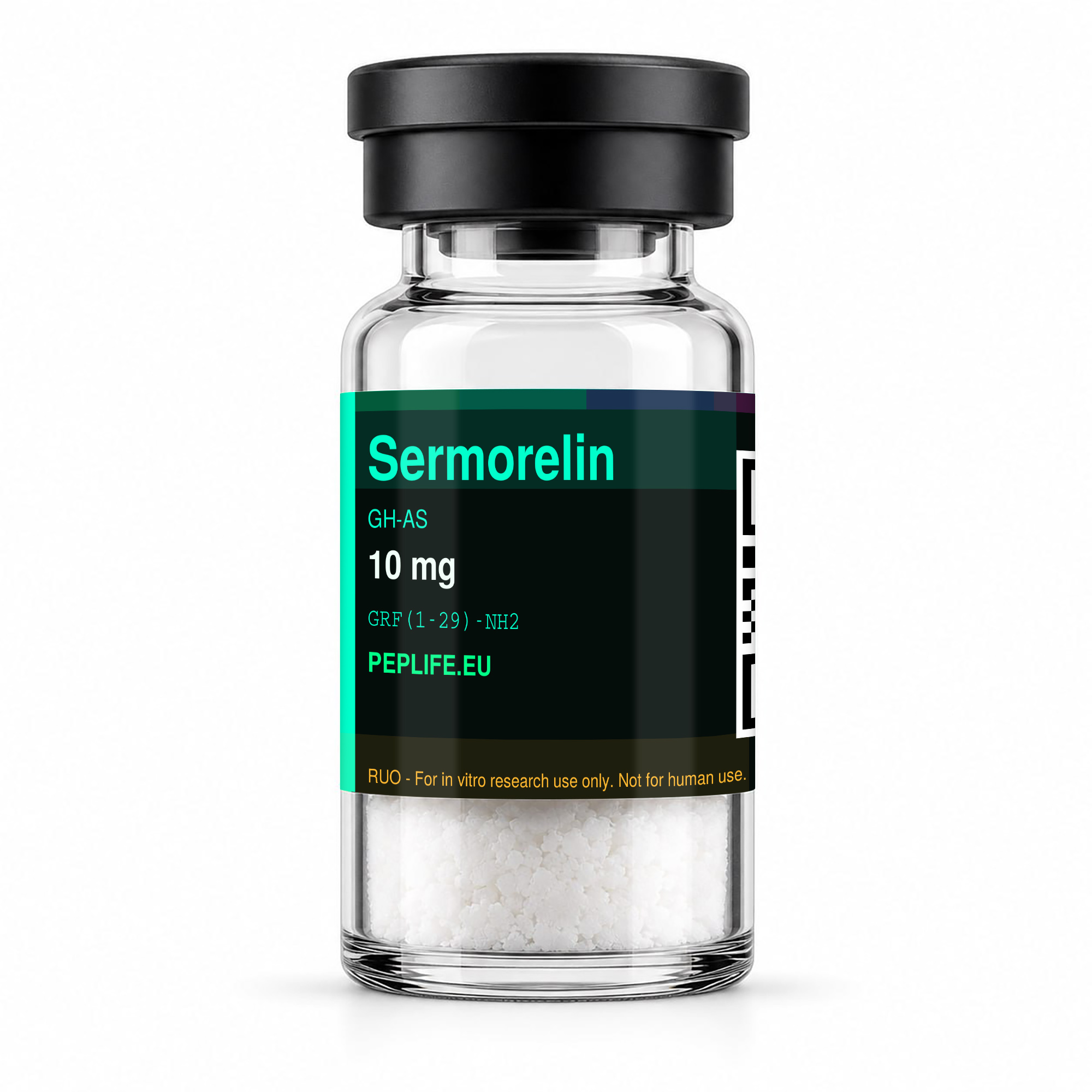
Sermorelin research focuses on one of the most-studied secretagogues of the growth hormone axis: a shortened, active fragment of the natural hormone GHRH. Unlike administered growth hormone itself, sermorelin acts one step earlier in the chain — it stimulates the pituitary to release its own growth hormone. It is precisely this indirect, physiological way of working that makes the substance interesting for researchers wanting to study the GH/IGF-1 axis without completely overriding the axis.
What is sermorelin?
Sermorelin (also called GRF 1-29 or sermorelin acetate) is a peptide consisting of the first 29 amino acids of human GHRH. The natural GHRH molecule has 44 amino acids, but research has shown that this first part — the so-called GHRH(1-29) sequence — carries the full biological activity needed to initiate growth hormone release. This makes sermorelin in effect the shortest possible, still fully active version of GHRH. In the literature the substance is classified as a growth hormone secretagogue: a molecule that triggers the secretion of growth hormone instead of replacing the hormone.
Chemically, sermorelin is registered at PubChem under CID 16132413. The relatively short plasma half-life — described in the literature as being on the order of minutes — is a recurring point of attention in research protocols, because it determines the duration of the GH peak.
How does sermorelin work? — the mechanism
Sermorelin binds to the GHRH receptor on the somatotropic cells of the anterior lobe of the pituitary. This binding activates the cAMP signalling route in the cell, which leads to the release of stored growth hormone into the bloodstream. That growth hormone then stimulates the production of IGF-1 (insulin-like growth factor 1) in the liver and other tissues, the main messenger along which many growth hormone effects proceed. Researchers refer to this as the GH/IGF-1 axis.
A property often emphasised in reviews is that sermorelin leaves the body's natural feedback intact. Release remains subject to somatostatin, the body's own brake on growth hormone, so that the GH peaks follow a pulsatile, more physiological pattern. This distinguishes GHRH analogues mechanistically from the ghrelin mimetics (the so-called GHRPs, such as ipamorelin), which act via a different receptor. In many research setups both classes are therefore studied together to see whether their effects on the GH peak reinforce each other.
What is sermorelin studied for?
Historically, sermorelin was used clinically as a diagnostic tool in testing pituitary function and studied in growth hormone deficiency. In the broader research literature, the GHRH(1-29) analogue is now viewed from several angles:
- Growth-hormone axis and ageing: in reviews of adult growth hormone deficiency it has been suggested that stimulating the body's own GH release could be a more physiological approach than exogenous growth hormone; researchers are studying whether this better preserves the natural pulsatility.
- IGF-1 response: in a 2017 study, Sigalos and colleagues reported that a secretagogue protocol including sermorelin significantly increased the average serum IGF-1 level in hypogonadal men relative to baseline.
- Body composition and recovery: because the GH/IGF-1 axis is involved in protein synthesis and fat metabolism, preclinical and exploratory research looks at markers around muscle mass, fat distribution and recovery.
- Sleep and neurological parameters: GHRH plays a role in the regulation of deep sleep; researchers are studying how GHRH signalling relates to sleep architecture and related brain parameters.
In all these cases these are observations from studies and models — effects are attributed to the research, not to any application in the reader.
Sermorelin in laboratory research: handling & dissolving
Sermorelin is supplied as a freeze-dried (lyophilised) powder in a vial and is reconstituted in the laboratory, usually with bacteriostatic or sterile water. Because of the peptide structure, protocols pay attention to a careful dissolving technique and to cool, dark storage to limit breakdown. More background on liquid choice and method is in the pillars reconstitute peptides and dissolve peptide: which liquid.
Quality & purity
Every relevant batch is independently HPLC-tested by an external laboratory; the certificate of analysis (CoA) is publicly verifiable per batch. For peptides like sermorelin this verification is important: the measurability of research results stands or falls with a known identity and purity of the starting material. In the pillar why a batch was rejected there is a concrete example of how that control works in practice.
Frequently asked questions about sermorelin research
What is the difference between sermorelin and growth hormone?
Growth hormone is the end hormone itself; sermorelin is a GHRH(1-29) analogue that prompts the pituitary to release the body's own growth hormone. In research sermorelin is therefore called a secretagogue and acts via the natural feedback of the GH axis.
What is the difference between sermorelin and CJC-1295 or tesamorelin?
All three are GHRH-based analogues. Sermorelin is the classic GRF(1-29). CJC-1295 DAC is modified for a longer half-life, and tesamorelin is a stabilised GHRH analogue studied mainly around fat metabolism. The differences lie mainly in stability and duration of action.
Why are sermorelin and a GHRP studied together?
GHRH analogues and ghrelin mimetics such as ipamorelin act via different receptors on the pituitary. In research it is examined whether a combination influences the GH peak more strongly than each molecule separately.
Is sermorelin approved by the EMA or FDA for consumers?
No. On peplife.eu, sermorelin is supplied solely for in-vitro laboratory research (Research Use Only) and is not intended for diagnostic or therapeutic use in humans or animals.
How is sermorelin stored in a laboratory?
The lyophilised powder is usually stored cool and dark; after reconstitution, protocols describe refrigerated storage to limit peptide breakdown. Storage conditions are always tailored to the research protocol.
What does GRF 1-29 mean?
GRF 1-29 refers to the first 29 amino acids of the growth-hormone-releasing factor (GHRH). This sequence carries the full activity needed for growth hormone release and is the molecular basis of sermorelin.
Read more & research at Peplife
- Research Sermorelin at Peplife
- View all GH axis peptides
- Growth hormone peptides: the complete overview
- Research CJC-1295 DAC
- Research Ipamorelin
- Research Tesamorelin
- Sermorelin vs tesamorelin
Sources: PubChem — Sermorelin (CID 16132413) · Sermorelin: a better approach to management of adult-onset GH deficiency? (Clinical Interventions in Aging) · Sigalos et al., 2017 — GH secretagogue treatment raises serum IGF-1 · Ishida et al., 2020 — Growth hormone secretagogues: history, mechanism, clinical development
Research Use Only. All products are supplied exclusively for in vitro laboratory research. Not intended for diagnostic or therapeutic use in humans or animals, and not approved by the EMA or FDA.
Sermorelin for laboratory research: HPLC-tested, with a per-batch verifiable CoA and discreet EU shipping.