




| Class | Neuropeptide (ACTH 4-10) |
| Molecular weight (Da) | 813.9 |
| Half-life (indicative) | very short (min) |
| Research status | Preclinical / RUO |
Research context (RUO): Semax is a synthetic heptapeptide derived from the ACTH(4-10) fragment and studied for its nootropic and neuroprotective properties. It is supplied solely for in-vitro laboratory research and not for human or animal use.
Semax research: the nootropic ACTH analogue under the microscope
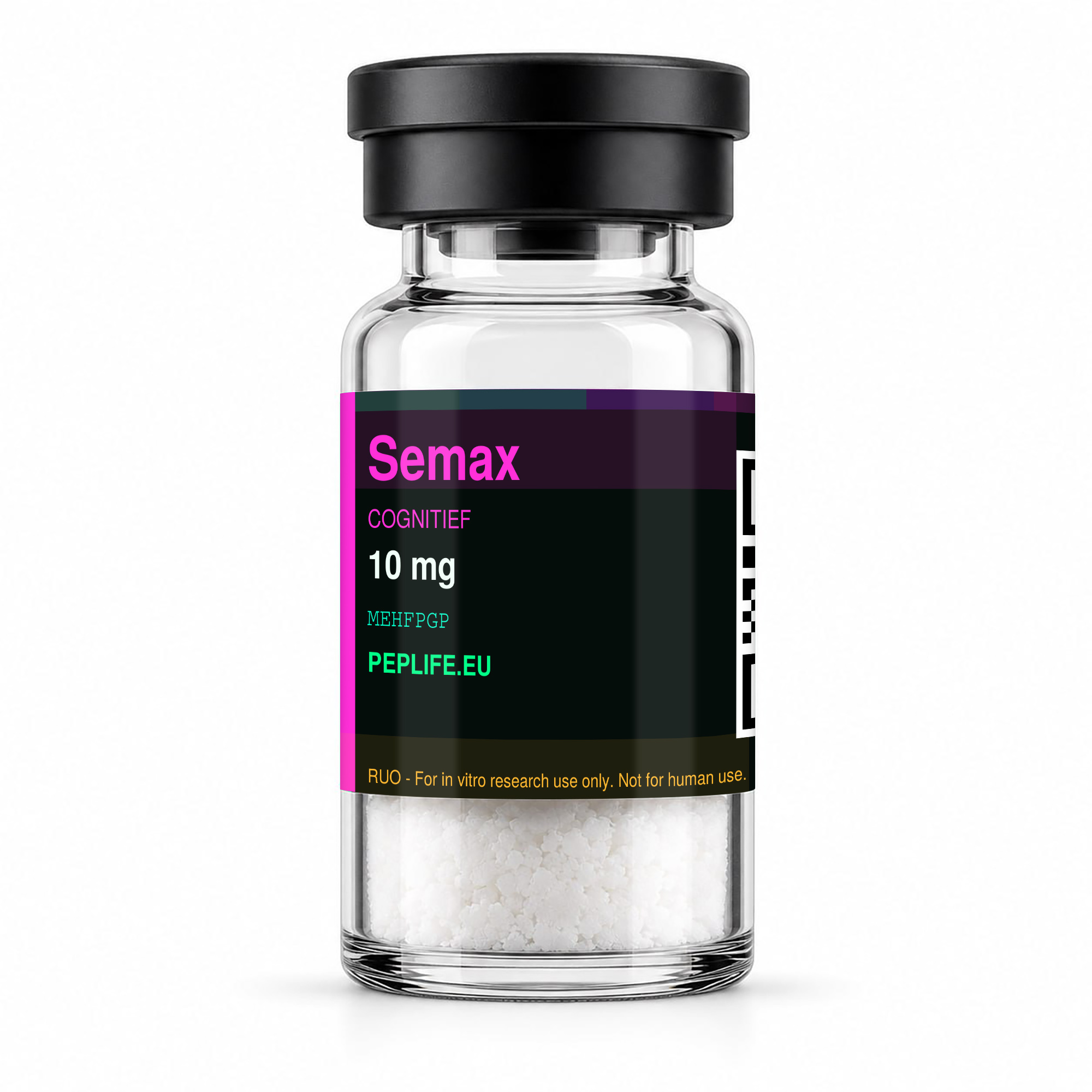
Het Semax research revolves around one of the most-studied synthetic peptides from Russian neuroscience. Semax is a short chain of seven amino acids (Met-Glu-His-Phe-Pro-Gly-Pro) designed as a stable analogue of a fragment of the hormone ACTH. Where the natural ACTH fragment is broken down within minutes, Semax remains intact considerably longer thanks to an added Pro-Gly-Pro tail — a property that makes it interesting for researchers wanting to study how short-chain peptides can influence processes in the brain.
What is Semax?
Semax is a synthetic heptapeptide first described in the scientific literature in 1991. It was developed in Russia, at Lomonosov University and the Institute of Molecular Genetics of the Russian Academy of Sciences. The structure is derived from ACTH(4-10) — the part of the adrenocorticotropic hormone associated with effects on learning and memory — but without the hormonal action on the adrenal gland. In other words: researchers isolated the piece of the molecule that seems to “talk” to the brain and made it more stable.
In Russia, Semax was eventually added to the list of vital and essential medicines. Outside that context it is internationally studied mainly as a model compound for neuropeptide research. In the lab, Semax is classified as a nootropic and neuroprotective research peptide and falls within the same family as other cognitive peptides.
How does Semax work in research? — the mechanism
The most-studied mechanism of action of Semax runs via the neurotrophins: proteins that support nerve cells, let them grow and let them communicate with each other. Two names recur again and again in Semax research: BDNF (brain-derived neurotrophic factor) and NGF (nerve growth factor). These molecules are often called “fertiliser for the brain”, because they play a key role in neuroplasticity — the brain's ability to form new connections.
In a much-cited study by Dolotov and colleagues (Brain Research, 2006), researchers reported that a single intranasal administration of Semax in rats increased BDNF protein levels in the hippocampus approximately 1.4-fold and the activation (phosphorylation) of the associated trkB receptor about 1.6-fold. The expression of the BDNF gene itself even rose several-fold. The authors concluded that Semax appears to modulate cognitive brain functions via this BDNF/trkB system. Besides the neurotrophins, other research suggests that Semax also activates serotonergic and dopaminergic systems and possibly inhibits the enzyme that breaks down enkephalins. The exact, complete mechanism, however, has not yet been unravelled and remains the subject of study.
What is Semax studied for?
Semax research covers a broad field, from cognition to recovery after oxygen shortage in the brain. Important: the points below describe what has been observed in studies, not what the peptide would do in a user.
- Cognition and memory: in animal models, Semax was associated with improved learning performance, such as better conditioned avoidance responses in the Dolotov (2006) study.
- Neuroprotection and ischaemia: researchers are studying whether Semax can protect nerve tissue after cerebral ischemia (oxygen shortage). Clinical research in Russia into its use in ischemic stroke reported neurological improvements (the Gusev & Skvortsova line of research, described among others in 2018).
- Neurotrophin expression: preclinical studies investigate how Semax and its breakdown product Pro-Gly-Pro influence the transcription of neurotrophins and their receptor genes after cerebral ischemia.
- Stress and attention: in animal models, Semax was studied for antidepressant- and anxiolytic-like effects via serotonergic and dopaminergic routes.
Semax in laboratory research: handling & dissolving
Semax is supplied as a freeze-dried (lyophilised) powder in a vial. For in-vitro work it is reconstituted in a research protocol with a suitable liquid, after which aliquots are stored cool and dark to limit degradation. Which liquid is suitable and why is explained in our pillar reconstitute peptides and in which liquid you use to dissolve a peptide. These pages give no dosing or usage advice for humans, but describe laboratory operations at the molecular level.
Quality & purity
Every relevant batch of Semax is independently HPLC-tested by an external laboratory; the certificate of analysis (CoA) is publicly verifiable per batch. For research into neuropeptides purity is crucial: contaminants or deviating composition can distort results. Peplife therefore publishes purity and identity per batch, so that an experiment remains reproducible and verifiable. See also our pillar on why we rejected a batch.
Frequently asked questions about Semax research
What exactly is Semax?
Semax is a synthetic heptapeptide (Met-Glu-His-Phe-Pro-Gly-Pro) derived from the ACTH(4-10) fragment. It is studied in laboratories for its nootropic and neuroprotective properties and is supplied solely for in-vitro research.
Why is Semax associated with BDNF and NGF?
Because several preclinical studies reported that Semax increases the expression and activation of neurotrophins such as BDNF and NGF in brain regions like the hippocampus. These proteins play a role in neuroplasticity, which explains why the peptide is popular in cognition-focused research.
How does Semax differ from Selank?
Both are Russian synthetic research peptides, but they are derived from different molecules: Semax from ACTH, whereas Selank is derived from the immune peptide tuftsin and is more often associated with anxiety and stress research. They are sometimes studied together within the cognitive peptides. The full comparison is in Selank vs Semax.
Is Semax approved as a drug?
In Russia, Semax is on the list of essential medicines, but it is not approved by the EMA or FDA. Within the EU it is offered solely for laboratory research (Research Use Only).
How stable is Semax compared with the natural ACTH fragment?
Considerably more stable. The added Pro-Gly-Pro tail protects the molecule against rapid enzymatic breakdown, so that it remains intact longer — one of the reasons it is an attractive research model.
Which other cognitive peptides are often studied alongside Semax?
Besides Selank, peptides such as DSIP studied within the broader field of neuropeptide and sleep research.
Read more & research at Peplife
- Research Semax at Peplife
- View all cognitive peptides
- Knowledge base: cognitive peptides compared
- Research Selank at Peplife
- Research DSIP at Peplife
Sources: Dolotov et al., Brain Research 2006 (PMID 16996037) · Efficacy of semax in ischemic stroke (PMID 29798983) · Semax & Pro-Gly-Pro: neurotrophin transcription after cerebral ischemia (PMC) · Semax — overview
Research Use Only. All products are supplied exclusively for in vitro laboratory research. Not intended for diagnostic or therapeutic use in humans or animals, and not approved by the EMA or FDA.
Semax for laboratory research: HPLC-tested, with a per-batch verifiable CoA and discreet EU shipping.