




| Aliases | AM833 |
| Class | Amylin agonist |
| Molecular weight (Da) | 4409.0 |
| Half-life (indicative) | ~7 d |
| Research status | In clinical research |
Research context (RUO): Cagrilintide is a long-acting amylin analogue studied in clinical and preclinical research for metabolism and weight regulation. It is supplied solely for in-vitro laboratory research and is not intended for human or animal use.
Cagrilintide research: the amylin analogue behind CagriSema
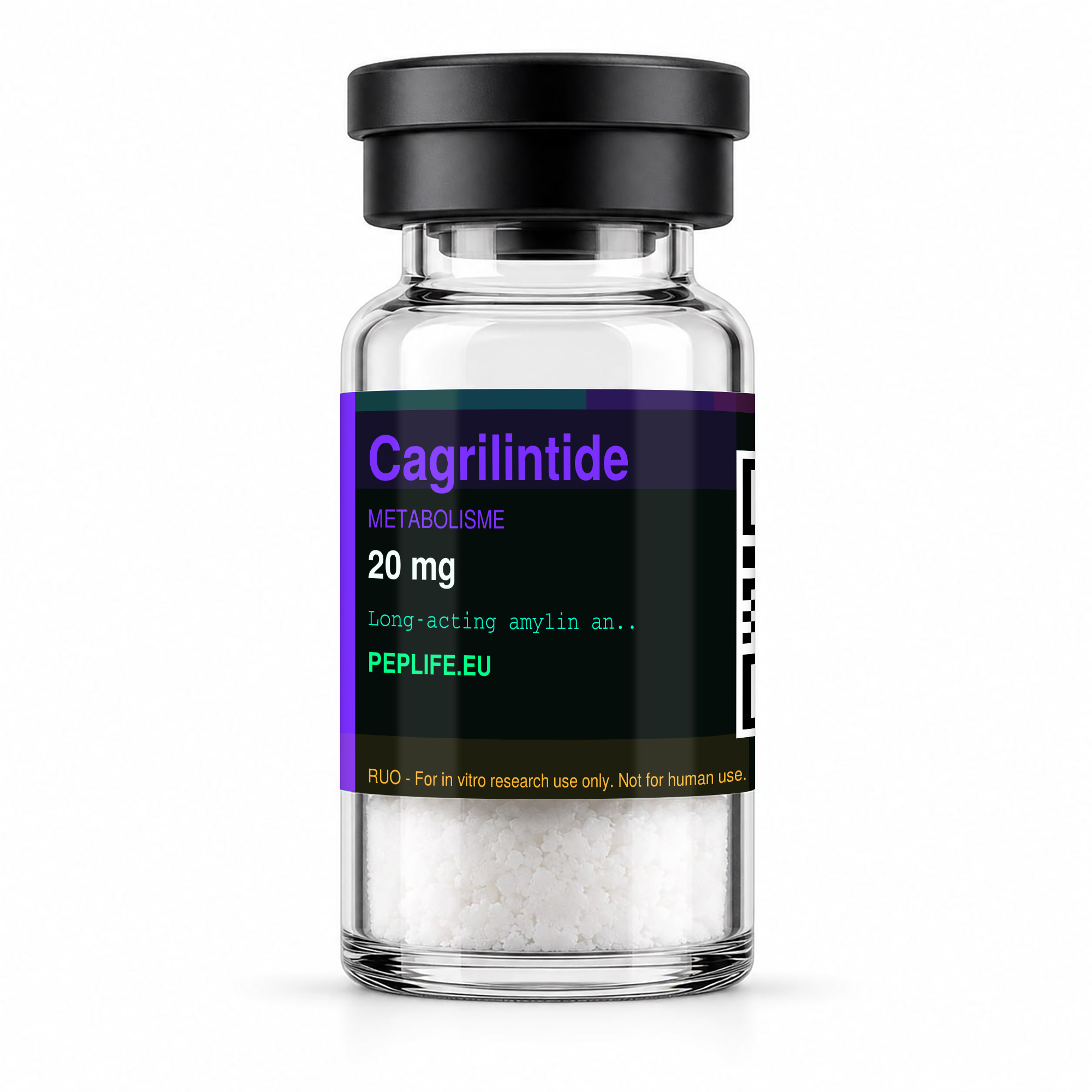
Het Cagrilintide research has taken off steeply in recent years, especially since it became clear that this long-acting amylin analogue can substantially reinforce the effects of GLP-1 peptides such as semaglutide. Amylin is a naturally occurring hormone released by the pancreas together with insulin, playing a role in satiety and the speed at which the stomach empties. Cagrilintide is designed to mimic that action, but with a much longer duration of action, so that a single administration per week suffices in research protocols. In this article we set out what the research shows so far — without exceeding the boundaries of Research Use Only.
What is cagrilintide?
Cagrilintide is a synthetic, long-acting analogue of the gut and pancreatic hormone amylin (also called IAPP). The molecule is chemically modified so that it is more stable and remains in the circulation longer than the body's own amylin, which is broken down within minutes. This makes cagrilintide suitable for a weekly research schedule in studies. The peptide was developed by Novo Nordisk and drew broad attention when researchers combined it with semaglutide into the fixed combination known as CagriSema. In the catalogue, cagrilintide falls under the metabolism peptides, the group most studied for fat loss and energy metabolism.
How does cagrilintide work? — the mechanism
Amylin acts mainly in the brainstem, where it engages amylin receptors that relay satiety signals. In laboratory research, cagrilintide has affinity for several amylin receptors and for the calcitonin receptor, which explains its broad action profile. In a mechanistic 2025 study, researchers reported that cagrilintide lowered body weight in test animals via amylin receptors in the brain, with the effect on food intake being centrally driven. Two mechanisms recur throughout the literature: slowing gastric emptying and enhancing satiety. Where GLP-1 peptides such as semaglutide act on a partly overlapping but complementary route, researchers sometimes speak of a “semaglutide squared” effect for the combination — the two classes reinforce each other. If you want to see those routes side by side, the pillar comparing GLP-1 peptides a good next step.
What is cagrilintide studied for?
The focus of the research is on metabolism, weight regulation and the synergy with GLP-1 agonists. The main research areas:
- Weight regulation (monotherapy): in a dose-finding phase 2 study (Lancet, 2021), researchers investigated weekly cagrilintide in people with overweight and obesity; higher doses were associated with greater weight loss than placebo over a period of 26 weeks.
- Combination with semaglutide (CagriSema): in the phase 3 study REDEFINE 1 (NEJM, 2025) with 3,417 adults, researchers reported after 68 weeks an average weight reduction of 22.7% with CagriSema versus 2.3% with placebo — one of the highest values described with a weight intervention up to then.
- Type 2 diabetes: in the corresponding REDEFINE 2 population with diabetes, an average weight reduction of about 13.7% versus 3.4% was reported, alongside improvements in HbA1c and blood pressure.
- Satiety and food intake: preclinical models are used to study how amylin signalling influences appetite and gastric emptying.
Cagrilintide in laboratory research: handling & dissolving
Cagrilintide is supplied as a freeze-dried (lyophilised) powder that must be reconstituted in the lab before use, usually with bacteriostatic or sterile water. The correct choice of liquid and careful reconstitution are decisive for the stability of the peptide during research. In the pillars reconstitute peptides and dissolve peptide: which liquid you can read how researchers approach this step by step and what the storage conditions are. This information is intended solely for laboratory applications.
Quality & purity
Every relevant batch of cagrilintide is independently HPLC-tested by an external laboratory; the certificate of analysis (CoA) is publicly verifiable per batch. Purity is no side issue in peptide research: contaminants or degradation products can distort research results. Why a strict rejection policy belongs with this, we show in why we rejected a batch.
Frequently asked questions about cagrilintide
What is the difference between cagrilintide and semaglutide?
Cagrilintide is an amylin analogue, whereas semaglutide is a GLP-1 receptor agonist. They act on different, complementary routes of satiety and gastric emptying. In research they are therefore often studied together. See also semaglutide in the catalogue.
What is CagriSema?
CagriSema is the fixed combination of cagrilintide and semaglutide investigated in the phase 3 studies REDEFINE 1 and 2. In those studies the combination showed a stronger average weight reduction than the individual components. The combination is available as research material as CagriSema.
How long does cagrilintide act?
Cagrilintide is designed as a long-acting analogue, which is why a weekly administration schedule is used in clinical studies. The exact half-life is the subject of pharmacokinetic research.
Why is cagrilintide combined with a GLP-1 peptide?
Because amylin and GLP-1 signalling drive partly different mechanisms, scientists are investigating whether combining them leads to a greater effect than each peptide separately. In REDEFINE 1, an average weight reduction of 22.7% was reported with the combination. You will find more context in semaglutide vs tirzepatide.
Which category does cagrilintide fall under?
Cagrilintide is grouped under the fat-loss peptides and metabolism peptides, the groups most studied for weight and energy metabolism.
Read more & research at Peplife
- Research Cagrilintide at Peplife
- View all metabolism peptides
- Research CagriSema (cagrilintide + semaglutide)
- Research Semaglutide at Peplife
- comparing GLP-1 peptides
- Semaglutide vs tirzepatide
- Fat-loss peptides in research
Sources: Lau et al., Lancet 2021 — phase 2 dose-finding cagrilintide · REDEFINE 1, NEJM 2025 — coadministered cagrilintide and semaglutide · Cardiology in Review 2023 — Cagrilintide: A Long-Acting Amylin Analog · Cagrilintide lowers bodyweight through brain amylin receptors, 2025
Research Use Only. All products are supplied exclusively for in vitro laboratory research. Not intended for diagnostic or therapeutic use in humans or animals, and not approved by the EMA or FDA.
HPLC-tested by an external laboratory, with a per-batch verifiable CoA and discreet shipping within the EU.