




| Class | Coenzyme |
| Molecular weight (Da) | 663.4 |
| Half-life (indicative) | ~8 h (intracellular turnover) |
| Research status | Supplement / cofactor |
Research context (RUO): NAD+ (nicotinamide adenine dinucleotide) is an endogenous coenzyme that is central to energy metabolism and ageing. At Peplife it is supplied exclusively as research material for in-vitro laboratory research (Research Use Only) — not for human or animal use.
NAD+ research: the coenzyme for cellular energy and ageing
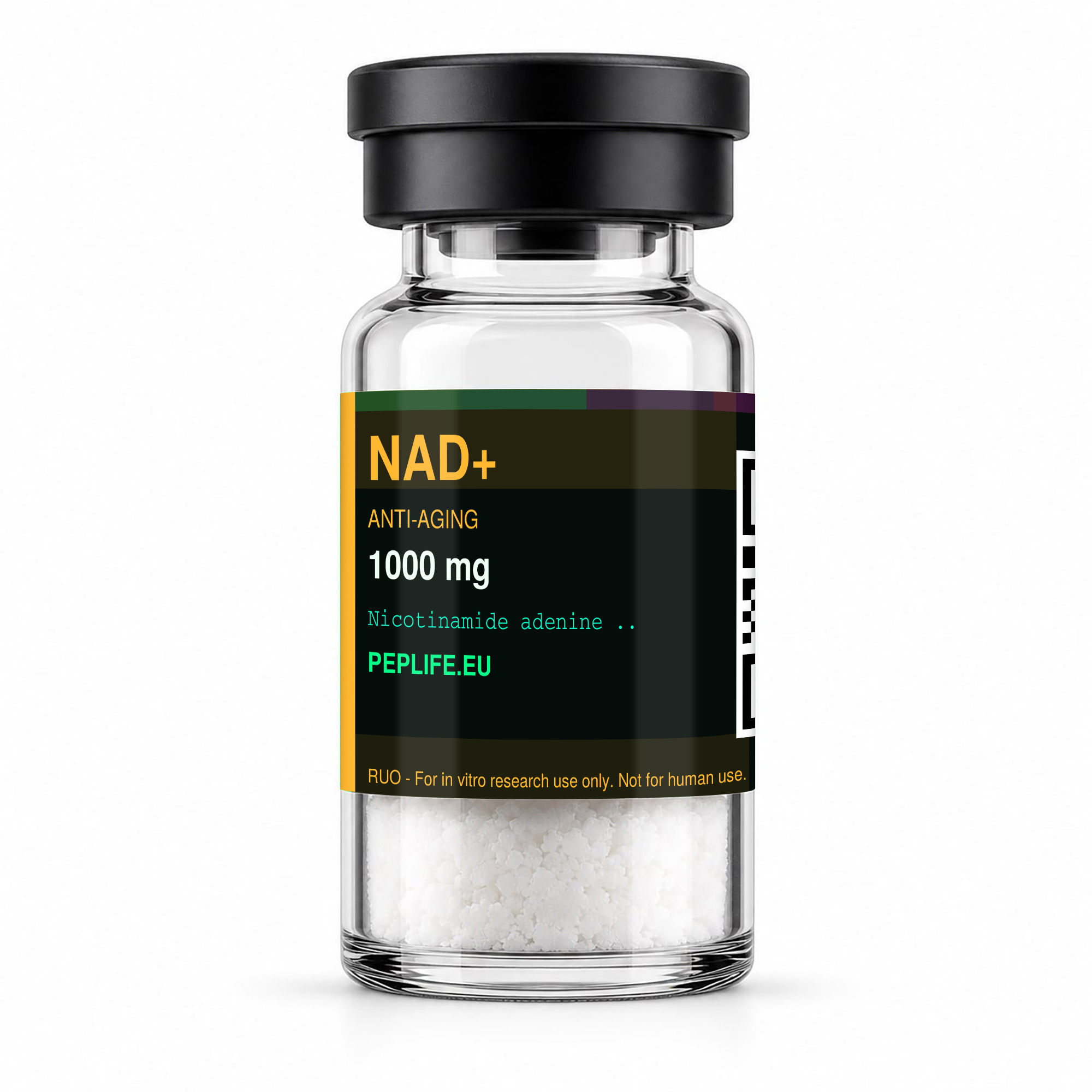
NAD+ research has in recent years grown into one of the most studied topics within the biology of ageing. Nicotinamide adenine dinucleotide, NAD+ for short, is not a peptide but a coenzyme: a small molecule that hundreds of enzymes need in order to function. Because NAD+ levels in tissues measurably decline with age, scientists investigate whether restoring those levels affects energy metabolism, DNA repair and cellular ageing. This page summarises what the literature shows — each time attributed to the underlying research.
What is NAD+?
NAD+ is a coenzyme that occurs in virtually every living cell. Chemically it consists of two nucleotides (one with nicotinamide, one with adenine) linked together via two phosphate groups; the molecular formula is C21H27N7O14P2. The cell builds NAD+ from nutrients such as vitamin B3 (niacin), nicotinamide and the amino acid tryptophan, via the so-called salvage– and de novo pathways. NAD+ constantly alternates between two forms: the oxidised form (NAD+) and the reduced form (NADH). This back-and-forth switching is precisely what makes the molecule useful as an “electron taxi” in metabolism.
How does NAD+ work? — the mechanism
The function of NAD+ falls into two broad categories. Firstly, it is a redox cofactor: in glycolysis, the citric acid cycle and mitochondrial oxidative phosphorylation, NAD+ takes up electrons (becoming NADH) and releases them again. This electron transport ultimately drives the production of ATP, the cell's energy currency. Without a healthy NAD+/NADH ratio, energy production stalls.
Secondly, NAD+ is a substrate for enzymes that literally consume the molecule. The best known are the sirtuins (SIRT1–SIRT7), the PARP enzymes and CD38. Sirtuins use NAD+ to “deacetylate” proteins and histones and thereby play a role in gene regulation, mitochondrial function and stress resistance. PARP enzymes consume NAD+ when repairing DNA damage. Because all these enzymes draw from the same NAD+ pool, an interesting competition arises in research: chronic DNA damage or inflammation can deplete the NAD+ supply and thus leave less for the sirtuins. Covarrubias and colleagues described this interplay extensively in their review in Nature Reviews Molecular Cell Biology (2021).
What is NAD+ studied for?
NAD+ research focuses mainly on the question of why NAD+ levels decline with age and what restoring them does in model systems. Important: these are research directions from lab and animal models. They say nothing about application in humans and are described here solely as scientific context.
- Cellular energy & mitochondria: in preclinical studies, a higher NAD+ availability was associated with better mitochondrial function and energy metabolism.
- Sirtuin activity & longevity: researchers study whether NAD+, as fuel for sirtuins, influences processes associated with ageing; in animal models, raising NAD+ showed effects on gene regulation and stress response.
- DNA repair: because PARP enzymes consume NAD+ when repairing DNA breaks, research examines how the NAD+ supply and repair capacity influence each other.
- Metabolic and cardiovascular models: reviews link NAD+ metabolism to research into insulin sensitivity and vascular function in animal models.
- Senescence (cellular ageing): studies investigate the role of NAD+ in the accumulation of “senescent” cells and the associated inflammatory signals.
NAD+ in laboratory research: handling & dissolving
NAD+ is supplied as a freeze-dried (lyophilised) powder in a vial and is reconstituted in the lab into a solution before it is used in experiments. The molecule is sensitive to moisture, heat and repeated freeze-thaw cycles, so cool and dry storage is customary. For the general principles of dissolving and storing research material, see our pillar on reconstituting peptides and the overview which liquid you use to dissolve. The choice of solvent, concentration and pH depends on the experimental protocol of the laboratory in question.
Quality & purity
Every relevant batch is independently HPLC-tested by an external laboratory; the certificate of analysis (CoA) is publicly verifiable per batch. For NAD+ research, that purity is essential: contaminants or degradation products can distort redox measurements and enzyme assays. A verifiable CoA per batch makes research results reproducible and verifiable. See also why we are transparent about rejection in why we rejected a batch.
Frequently asked questions about NAD+ research
Is NAD+ a peptide?
No. NAD+ is a dinucleotide coenzyme, not a peptide. At Peplife it is nonetheless supplied as research material, just like the peptides in the range, and solely for in-vitro laboratory research.
What is the difference between NAD+ and NADH?
They are two forms of the same molecule. NAD+ is the oxidised form that can take up electrons; NADH is the reduced form that has taken up electrons. The ratio between the two is a measure of a cell's metabolic state.
Why does NAD+ decline with age?
Reviews point to a combination of reduced production and increased consumption — among other things due to more DNA damage (PARP activity) and a higher activity of CD38. Researchers are still actively studying this balance.
What is the link between NAD+ and sirtuins?
Sirtuins need NAD+ as a substrate in order to function. At lower NAD+ levels, sirtuin activity decreases in model systems, which is one reason why NAD+ receives so much attention in longevity research.
Why is NAD+ compared with glutathione?
Both are small, endogenous molecules that appear in research into oxidative stress and ageing. The comparison is covered in our pillar NAD+ and glutathione research.
May I use NAD+?
No. All material is Research Use Only and intended solely for laboratory research, not for human or animal use.
Read more & research at Peplife
- Research NAD+ at Peplife
- View all anti-aging peptides
- Research Glutathione at Peplife
- Research Epitalon at Peplife
- NAD+ and glutathione research compared
- Longevity peptides: the research
Sources: Covarrubias et al., Nat Rev Mol Cell Biol (2021) · PubChem: beta-Nicotinamide adenine dinucleotide (CID 925) · NAD+ in Aging Biology, Endocrine Reviews (2023) · The Central Role of the NAD+ Molecule in Aging, PubMed (2023)
Research Use Only. All products are supplied exclusively for in vitro laboratory research. Not intended for diagnostic or therapeutic use in humans or animals, and not approved by the EMA or FDA.
NAD+ for your lab: HPLC-tested by an external laboratory, CoA verifiable per batch and discreet shipping within the EU.