




| Aliases | Bepecin, PL 14736 |
| Class | Repair/tissue |
| Molecular weight (Da) | 1419.5 |
| Half-life (indicative) | short/uncertain † |
| Research status | Preclinical / RUO |
Research context (RUO): BPC-157 and TB-500 are two synthetic recovery peptides that are intensively studied in preclinical tissue-repair research. Both are supplied by Peplife exclusively for in-vitro laboratory research (Research Use Only) and are not intended for human or animal use.
BPC-157 vs TB-500: two recovery peptides compared
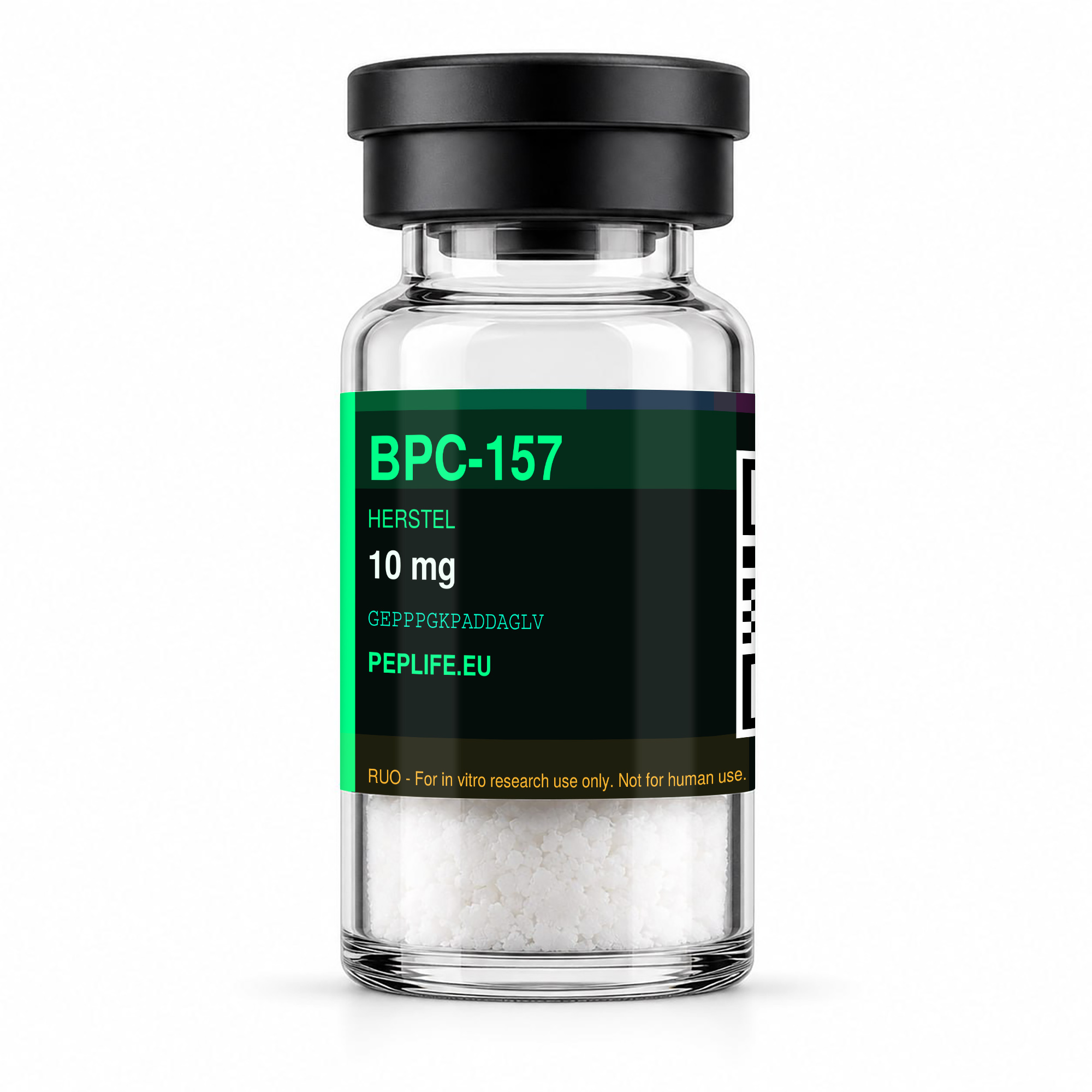
The comparison BPC-157 vs TB-500 is one of the most frequently asked questions in recovery-peptide research. Both peptides are studied in animal models for tendons, muscles, connective tissue and blood vessel formation, and yet their molecular targets are fundamentally different. Where BPC-157 is derived from a stomach-protecting protein, TB-500 is a fragment of the body's own protein thymosin beta-4. That difference in origin explains why researchers sometimes study them separately, and sometimes precisely together.
Similarities between BPC-157 and TB-500
Despite their different chemistry, both peptides share a number of striking research themes. In preclinical studies, both are associated with accelerated tissue repair, with a beneficial effect on the formation of new blood vessels (angiogenesis) and with cell migration towards damaged tissue. Both are therefore studied as candidates within the same broad field: regeneration of muscle, tendon and connective tissue after injury. They are also practically similar: both are water-soluble peptides that are reconstituted under laboratory conditions with bacteriostatic or sterile water before being studied in cell-culture or animal models.
Differences in mechanism — the real distinction
The core difference between BPC-157 and TB-500 lies in how each peptide works at the cellular level. This is where the two recovery peptides clearly diverge.
BPC-157 — stomach-derived and cytoprotective. BPC-157 (Body Protection Compound) is a stable gastric pentadecapeptide of fifteen amino acids, isolated from a protective protein in human gastric juice. In animal models it is mainly associated with cytoprotection (protection of cells against damage) and with stimulating angiogenesis. In a study by Seiwerth and colleagues (2009), researchers reported that BPC-157 promoted the repair of bruised and severed muscle and tendon, associated with an increased expression of VEGF, a key factor for the formation of new blood vessels. Researchers are additionally studying a link with the nitric oxide pathway (NO system) and with the production of collagen in tendons.
TB-500 — thymosin beta-4 fragment and actin binding. TB-500 is a synthetic fragment that mimics the presumed active region of thymosin beta-4, a naturally occurring protein present in virtually every cell. The central mechanism revolves around actin binding: thymosin beta-4 binds to G-actin, a building block of the cytoskeleton, and thereby regulates the assembly and disassembly of the cellular “scaffolds” that cells need in order to move. This actin regulation is linked in research to cell migration: the ability of repair cells to move towards a wound. In the study by Malinda and colleagues (1999), thymosin beta-4 accelerated wound healing in animal models, and later work showed that it is precisely the actin-binding region that promotes angiogenesis.
In short: BPC-157 is studied mainly as a signal peptide that drives blood vessel growth and cellular protection, whereas TB-500 is studied as a structural peptide that influences the motility of repair cells via the actin cytoskeleton. Different pathways, partly overlapping outcomes.
What is each peptide studied for?
- BPC-157 — tendons, ligaments and digestive tissue: in animal models, BPC-157 is mainly studied for tendon and muscle repair, the tendon-bone junction and protection of the gastrointestinal mucosa. More on this in our pillar on BPC-157 research.
- TB-500 — broad tissue regeneration and flexibility: researchers study TB-500 (and the parent protein thymosin beta-4) for muscle and skin repair, cardiac and corneal tissue, and for a beneficial effect on tissue flexibility. See the pillar on TB-500 research.
- Angiogenesis: both peptides are associated with promoting new blood vessels in damaged tissue, albeit via different signalling pathways.
- Inflammation modulation: in preclinical models, a dampening of the inflammatory response around injury is reported for both.
Studied together: the “Wolverine” blend
Because the mechanisms of BPC-157 and TB-500 theoretically complement each other — one focuses on blood vessel growth and protection, the other on cell migration via the actin cytoskeleton — they are sometimes studied in combination in the research world. This combination is informally known as the Wolverine stack, a reference to the rapid healing of the well-known comic character. The idea behind this research protocol is that two complementary repair pathways are addressed simultaneously. The combined BPC-157 + TB-500 Wolverine Blend makes it easier for laboratories to study both peptides in a single preparation. Important: controlled comparative studies of this specific blend in humans are lacking; it remains a preclinical and in-vitro research topic.
BPC-157 vs TB-500 in laboratory research: handling & dissolving
Both peptides are supplied as a freeze-dried (lyophilised) powder and reconstituted under laboratory conditions with bacteriostatic or sterile water before being studied in models. The correct choice of solvent and proper storage determine the stability of the preparation. Our pillars on reconstituting peptides and which liquid is suitable for dissolving peptides describe this process step by step for research purposes.
Quality & purity
Every relevant batch of both BPC-157 and TB-500 is independently HPLC-tested by an external laboratory; the certificate of analysis (CoA) is publicly verifiable per batch. For comparative research, purity is crucial: only with a known, verified identity and concentration can outcomes between two peptides be reliably compared. Why we are strict about batch quality is explained in the article why we rejected a batch.
Frequently asked questions about BPC-157 vs TB-500
What is the main difference between BPC-157 and TB-500?
The mechanism. BPC-157 is a stomach-derived peptide that in research is mainly associated with cytoprotection and the stimulation of blood vessel growth (angiogenesis) via VEGF. TB-500 is a fragment of thymosin beta-4 that works through actin binding and thereby influences the migration of repair cells.
What are BPC-157 and TB-500 studied for?
Both are studied in animal models for muscle, tendon and connective-tissue repair after injuries and for angiogenesis. BPC-157 research additionally emphasises tendons and the digestive mucosa; TB-500 research broad tissue regeneration, cardiac and skin tissue.
Why are BPC-157 and TB-500 sometimes studied together?
Because their mechanisms theoretically complement each other: blood vessel growth plus cellular protection (BPC-157) alongside cell migration via the cytoskeleton (TB-500). This combination is informally called the Wolverine stack in the research world and studied preclinically.
Which of the two is “better”?
That question cannot be answered scientifically. There are no controlled head-to-head studies in humans; both are Research Use Only. They are studied for partly different tissues and via different routes, so “better” depends entirely on the research question.
Are BPC-157 and TB-500 approved for use?
No. Both peptides are not approved by the EMA, NVWA or FDA and are supplied exclusively for in-vitro laboratory research, not for diagnostic or therapeutic use.
Can you study BPC-157 and TB-500 separately or as a blend?
Both are available separately as an individual peptide, and there is a combined Wolverine Blend for laboratories that wish to study both in a single preparation.
Read more & research at Peplife
- Research BPC-157 at Peplife
- Research TB-500 at Peplife
- Research BPC-157 + TB-500 Wolverine Blend
- View all recovery peptides
- Pillar: BPC-157 research
- Pillar: TB-500 research
Sources: Seiwerth et al., BPC 157 and angiogenesis in muscle and tendon healing (J Physiol Pharmacol, 2009) · Progress on the Function and Application of Thymosin β4 (2021) · Malinda et al., Thymosin beta4 accelerates wound healing (1999) · The actin binding site on thymosin beta4 promotes angiogenesis (2003) · Thymosin Beta-4 and TB-500 in Tissue Healing: A Scoping Review (2026)
Research Use Only. All products are supplied exclusively for in vitro laboratory research. Not intended for diagnostic or therapeutic use in humans or animals, and not approved by the EMA or FDA.
HPLC-tested by an external laboratory, CoA verifiable per batch and discreet EU shipping — both recovery peptides separately or as a Wolverine blend.