




| Class | Mitochondrial peptide |
| Molecular weight (Da) | 2174.6 |
| Half-life (indicative) | short (min–h) † |
| Research status | Preclinical / RUO |
Research context (RUO): MOTS-C is a mitochondrial-derived peptide studied for its role in energy metabolism and ageing. It is supplied solely for in-vitro laboratory research and is not intended for human or animal use.
❯ Recent research from our research hub
New studies and publications discussing MOTS-c (discussing research, not usage advice):
All research updates in the Research & News hub · latest bulletin.
MOTS-C research: the mitochondrial peptide studied as an exercise mimetic
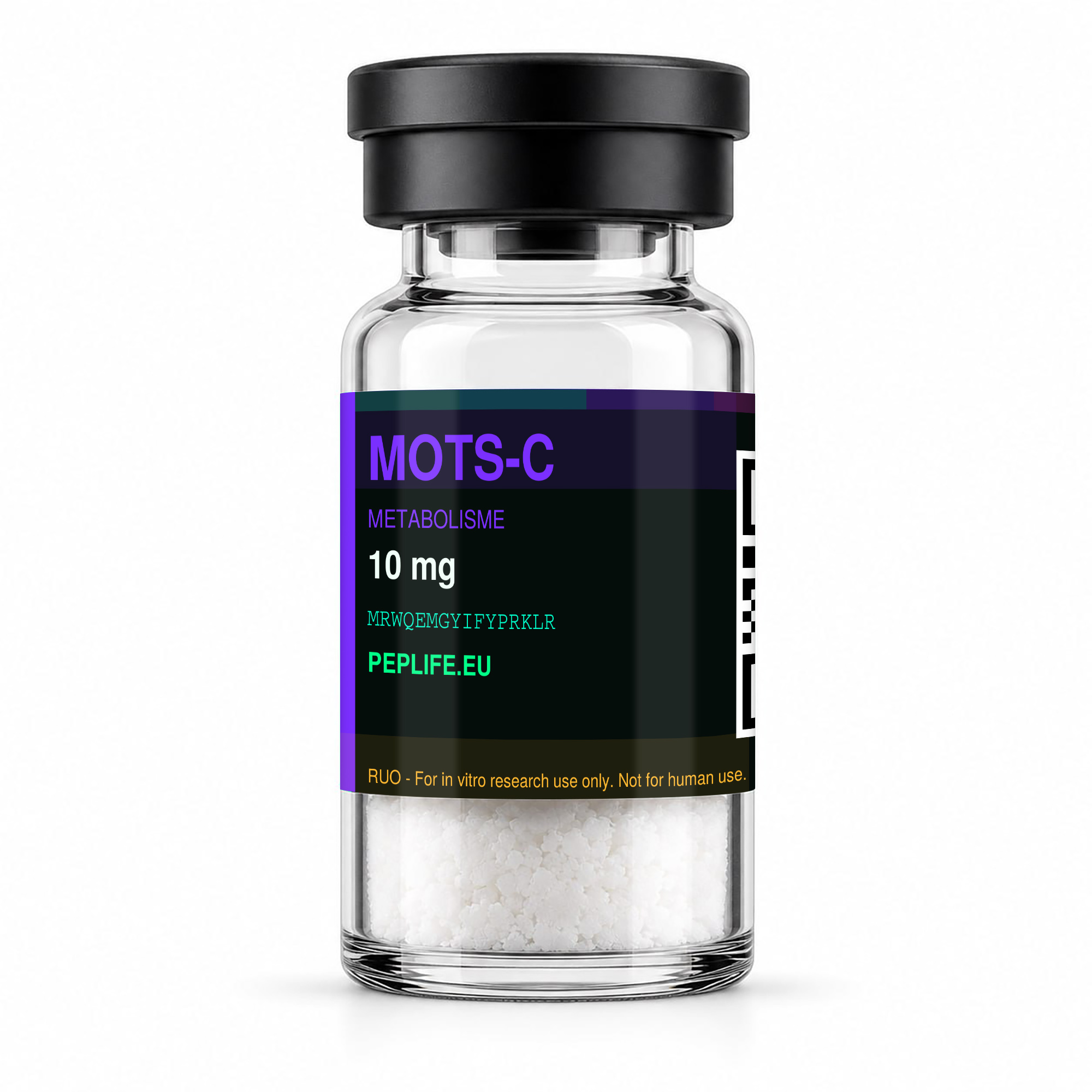
Around MOTS-C research a striking amount of literature has emerged over the past decade, because this small peptide turns out to be a surprising link between the mitochondria and the rest of the cell. Where most studied peptides are encoded by nuclear DNA, MOTS-C comes from the mitochondrial genome itself. That makes it, for researchers, an intriguing molecule for mapping the communication between the cell's “power plants” and metabolism.
What is MOTS-C?
MOTS-C stands for “Mitochondrial Open reading frame of the Twelve S rRNA type-c”. It is a peptide of only 16 amino acids hidden within the 12S rRNA gene of the mitochondrial DNA. It was first described in 2015 by Lee and colleagues in Cell Metabolism, who designated it as one of the first known “mitochondrial-derived peptides” (MDPs). This class — to which humanin also belongs — is studied as a group of signalling molecules with which mitochondria appear to relay their state to the rest of the body. In a laboratory context, MOTS-C is therefore often positioned within the broader field of metabolism peptides.
How does MOTS-C work? — the mechanism
The central mechanism that in MOTS-C research emerges, revolves around the enzyme AMPK (AMP-activated protein kinase), often described as the “energy sensor” of the cell. In the study by Lee et al. (2015), researchers reported that MOTS-C intervenes in the folate-methionine cycle, which leads to accumulation of AICAR — a molecule that activates AMPK. When AMPK is switched on, the cellular metabolism shifts towards glucose uptake and fat burning, a response that normally occurs during energy shortage or physical exercise.
A second layer of the mechanism that is studied is the movement of MOTS-C to the cell nucleus under metabolic stress. Researchers described that under oxidative or nutritional stress the peptide translocates to the nucleus and there helps regulate the expression of antioxidant and metabolic genes. This dual role — via AMPK and via gene regulation — makes MOTS-C an attractive model for studying how mitochondria adapt to stress and ageing.
What is MOTS-C studied for?
The research interest in MOTS-C spreads across various metabolic and ageing-related themes. Important areas from the published literature include:
- Insulin sensitivity & glucose metabolism: in the animal model of Lee et al. (2015), MOTS-C was associated with reduced diet-induced obesity and improved insulin sensitivity in mice on a high-fat diet. Kim et al. (2019) reported in Physiological Reports additionally that MOTS-C influenced the plasma metabolome and increased insulin sensitivity.
- Exercise mimetic & physical capacity: in a study in Nature Communications (2021) researchers described that MOTS-C administration significantly increased the running capacity of mice. In old mice they saw an approximately two-fold increase in running distance and duration, which explains the nickname “exercise mimetic”.
- Ageing & metabolic flexibility: in the same study, MOTS-C was linked to restoration of “metabolic flexibility” — the ability to switch between fuel sources — and to improvements in grip strength and step length with late-life treatment.
- Stress response & proteostasis: review literature (2023) discusses MOTS-C as a regulator of heat-shock responses and protein homeostasis, partly via HSF1-dependent routes in skeletal muscle.
Important: all these findings come from cell-culture and animal models. They describe what was observed in the laboratory and do not constitute a statement about application in humans.
MOTS-C in laboratory research: handling & dissolving
As a lyophilisate (freeze-dried powder), MOTS-C is usually stable for a long time when stored cool, dry and dark. For in-vitro protocols the peptide is reconstituted, usually with bacteriostatic or sterile water. Because the correct choice of reconstitution liquid and concentration affects stability within a research setup, we refer to our extensive pillar on reconstituting peptides for the laboratory principles. After reconstitution the solution is usually stored refrigerated and protected against repeated temperature fluctuations.
Quality & purity
Every relevant batch is independently HPLC-tested by an external laboratory; the certificate of analysis (CoA) is publicly verifiable per batch. For peptide research this verification is essential, because the reliability of in-vitro results depends directly on the purity and the correct identity of the molecule used. For MOTS-C — a relatively short peptide — the HPLC analysis provides insight into the degree of purity, while mass spectrometry confirms the molecular mass. This way a researcher knows exactly what is in the vial.
Frequently asked questions about MOTS-C
What exactly is MOTS-C?
MOTS-C is a mitochondrial-derived peptide of 16 amino acids, encoded within the 12S rRNA gene of the mitochondrial DNA. It is studied as a signalling molecule that regulates energy metabolism, particularly via the enzyme AMPK.
Why is MOTS-C called an “exercise mimetic”?
Because researchers observed effects in animal models that resemble the metabolic adaptations after physical exercise — such as increased running capacity and improved glucose balance. In the study in Nature Communications (2021) it was moreover described that physical exercise itself increases MOTS-C expression.
How does MOTS-C differ from other metabolism peptides?
Unlike peptides encoded by the cell nucleus, MOTS-C comes from the mitochondrial genome. Researchers therefore study it specifically as a bridge between mitochondrial function and systemic metabolism, while for example 5-Amino-1MQ is studied via a different route (NNMT inhibition).
Is MOTS-C associated with ageing?
In animal models, MOTS-C was associated with the preservation of physical capacity and metabolic flexibility in old animals. These findings place it within the research into longevity peptides, but remain limited to preclinical models.
Can I buy MOTS-C for personal use?
No. MOTS-C at Peplife is supplied solely as Research Use Only material for in-vitro laboratory research. It is not intended or approved for human or animal use.
How does MOTS-C relate to mitochondrial peptides such as SS-31?
Both are studied in the context of mitochondrial health, but via different mechanisms. SS-31 (Elamipretide) is studied as a stabiliser of the inner membrane (cardiolipin), while MOTS-C is mainly studied via AMPK signalling.
Read more & research at Peplife
- Research MOTS-C at Peplife
- View all metabolism peptides
- Longevity peptides: the research into ageing
- Fat-loss peptides in research
- NAD+ and glutathione: the research into cellular energy
- Research SS-31 (Elamipretide)
- Research 5-Amino-1MQ
Sources: Lee et al., Cell Metabolism 2015 (PMID 25738453) · Reynolds et al., Nature Communications 2021 · Kim et al., Physiological Reports 2019 · Review: MOTS-c, stress, metabolism and ageing (PMC9854231)
Research Use Only. All products are supplied exclusively for in vitro laboratory research. Not intended for diagnostic or therapeutic use in humans or animals, and not approved by the EMA or FDA.
HPLC-tested by an external laboratory, with a per-batch verifiable CoA and discreet EU shipping.