




| Aliases | Epithalon, AEDG |
| Class | Bioregulator (Khavinson) |
| Molecular weight (Da) | 390.3 |
| Half-life (indicative) | very short (min) |
| Research status | Preclinical / RUO |
Research context (RUO): Epitalon (also spelled Epithalon) is a synthetic tetrapeptide originally derived from an extract of the pineal gland and studied in ageing and telomere research. It is supplied solely for in-vitro laboratory research and is not intended for human or animal use.
Epitalon research: the pineal tetrapeptide under the microscope
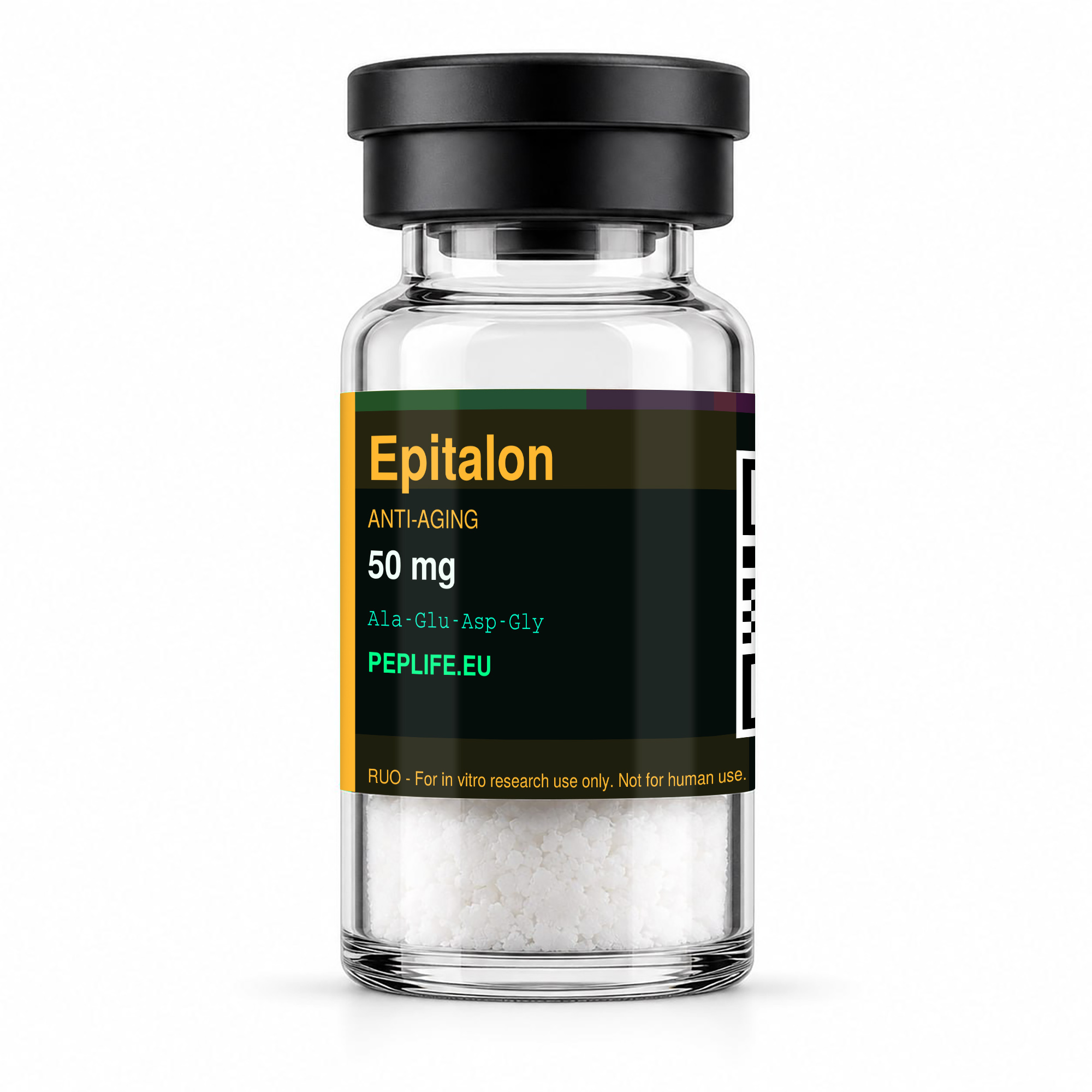
Epitalon research has focused for more than two decades on the question of whether a small synthetic peptide can influence processes associated with ageing. Epitalon is a tetrapeptide with the amino-acid sequence Ala-Glu-Asp-Gly (AEDG) and was designed by the Russian gerontologist Vladimir Khavinson and colleagues as a synthetic counterpart to epithalamine, a peptide extract from the pineal gland of cattle. In laboratories it is today studied mainly in the context of telomerase activity, melatonin regulation and so-called geroprotective (ageing-slowing) effects in cell and animal models.
What is epitalon?
Epitalon is a short chain of four amino acids (alanine, glutamic acid, aspartic acid and glycine), registered under PubChem CID 219042 with molecular formula C14H22N4O9. The pineal gland (glandula pinealis) is a small organ in the brain that produces melatonin among other things and is involved in the day-night rhythm. Because the function of this gland declines with age, epithalamine — and later the better-defined synthetic epitalon — became an interesting object of study for researchers wanting to understand ageing mechanisms. The fact that epitalon has an exactly defined sequence makes it more reproducible in research than the original gland extract.
How does epitalon work? — the mechanism
The most-discussed mechanism of action in epitalon research is the possible influence on telomerase. Telomeres are the protective “caps” at the ends of chromosomes that become shorter with each cell division; telomerase is the enzyme that can lengthen these ends. In a much-cited 2003 study, Khavinson and colleagues reported that adding epitalon to cultured human fibroblasts (skin cells that normally show no telomerase activity) led to expression of the catalytic telomerase subunit, measurable telomerase activity and lengthening of the telomeres. The researchers suggested that this could indicate a reactivation of the telomerase gene in somatic cells.
In addition, an extensive 2025 review article in International Journal of Molecular Sciences describes epitalon as a bioactive peptide with reported antioxidant, neuroprotective and antimutagenic properties that in research influences, among other things, melatonin synthesis and the activity of various enzymes. The authors emphasise, however, that after 25 years of research the physico-chemical characterisation is still limited and that the full mechanistic picture is not established.
What is epitalon studied for?
Within the laboratory research a few recurring themes emerge. Important: the points below describe what studies report in cell and animal models, not what the peptide does in humans.
- Telomeres & cellular ageing: in cell-culture research, epitalon was associated with telomerase activity and telomere lengthening, which researchers link to the lifespan of cell populations.
- Melatonin & circadian rhythm: in a 2007 study in old monkeys and elderly humans, Korkushko, Khavinson and colleagues reported that pineal peptides (epithalamine and epitalon) normalised the nocturnal melatonin level and the daily rhythm.
- Geroprotection: the 2025 review article summarises epitalon as a compound with “geroprotective” properties that is studied in in-vitro, in-vivo and computational models.
- Antioxidation & neuroprotection: reviews describe reported antioxidant and neuroprotective effects via both specific and non-specific routes.
It is important to remain sober about the strength of the evidence. A large part of the epitalon research comes from a single research group, much data comes from cell culture and animal models, and large-scale, independently replicated clinical studies are largely lacking. The findings are interesting but preliminary, and that is precisely why epitalon is a researchpeptide remains.
Epitalon in laboratory research: handling & dissolving
Epitalon is usually supplied as a freeze-dried (lyophilised) powder in a vial. For in-vitro applications researchers reconstitute the peptide with a suitable liquid; which liquid is customary for this and how reconstitution proceeds in research protocols is described in our pillar on reconstituting peptides and the overview dissolve peptide: which liquid. As a small tetrapeptide that dissolves well in water, epitalon is relatively easy to handle; storage in research settings is usually refrigerated and protected against light to limit degradation.
Quality & purity
Every relevant batch of epitalon is independently HPLC-tested by an external laboratory; the certificate of analysis (CoA) is publicly verifiable per batch. For short-peptide research purity is crucial, because contaminants or degradation products can compromise the reproducibility of experiments. Why we reject a batch entirely when results deviate is explained in why we rejected a batch.
Frequently asked questions about epitalon
Is epitalon the same as epithalon or epithalamine?
“Epitalon” and “epithalon” are two spellings for the same synthetic tetrapeptide (AEDG). Epithalamine is something different: it is the original peptide extract from the pineal gland from which epitalon was derived as a defined synthetic version.
What does the sequence AEDG mean?
AEDG stands for the four amino acids in the peptide: alanine (A), glutamic acid (E), aspartic acid (D) and glycine (G), in that order. It is thereby one of the shortest peptides in ageing research.
Does epitalon lengthen telomeres?
In cell-culture research — in particular the 2003 study by Khavinson and colleagues — telomerase activity and telomere lengthening were reported in human fibroblasts. Whether this translates to living organisms or to humans has not been demonstrated with the current, preliminary data.
What is the connection between epitalon and melatonin?
Because epitalon is derived from a pineal gland extract, its influence on melatonin is a central research theme. In a 2007 study, researchers reported that pineal peptides normalised the nocturnal melatonin level in old monkeys and elderly humans.
How strong is the evidence around epitalon?
Preliminary and limited. Much research comes from a single research group and from cell and animal models; independent, large-scale clinical replication is lacking. Epitalon is therefore offered solely as a research peptide.
What may epitalon be used for?
Solely for in-vitro laboratory research (Research Use Only). It is not intended for human or animal consumption and not approved for diagnostic or therapeutic use.
Read more & research at Peplife
- Research Epitalon at Peplife
- View all anti-aging peptides
- Longevity peptides: the research field overview
- NAD+ and glutathione research
- Research NAD+ · Research Pinealon · Research Thymalin
Sources: Khavinson et al., 2003 — Bull Exp Biol Med (telomerase & telomere) · Araj et al., 2025 — Int J Mol Sci (epitalon overview) · Korkushko et al., 2007 — Adv Gerontol (melatonin rhythm) · PubChem CID 219042 (Epitalon, AEDG)
Research Use Only. All products are supplied exclusively for in vitro laboratory research. Not intended for diagnostic or therapeutic use in humans or animals, and not approved by the EMA or FDA.
Epitalon (AEDG) for laboratory research — HPLC-tested, CoA per batch and discreet EU shipping.