




| Class | Melanocortin MC3/4/1R |
| Molecular weight (Da) | 1024.2 |
| Half-life (indicative) | ~1–2 h † |
| Research status | Preclinical / RUO |
Research context (RUO): Melanotan II is a synthetic melanocortin peptide studied in laboratory research to unravel melanogenesis (pigment formation) and melanocortin receptor signalling. It is supplied solely for in-vitro laboratory research and is not approved for human or animal use.
Melanotan 2 research: melanocortin agonist, melanogenesis and pigmentation
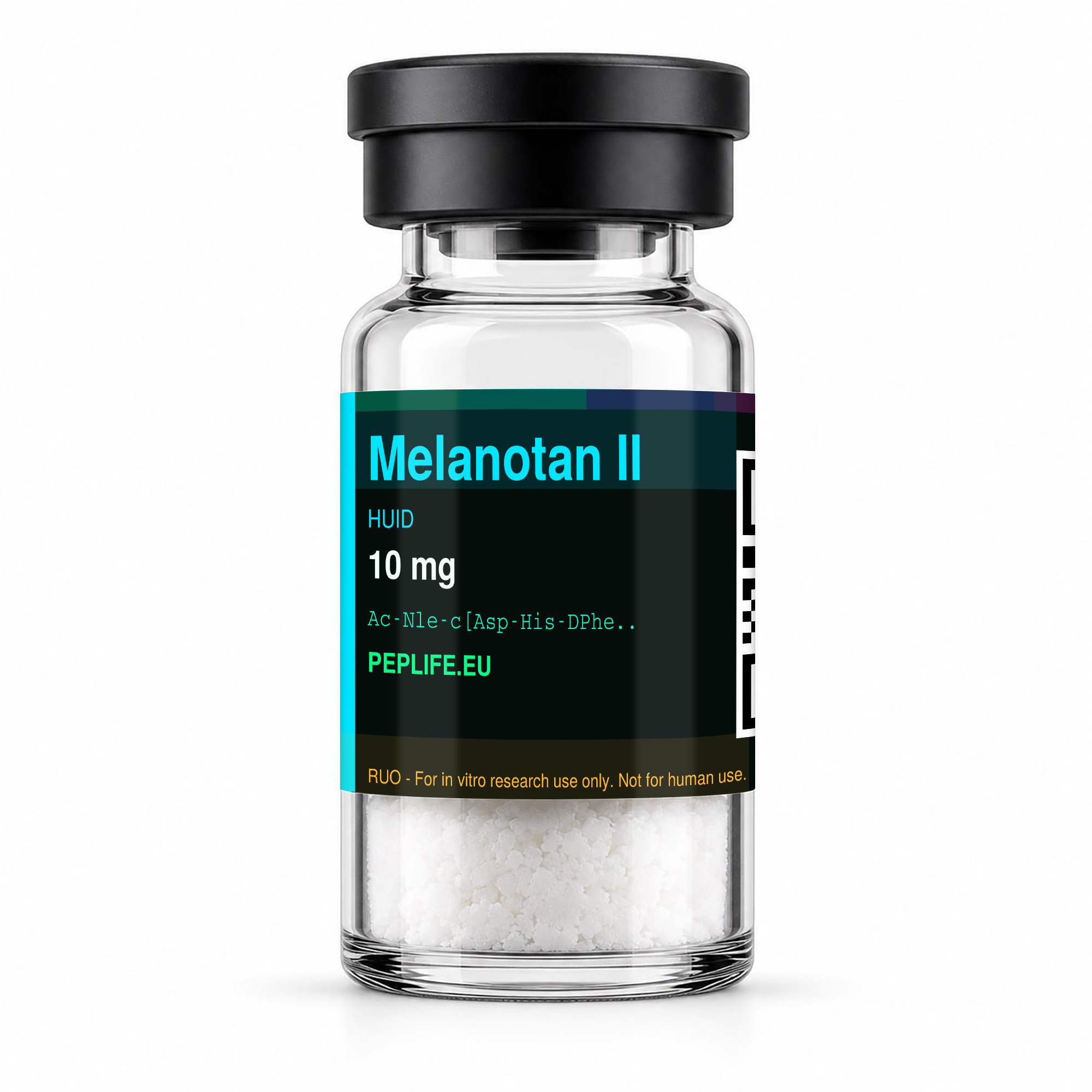
Melanotan 2 research revolves entirely around one central question: how does the melanocortin system drive the production of pigment? Melanotan II (abbreviated MT-II or MT-2) is a synthetic, cyclic analogue of the body's own alpha-melanocyte-stimulating hormone (α-MSH). In preclinical models it is used as a potent, long-acting probe to activate the melanocortin receptors and thereby map the biology of skin pigmentation, appetite and sexual signalling. This article summarises what researchers describe about this peptide — strictly as research material, not as a product for personal use.
What is melanotan 2?
Melanotan II is a small peptide developed in the 1980s at the University of Arizona as a more stable and more potent variant of natural α-MSH. Where the natural hormone is rapidly broken down, MT-II is cyclised, which makes it remain active longer in research models and engage several melanocortin receptors at once. In the scientific literature and databases it is registered as a non-selective melanocortin agonist; the associated PubChem compound page lists it under CID 92432. The peptide is pharmacologically closely related to bremelanotide (PT-141), which was derived by Palatin Technologies as a metabolite of MT-II — a detail that comes back later.
How does melanotan 2 work? — the mechanism
The mechanism of melanotan 2 revolves around the melanocortin receptor family. Research describes MT-II as a non-selective agonist that activates the receptors MC1R, MC3R, MC4R and MC5R. Each receptor tells a different part of the story:
- MC1R: Activation of this receptor on melanocytes (the pigment cells in the skin) triggers, in models, the production of eumelanin — the dark pigment. This is the point of action that researchers link to melanogenesis and pigmentation.
- MC4R (and possibly MC3R): This centrally located receptor in the brain is linked in research to appetite regulation and sexual signalling. The MC4R route explains why MT-II is pharmacologically related to libido-oriented melanocortins.
- MC5R: Is studied in relation to exocrine gland function and sebum, although this area is less crystallised.
Because MT-II hits multiple receptors at once, in the literature it is more of a broadly acting research probe than a precision instrument — one reason why researchers often compare it with more selective analogues.
What is melanotan 2 studied for?
The research interest in MT-II concentrates on a few clear themes, each attributed to the studies in which they occur:
- Melanogenesis & pigmentation: In clinical and preclinical studies, after repeated subcutaneous administration in models, an increase in eumelanin and visible pigment formation was described, often within a handful of doses. This makes MT-II a model compound to study the MC1R-driven pigment route.
- Melanocortin receptor pharmacology: Researchers use MT-II to unravel which receptor is responsible for which effect, by comparing it with more selective agonists and antagonists.
- MC4R and sexual signalling: Because MT-II engages MC4R, it serves in preclinical research as a starting point for the broader melanocortin libido hypothesis — the line that ultimately led to bremelanotide.
- Unexpected directions: An in-vivo study from 2020 reported that topically administered MT-II actually suppressed the progression of melanomas in the model, and a study from 2019 described that MT-II reversed autism-like features in a mouse model of maternal immune activation. Both illustrate that the melanocortin axis is studied more broadly than just pigment.
Melanotan 2 versus melanotan 1 (afamelanotide)
A frequently asked research question is the difference with the predecessor, melanotan 1. Melanotan 1 — now known as the medicine afamelanotide — is a linear α-MSH analogue that leans more selectively towards MC1R and is therefore mainly associated with the pigment route. Afamelanotide went through a formal development trajectory and was approved by the FDA in 2019 for a rare phototoxicity condition (erythropoietic protoporphyria). Melanotan II, by contrast, has never been approved as a medicine: it remained a non-selective, broadly acting compound that engages both MC1R and MC4R. That broader receptor profile is precisely why MT-II is associated in research with both pigmentation and the MC4R libido route, while afamelanotide has a narrower clinical profile. Anyone wanting to study the two side by side can use the melanotan 1 (afamelanotide analogue) include as comparison material.
The MC4R link: from melanotan 2 to bremelanotide (PT-141)
The connection between pigment and libido is one of the most intriguing chapters in melanotan 2 research. When researchers studied the MC4R effects of MT-II, it was noticed that test animals, alongside pigmentation, also displayed sexual-arousal behaviour. Palatin Technologies subsequently isolated a metabolite of MT-II — in which an amide group is replaced by a carboxy group — and developed it into bremelanotide (PT-141), which targets the MC4R route much more specifically. For anyone wanting to explore these central melanocortin and sexual signalling routes further, the pillar PT-141, kisspeptin and oxytocin deeper into this network.
Melanotan 2 in laboratory research: handling & dissolving
MT-II is supplied as a freeze-dried (lyophilised) powder and is reconstituted in research protocols with bacteriostatic or sterile water before it is applied in vitro. Correct reconstitution and cold storage are decisive for the stability of the peptide and the reproducibility of experiments. The background and method are described in the pillar reconstituting peptides. This information is intended solely for the laboratory context, not as a usage instruction.
Quality & purity
Every relevant batch is independently HPLC-tested by an external laboratory; the certificate of analysis (CoA) is publicly verifiable per batch. For a non-selective melanocortin agonist like MT-II, demonstrable purity is essential: contaminants or degradation products can distort receptor experiments. Peplife supplies MT-II as research material within the category skin peptides, with traceable batch documentation.
Frequently asked questions about melanotan 2
What exactly is melanotan 2?
It is a synthetic, cyclic analogue of α-MSH used as a non-selective melanocortin agonist in laboratory research into melanogenesis and receptor signalling. It is offered solely as RUO material.
What is the difference between melanotan 1 and melanotan 2?
Melanotan 1 (afamelanotide) is more selective towards MC1R and was approved as a medicine in 2019 for a rare condition. Melanotan 2 is non-selective, engages MC1R and MC4R among others, and is not approved for human use.
How is melanotan 2 related to PT-141?
PT-141 (bremelanotide) is pharmacologically derived from a metabolite of melanotan 2. Where MT-II acts broadly on the melanocortin receptors, PT-141 targets more specifically the MC4R route that is associated in research with sexual signalling.
Is melanotan 2 approved or safe for use?
No. In scientific sources MT-II is described as unlicensed and largely untested; regulators in the US and the UK, among others, have issued warnings. It is not approved by the EMA, NVWA or FDA and is supplied solely for in-vitro research.
What does research report about pigmentation?
In studies with repeated subcutaneous administration, an increase in eumelanin and visible pigment formation was described in models, usually within a few doses — attributed to MC1R activation on melanocytes.
Which side effects are described in the literature?
Sources such as DermNet mention, among others, facial flushing, nausea, reduced appetite and spontaneous erections in the short term, and in the longer term concerns about darkening moles and pigment changes. These observations come from the literature and underline the research character of the peptide.
Read more & research at Peplife
- Research Melanotan 2 (MT-II) at Peplife
- View all skin peptides
- Melanotan 1 (afamelanotide analogue) as comparison material
- PT-141 (bremelanotide) — the MC4R relative
- SNAP-8 — related skin peptide for research
- PT-141, kisspeptin and oxytocin: melanocortin and sexual signalling
- Melanotan 2 vs PT-141
Sources: Wikipedia — Melanotan II · PubChem CID 92432 — Melanotan-II · DermNet — Melanotan II · PMC — Changes in Oral Mucosa Associated with Melanotan II Injections (case report)
Research Use Only. All products are supplied exclusively for in vitro laboratory research. Not intended for diagnostic or therapeutic use in humans or animals, and not approved by the EMA or FDA.
HPLC-tested by an external laboratory, CoA publicly verifiable per batch and discreet EU shipping.