




| Aliases | Copper tripeptide-1 |
| Class | Copper peptide |
| Molecular weight (Da) | 402.9 |
| Half-life (indicative) | short (min–h) |
| Research status | Cosmetic ingredient |
Research context (RUO): GHK-Cu is a copper-binding tripeptide studied in laboratories for skin rejuvenation, collagen formation and tissue repair. All products are supplied solely for in-vitro laboratory research and are not intended for human or animal use.
❯ Recent research from our research hub
New studies and publications discussing GHK-Cu (discussing research, not usage advice):
All research updates in the Research & News hub · latest bulletin.
GHK-Cu research: what science shows about the copper peptide
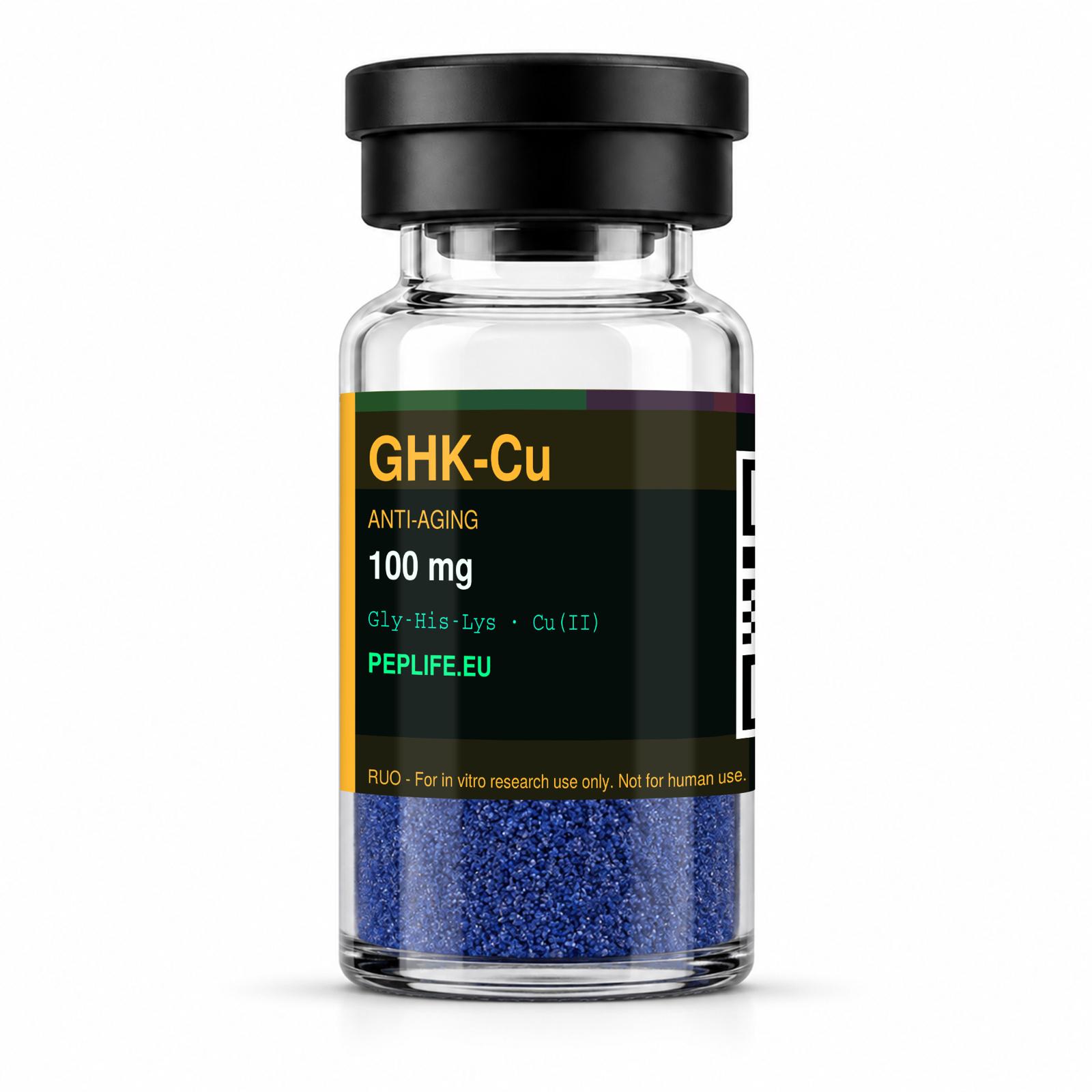
Around GHK-Cu research there now exists one of the richest bodies of literature of all short peptides. The copper peptide GHK-Cu (glycyl-L-histidyl-L-lysine bound to a copper ion) was identified in 1973 by Loren Pickart in human blood plasma, and has since drawn the attention of researchers focusing on skin rejuvenation, wound healing and collagen formation. This pillar summarises what GHK-Cu is actually researched for, which mechanisms emerge in studies, and how the peptide is handled in a laboratory setting.
What is GHK-Cu?
GHK-Cu is a complex of three amino acids — glycine, histidine and lysine — that binds a copper(II) ion with high affinity. That copper binding is no side issue: it is precisely that copper transport to which researchers attribute much of the reported biological activity. In the body the free GHK fragment occurs naturally, but the plasma level declines sharply with age. Pickart and Margolina describe that the concentration is about 200 ng/ml around the age of twenty and around 80 ng/ml by sixty. Researchers have linked that decline to the reduction in repair and regeneration capacity that accompanies ageing — which makes GHK-Cu a popular object of study within the anti-ageing peptides.
How does GHK-Cu work? — the mechanism
In GHK-Cu research three lines of action consistently recur. First, the peptide functions as a copper carrier: it delivers copper to cells, a trace element that is a cofactor of enzymes involved in collagen and elastin formation and in antioxidant defence. Second, there is gene regulation. Pickart and colleagues reported in 2018, based on the Broad Institute Connectivity Map data set, that GHK influences the expression of more than 4000 human genes — according to the authors often in the direction of a "younger", healthier expression pattern, with a favourable shift of genes involved in DNA repair, inflammation suppression and tissue building. Third, there is direct stimulation of the extracellular matrix: in cell-culture studies GHK-Cu was associated with increased production of collagen, elastin and glycosaminoglycans by fibroblasts.
What is GHK-Cu studied for?
GHK-Cu research spreads across several domains. The main research areas at a glance:
- Collagen & skin rejuvenation: Badenhorst and colleagues described in a 2025 review that human adult dermal fibroblasts, incubated with GHK-Cu at concentrations of 0.01, 1 and 100 nM, showed increased collagen and elastin synthesis — one of the reasons the peptide is intensively studied in cosmetic science.
- Wound healing & tissue repair: in in-vitro fibroblast and keratinocyte models and in rodent wound models, scientists studied effects on epithelialisation, collagen remodelling and angiogenesis (the formation of new blood vessels).
- Antioxidation & DNA repair: based on gene-expression data, it is studied whether GHK can modulate genes involved in neutralising free radicals and repairing damaged DNA.
- Hair & hair follicles: researchers are studying whether GHK-Cu enlarges the size of hair follicles and influences signalling routes around follicle growth; various experimental tissue models focus on the interaction with 5-alpha-reductase-related signalling.
- Inflammation modulation: in preclinical models, GHK was associated with a dampening effect on inflammation markers, which is relevant for research into chronic tissue damage.
Important: all these outcomes come from laboratory and animal models. They describe what researchers observed in controlled experiments, not an application in humans.
GHK-Cu versus AHK-Cu in research
In comparative research, GHK-Cu is often placed alongside the related copper peptide AHK-Cu. Where GHK-Cu is broadly studied for skin, matrix and wound healing, the literature around AHK-Cu focuses more strongly on hair-follicle-related parameters. Anyone wanting to place the two side by side finds the details in our pillar Compare GHK-Cu and AHK-Cu. Because the reported effects of GHK partly run via gene regulation and longevity-related routes, the topic also touches on the broader field of longevity peptides.
GHK-Cu in laboratory research: handling & dissolving
GHK-Cu is supplied as a lyophilised (freeze-dried) powder and is usually reconstituted in research protocols with bacteriostatic or sterile water before it is applied in in-vitro assays. The copper binding makes the peptide sensitive to pH and light, so laboratories work with correct storage and protection against degradation. The practical steps — which liquid, which ratio, how to store — are worked out in our pillar reconstitute peptides. This is solely information for laboratory operations, not an instruction for administration.
Quality & purity
Reliable GHK-Cu research stands or falls with the purity of the starting material — and for a copper peptide the correct copper-to-peptide ratio is extra critical. Every relevant batch is independently HPLC-tested by an external laboratory; the certificate of analysis (CoA) is publicly verifiable per batch. This way researchers know which molecule and which concentration they are actually bringing into their assay. More context on how we safeguard quality is in why we rejected a batch.
Frequently asked questions about GHK-Cu research
What exactly is GHK-Cu?
It is a copper-binding tripeptide (glycyl-histidyl-lysine + a copper ion) that occurs naturally in human plasma and is studied in laboratories for collagen formation, wound healing and skin rejuvenation. It is supplied exclusively as an RUO research compound.
What is GHK-Cu studied for?
In studies, GHK-Cu research focuses mainly on stimulation of collagen, elastin and glycosaminoglycans by fibroblasts, on wound healing and angiogenesis in tissue models, on antioxidant and DNA-repair-related gene expression, and on effects around hair follicles.
Is it true that GHK-Cu influences thousands of genes?
Pickart and colleagues reported in 2018, based on gene-expression data, that GHK can modulate the expression of more than 4000 human genes. This is a finding from data sets and cell studies, not a statement about application in humans.
What is the difference between GHK and GHK-Cu?
GHK is the bare tripeptide; GHK-Cu is that same peptide bound to a copper ion. Much of the activity described in research is attributed precisely to that bound copper.
Is GHK-Cu also studied for hair?
Yes. Researchers are studying whether GHK-Cu influences the size of hair follicles and how it acts on signalling routes around follicle growth, partly in comparison with the related peptide AHK-Cu.
Is GHK-Cu suitable for human use?
No. Everything Peplife supplies is Research Use Only: intended solely for in-vitro laboratory research, not for diagnostic or therapeutic use in humans or animals.
Read more & research at Peplife
- Research GHK-Cu at Peplife
- View all anti-aging peptides
- Research AHK-Cu at Peplife
- Research SNAP-8 at Peplife
- Compare GHK-Cu and AHK-Cu
- Longevity peptides in research
- Hair growth peptides: which pathways are being researched
Sources: Pickart & Margolina, GHK Peptide as a Natural Modulator of Multiple Cellular Pathways in Skin Regeneration (2015) · Pickart et al., Regenerative and Protective Actions of the GHK-Cu Peptide in the Light of the New Gene Data (2018) · Badenhorst et al., Tripeptides in Wound Healing and Skin Regeneration, Int. J. Med. Sci. (2025) · PubChem: Copper tripeptide (CID 139035031)
Research Use Only. All products are supplied exclusively for in vitro laboratory research. Not intended for diagnostic or therapeutic use in humans or animals, and not approved by the EMA or FDA.
HPLC-tested by an external laboratory, CoA publicly verifiable per batch, discreet shipping within the EU.