




| Aliases | Mod GRF 1-29, DAC:GRF |
| Class | GHRH analogue |
| Molecular weight (Da) | 3647.3 (with DAC) / 3367.9 (without DAC) |
| Half-life (indicative) | ~6–8 d (with DAC) / ~30 min (without DAC) |
| Research status | Preclinical / RUO |
Research context (RUO): CJC-1295 is a synthetic GHRH analogue studied in laboratories to stimulate the growth hormone and IGF-1 axis. It is supplied exclusively for in-vitro laboratory research and not for human or animal use.
CJC-1295 research: DAC vs no-DAC and the GH axis
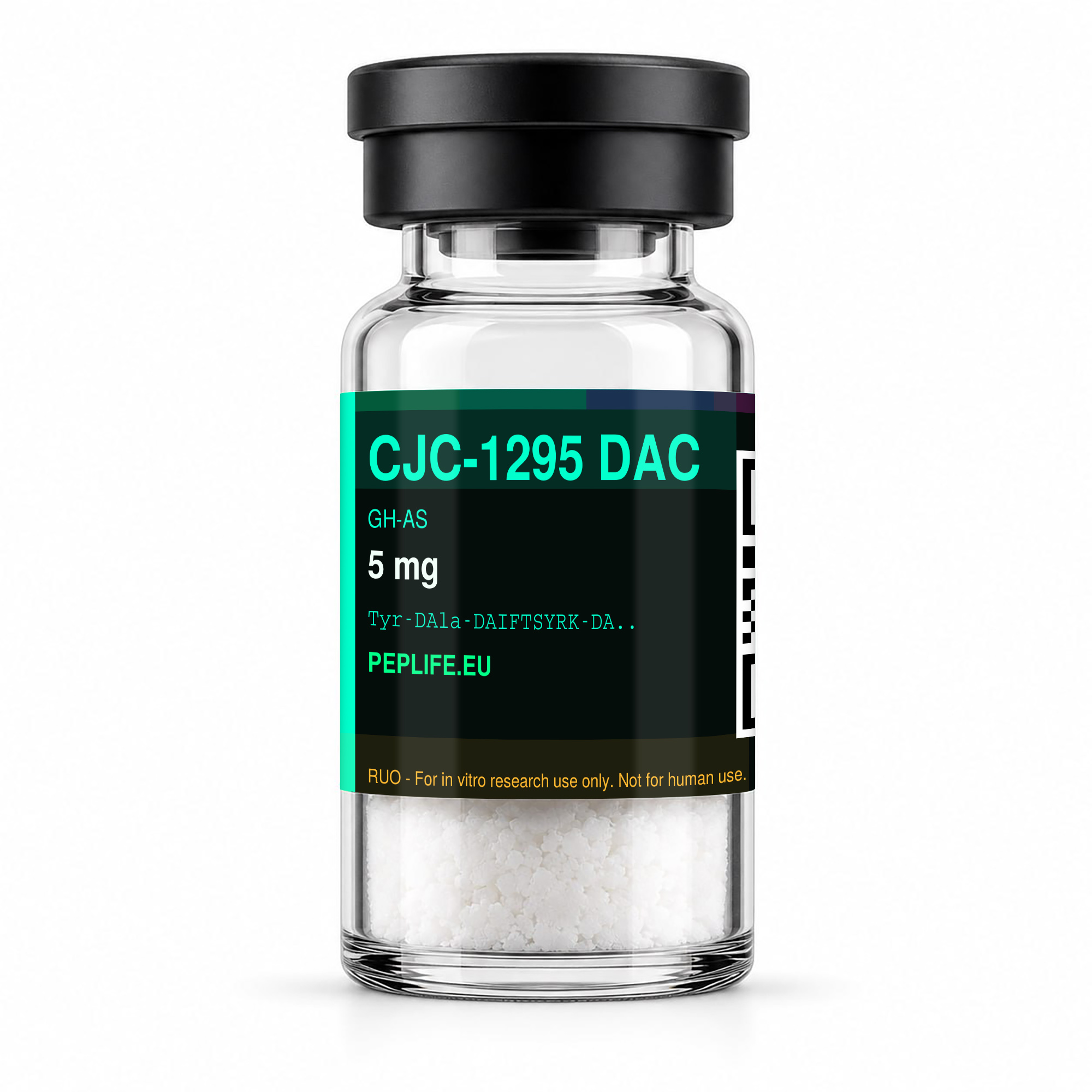
Around CJC-1295 research almost everything revolves around one question: with or without DAC? CJC-1295 is a long-acting analogue of the growth-hormone-releasing hormone (GHRH), designed to activate the natural pulses of growth hormone (GH) longer and more strongly. The biggest variable in that research is the Drug Affinity Complex — a small chemical group that determines whether the peptide stays active for minutes or days. This article explains what CJC-1295 is, how the mechanism works, how the DAC and no-DAC variants differ, and what it is studied for in preclinical studies.
What is CJC-1295?
CJC-1295 is a modified fragment of human GHRH. Endogenous GHRH consists of 44 amino acids, but the biological activity lies mainly in the first 29 — the so-called GRF(1-29). Researchers discovered that this short fragment is broken down extremely quickly by the enzyme dipeptidyl peptidase-4 (DPP-4), so that the natural half-life is only a few minutes. CJC-1295 is therefore modified at four positions to slow that enzymatic breakdown. This modified base is also referred to in the literature as Modified GRF(1-29) and forms the core of both variants circulating on the market. The amino-acid structure is publicly documented in the PubChem database.
How does CJC-1295 work? — the mechanism
CJC-1295 binds to the GHRH receptor on the somatotropic cells in the pituitary gland. That binding prompts the cell to release growth hormone, which then stimulates the production of insulin-like growth factor 1 (IGF-1) in the liver. Unlike a direct GH injection, CJC-1295 therefore works higher up in the chain: it reinforces the endogenous, pulsatile release pattern instead of overriding it. In a study by Ionescu and Frohman (2006), that pulsatile GH release was preserved, even under continuous stimulation by CJC-1295 — an important finding, because the natural rhythm of GH pulses is considered physiologically relevant. This action via the GHRH receptor is the reason CJC-1295 is often combined in research with a ghrelin mimetic that works via a completely different receptor.
CJC-1295 with DAC versus without DAC
This is the central distinction in virtually every CJC-1295 research. The DAC — Drug Affinity Complex — is a maleimidopropionyl group coupled to the peptide. As soon as the peptide enters solution, this group binds covalently to a free cysteine on serum albumin, the most common protein in blood plasma. By “hitching a ride” on albumin, the peptide escapes rapid renal clearance and enzymatic breakdown.
- CJC-1295 DAC: in the study by Teichman et al. (2006), after a single injection an estimated residence time of 5.8 to 8.1 days was measured. GH concentrations remained elevated for 6 days or longer and IGF-1 remained above baseline for up to 28 days with repeated administration. This long half-life makes the DAC variant the study model for research into sustained, stable exposure. For this researchers use CJC-1295 DAC.
- CJC-1295 no-DAC (Modified GRF 1-29): without the albumin binding the half-life is much shorter — on the order of about half an hour. This gives a sharp, short-lived GH peak that more closely mimics the natural pulse pattern, and is the model of choice for research into delimited, pulsatile stimulation. See CJC-1295 no-DAC.
In short: DAC stands for long, flat exposure (“GH bleed”) and no-DAC for short, sharp peaks. Which variant is relevant depends entirely on the research question.
What is CJC-1295 studied for?
Because CJC-1295 activates the GH/IGF-1 axis, the research focuses on the physiological domains in which that axis plays a role:
- Tissue repair and muscle metabolism: IGF-1 is associated in preclinical models with protein synthesis and repair processes; researchers are studying whether sustained GH stimulation affects these routes.
- Body composition and fat metabolism: GH plays a role in lipolysis, which is why CJC-1295 is studied in models for metabolism and fat distribution.
- Bone density and connective tissue: the GH/IGF-1 axis is involved in collagen and bone turnover; this is one of the outcome measures studied.
- Longevity and ageing: because GH and IGF-1 levels decline with age, researchers study the GH axis within the broader framework of ageing.
These effects are always attributed to the study or the animal model — not to the user. More context about this class is in our pillar growth hormone peptides.
Combining CJC-1295 with ipamorelin
The most-studied combination is CJC-1295 with ipamorelin. Both trigger GH release, but via different receptors: CJC-1295 acts on the GHRH receptor, ipamorelin on the ghrelin receptor (GHS-R) as a selective GH secretagogue. In research models these two routes are described as complementary — GHRH signalling and the ghrelin route reinforce each other in activating the somatotropic cell, while ipamorelin is known for its selectivity (little influence on cortisol or prolactin in preclinical research). This synergy is why the two are often studied together in one protocol. For this Peplife offers a ready-made CJC-1295 + ipamorelin blend.
CJC-1295 in laboratory research: handling & dissolving
CJC-1295 is supplied as a freeze-dried (lyophilised) powder and is reconstituted in the lab with bacteriostatic or sterile water before it is used in in-vitro assays. With the DAC variant it is important that albumin binding only occurs after reconstitution, which makes the choice of solvent and storage relevant for stability. Practical background on reconstitution and solvents is in the pillar reconstitute peptides. All operations concern laboratory work only.
Quality & purity
Every relevant batch is independently HPLC-tested by an external laboratory; the certificate of analysis (CoA) is publicly verifiable per batch. For a GHRH analogue like CJC-1295 this is essential: the four structural modifications and the DAC coupling must be correctly present, and purity determines how reliably research results are reproducible. Peplife states purity and peptide content per lot, so that researchers can base their protocol on verified data.
Frequently asked questions about CJC-1295 research
What is the difference between CJC-1295 with DAC and without DAC?
The Drug Affinity Complex (DAC) allows the peptide to bind to serum albumin, which extends the half-life from about half an hour (no-DAC) to several days (DAC, estimated 5.8-8.1 days in Teichman et al. 2006). DAC gives prolonged exposure, no-DAC gives short peaks.
Why is CJC-1295 combined with ipamorelin in research?
They stimulate GH release via two different receptors (GHRH receptor versus ghrelin receptor). In models these routes are described as complementary, which is why the combination is often studied together.
Is CJC-1295 the same as Modified GRF(1-29)?
The no-DAC variant is in practice equal to Modified GRF(1-29): the modified GRF(1-29) fragment without the DAC group. The DAC variant adds the Drug Affinity Complex to it.
How long does CJC-1295 DAC remain active?
In the study by Teichman et al. (2006), GH levels remained elevated for 6 days or longer after a single dose, and IGF-1 up to 28 days with repeated administration. This concerns clinical research data, not a usage instruction.
What is CJC-1295 studied for?
Research focuses on the GH/IGF-1 axis: tissue repair, muscle metabolism, body composition, bone density and ageing — always in a preclinical or clinical research context.
Is CJC-1295 legal to buy?
CJC-1295 is supplied solely for in-vitro laboratory research (Research Use Only) and is not approved for human or animal use.
Read more & research at Peplife
- Research CJC-1295 DAC at Peplife
- Research CJC-1295 no-DAC at Peplife
- CJC-1295 + ipamorelin blend
- Ipamorelin
- View all GH axis peptides
- Knowledge base: growth-hormone peptides
- Knowledge base: reconstituting peptides
- CJC-1295 with DAC vs without DAC
- Sermorelin vs tesamorelin
Sources: Teichman et al. 2006, J Clin Endocrinol Metab · Ionescu & Frohman 2006, pulsatile GH secretion · PubChem: CJC-1295 (CID 91971820) · PubChem: CJC-1295 without DAC (CID 91976842)
Research Use Only. All products are supplied exclusively for in vitro laboratory research. Not intended for diagnostic or therapeutic use in humans or animals, and not approved by the EMA or FDA.
CJC-1295 DAC, HPLC-tested with per-batch CoA and discreet EU shipping.