




| Class | GH secretagogue |
| Molecular weight (Da) | 711.9 |
| Half-life (indicative) | ~2 h |
| Research status | Preclinical / RUO |
Research context (RUO): Ipamorelin is a selective growth hormone secretagogue (a ghrelin receptor agonist) studied in preclinical studies to stimulate the release of growth hormone. This substance is supplied solely for in-vitro laboratory research and is not intended for human or animal use.
Ipamorelin research: the selective GH secretagogue explained
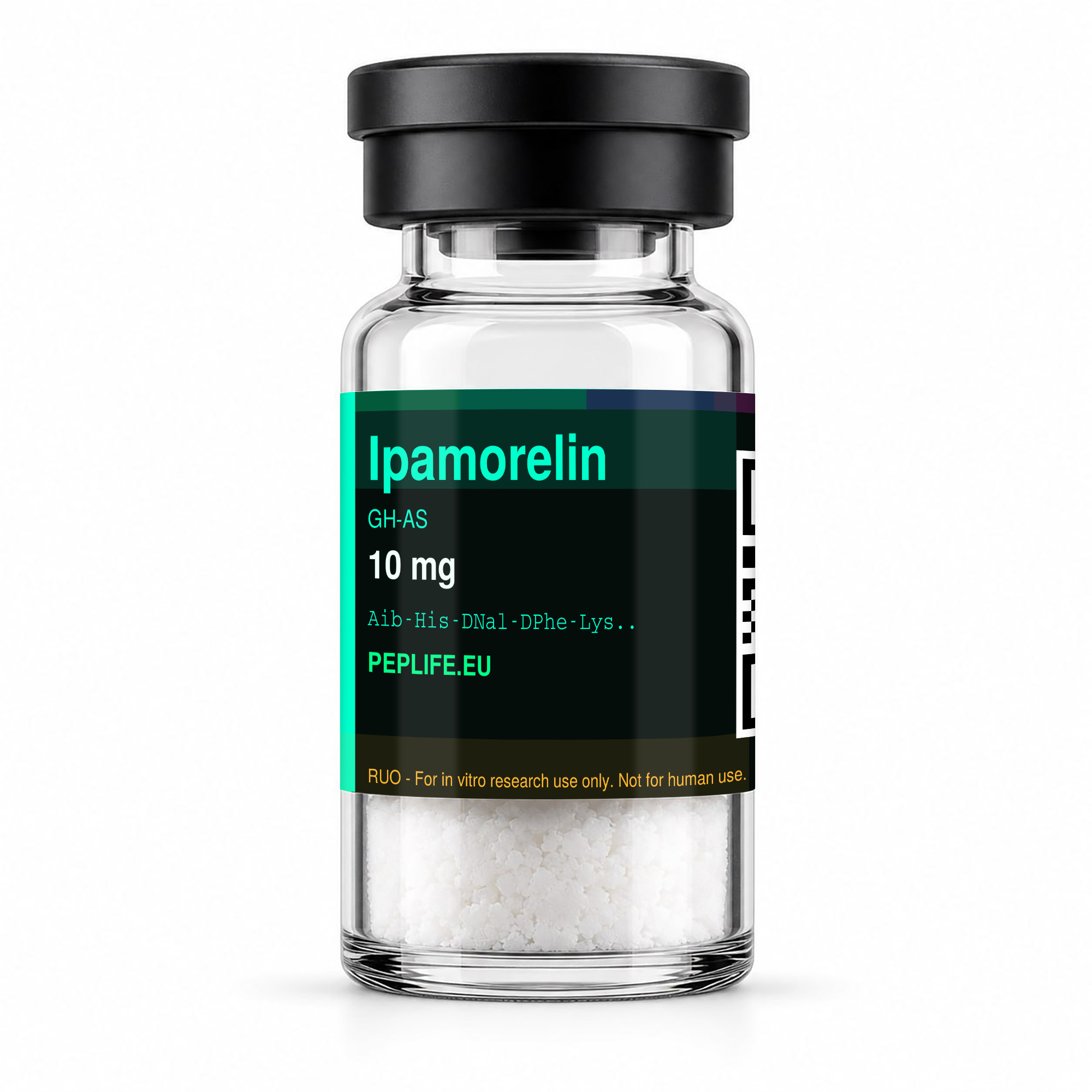
Ipamorelin research has focused for more than two decades on one striking property: this pentapeptide prompts the pituitary to release growth hormone (GH) without at the same time strongly raising the stress hormones cortisol and ACTH or the hormone prolactin. That selectivity made ipamorelin, at its introduction, a special object of study within the family of growth hormone secretagogues. In this knowledge-base article, researchers look at what ipamorelin is, how the mechanism works and what the substance is studied for in preclinical models.
What is ipamorelin?
Ipamorelin is a synthetic pentapeptide — a chain of five amino acids (Aib-His-D-2-Nal-D-Phe-Lys-NH2) — that belongs to the class of growth-hormone-releasing peptides (GHRPs). In the chemical databases the substance is registered under PubChem CID 9831659, with the molecular formula C38H49N9O5. Functionally, ipamorelin is classified as a ghrelin receptor agonist: it binds to the same receptor (the GHS-R1a, the growth-hormone-secretagogue receptor) on which the body's own hormone ghrelin also acts. This makes ipamorelin a so-called ghrelin mimetic: it mimics part of the action of ghrelin.
The substance was developed in the late 1990s by a research group around Raun and colleagues, and in a 1998 study in European Journal of Endocrinology described as “the first selective growth hormone secretagogue”. That qualification — selective — is the thread running through virtually all later ipamorelin research.
How does ipamorelin work? — the mechanism
Growth hormone is controlled in the body in two ways. The classic route runs via GHRH (growth-hormone-releasing hormone). The second route runs via ghrelin, which acts on the GHS-R1a receptor in the pituitary and the hypothalamus. Ipamorelin follows that second route: by binding to the ghrelin receptor it prompts the somatotropic cells of the pituitary to a pulsatile release of growth hormone.
The interesting thing about the mechanism is what not happens. In the study by Raun and colleagues (1998), the researchers reported that ipamorelin gave a GH release comparable in potency to the well-known GHRP-6, but with a selectivity resembling that of GHRH itself. Unlike GHRP-6 and GHRP-2, ipamorelin did not raise plasma levels of ACTH and cortisol significantly more than GHRH — not even at doses exceeding the effective GH dose more than 200-fold. The researchers additionally reported that none of the secretagogues tested affected the levels of FSH, LH, prolactin or TSH. This selective profile — GH up, stress hormones relatively untouched — is exactly why ipamorelin received so much attention within the growth hormone peptides.
What is ipamorelin studied for?
Because ipamorelin stimulates the GH axis, the substance is studied in preclinical studies from various angles. Important: all these research areas concern laboratory and animal models, not recommended applications.
- Growth-hormone physiology: ipamorelin serves as a model compound to study how the ghrelin receptor regulates the pulsatile GH release, independently of the GHRH route.
- Gastrointestinal motility: in a rat model of postoperative ileus (bowel paralysis after an operation), Venkova and colleagues (2009, Journal of Pharmacology and Experimental Therapeutics) whether ipamorelin could restore bowel function. Repeated administration in that model significantly increased faecal output, food intake and weight gain; the researchers concluded that ghrelin mimetics show potential in postoperative bowel dysfunction.
- Body composition and recovery: as a GH secretagogue, ipamorelin is studied in the broader context of muscle protein synthesis, bone metabolism and tissue repair — areas in which growth hormone and the downstream factor IGF-1 play a role.
- Selectivity as a research tool: precisely because ipamorelin leaves the stress axis relatively untouched, researchers use the compound to isolate GH effects from cortisol-mediated effects.
Ipamorelin in laboratory research: handling & reconstitution
Ipamorelin is supplied as freeze-dried (lyophilised) powder in a vial. For in-vitro research, the powder is reconstituted — dissolved — with a suitable liquid such as bacteriostatic or sterile water, after which the solution is stored refrigerated. The precise procedure, the choice of solvent and the handling of concentrations belong to the research protocol and not to any human application. Researchers wishing to read up on the reconstitution technique will find more background in our pillar reconstitute peptides. For the broader context of how ipamorelin relates to related compounds, the overview pillar growth hormone peptides a logical starting point.
In research setups, ipamorelin is often compared or combined with a GHRH analogue. A much-studied combination is the one with CJC-1295, in which the GHRH route (CJC-1295) and the ghrelin route (ipamorelin) are stimulated at the same time. For this Peplife offers both CJC-1295 DAC as the ready-made CJC-1295 + Ipamorelin blend on.
Quality & purity
Every relevant batch of ipamorelin is independently HPLC-tested by an external laboratory; the certificate of analysis (CoA) is publicly verifiable per batch. For reproducible in-vitro research this verifiable purity is essential: only with a known purity percentage and a documented identity are results comparable between laboratories. Peplife publishes the CoA data so that researchers can check the identity and purity of their research material before a protocol starts.
Frequently asked questions about ipamorelin research
What is the difference between ipamorelin and other GHRPs such as GHRP-6?
In the ipamorelin research by Raun and colleagues (1998), ipamorelin gave a GH release comparable in potency to GHRP-6, but without the significant rise in ACTH and cortisol seen with GHRP-6 and GHRP-2. That selectivity is the most important distinction described in the literature.
Why is ipamorelin called “selective”?
Because in preclinical studies it stimulated the release of growth hormone without substantially changing the levels of cortisol, ACTH, prolactin, FSH, LH or TSH. This narrowly GH-focused action is the reason the substance was called “the first selective growth hormone secretagogue”.
Which receptor does ipamorelin act on?
Ipamorelin is an agonist of the growth-hormone-secretagogue receptor (GHS-R1a), the same receptor on which the body's own hormone ghrelin acts. It is therefore classified as a ghrelin receptor agonist or ghrelin mimetic.
Why is ipamorelin combined with CJC-1295 in research?
CJC-1295 is a GHRH analogue and works via a different route than ipamorelin. In research setups both routes are sometimes stimulated at the same time to study the GH axis from two mechanisms. This concerns laboratory research only.
Is ipamorelin approved for human use?
No. Ipamorelin is supplied solely for in-vitro laboratory research and is not approved as a medicine by the EMA, NVWA or FDA.
Where can you buy ipamorelin for research?
Peplife offers HPLC-tested ipamorelin with a verifiable certificate of analysis per batch, solely for research purposes. View the ipamorelin product page for the current batch data.
Read more & research at Peplife
- Research Ipamorelin at Peplife
- View all GH axis peptides
- CJC-1295 DAC for research
- CJC-1295 + Ipamorelin blend
- Overview: growth-hormone peptides
- Reconstituting peptides — step by step
Sources: Raun et al. (1998), Eur J Endocrinol — Ipamorelin, the first selective growth hormone secretagogue (PMID 9849822) · Venkova et al. (2009), J Pharmacol Exp Ther — Ipamorelin in postoperative ileus (PMID 19289567) · PubChem CID 9831659 — Ipamorelin
Research Use Only. All products are supplied exclusively for in vitro laboratory research. Not intended for diagnostic or therapeutic use in humans or animals, and not approved by the EMA or FDA.
HPLC-tested ipamorelin with a publicly verifiable CoA per batch and discreet EU shipping.