




| Aliases | R8-PTD + Dvl-binding motif |
| Class | Wnt modulator (hair-growth research) |
| Molecular weight (Da) | ~3082.7 (calculated) |
| Half-life (indicative) | not published |
| Research status | Preclinical / RUO |
Research context (RUO): PTD-DBM is a synthetic cell-penetrating peptide that is studied in laboratory biology as a disruptor of the CXXC5–Dishevelled interaction within the Wnt/β-catenin pathway. It is supplied exclusively for in-vitro laboratory research and is not intended for human or animal use.
PTD-DBM research: how a competing peptide activates the Wnt pathway
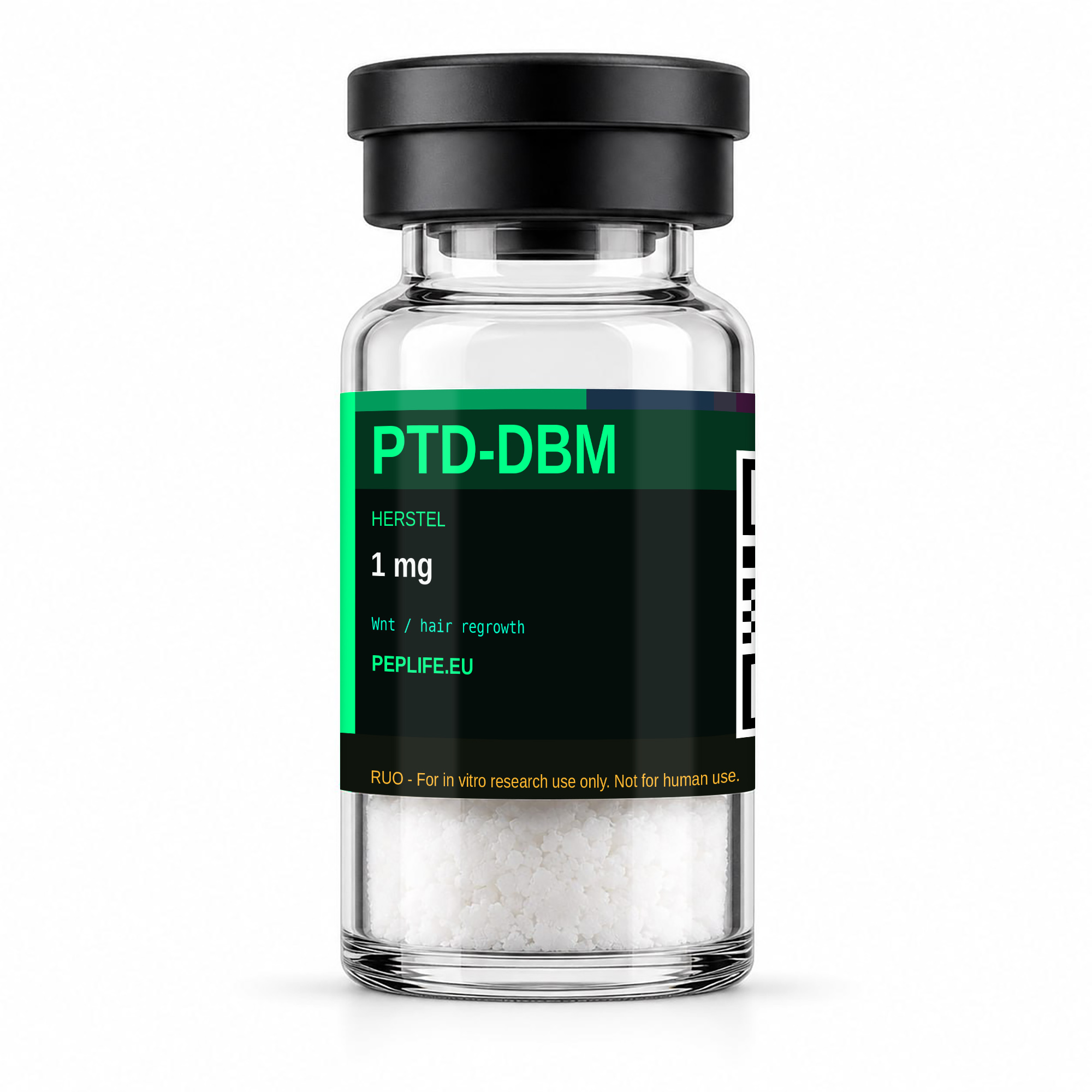
PTD-DBM research revolves around a striking idea: instead of adding a growth factor, researchers actually remove a brake way. PTD-DBM (in full a “protein transduction domain – Dishevelled binding motif” peptide) is designed to pry a protein called CXXC5 loose from its binding partner Dishevelled. As a result, the Wnt/β-catenin pathway — a central switch for tissue regeneration — gets going again. In preclinical animal models, this peptide was mainly studied for hair growth and wound healing. Below we explain what the peptide exactly is, how it works and what it is studied for in studies.
What is PTD-DBM?
PTD-DBM is a short, artificially assembled amino acid chain that consists of two functional parts. The first part, the protein transduction domain (PTD), is a “transport sequence” that lets the peptide penetrate into laboratory cells — something ordinary peptides often cannot do. The second part, the Dishevelled binding motif (DBM), is a replicated piece of the CXXC5 protein: precisely the fragment with which CXXC5 normally binds to Dishevelled. By bringing that decoy into the cell, PTD-DBM competes with the real CXXC5 for the same spot. In scientific publications, PTD-DBM is therefore described as a competing or competitive peptide. It was developed and characterised by the research group of Kang-Yell Choi (Yonsei University, South Korea), who published a series of studies on CXXC5 and the Wnt pathway.
How does PTD-DBM work? — the mechanism
To understand the mechanism, it helps to see the Wnt/β-catenin pathway as a light switch. When Wnt signals are active, the protein β-catenin accumulates and switches on genes involved in cell division, tissue build-up and hair follicle formation. The protein Dishevelled (abbreviated Dvl) is a key relay that passes on this signal. In this story, CXXC5 acts as a negative feedback: it binds to Dishevelled and thereby partly switches off the switch — a built-in emergency brake that prevents the pathway from running on endlessly.
PTD-DBM intervenes at exactly that contact point. Because the peptide mimics the binding site of CXXC5, it displaces CXXC5 from Dishevelled. Dishevelled is thereby freed to pass on the Wnt signal again, β-catenin accumulates and the regenerative genes are activated. In short: PTD-DBM releases the brake instead of pressing the accelerator. In studies, this effect is often combined with valproic acid (VPA), a substance that reinforces the pathway via a different target (inhibition of GSK-3β), to study an additive effect in models.
What is PTD-DBM studied for?
PTD-DBM research focuses on tissues where the Wnt pathway plays a major role in repair and renewal. The main research areas:
- Hair growth & hair follicle formation: In a 2017 study in The Journal of Investigative Dermatology Lee et al. reported that disrupting the CXXC5–Dishevelled interaction with a competing peptide activated the Wnt/β-catenin pathway and, in mouse models, accelerated both hair growth and wound-induced neogenesis of hair follicles.
- Wound healing: In a 2015 study in The Journal of Experimental Medicine researchers described CXXC5 as a negative feedback regulator of Wnt/β-catenin in cutaneous wound healing. Combined treatment of skin wounds with PTD-DBM and valproic acid accelerated re-epithelialisation and collagen production in mouse models.
- Diabetic wound healing & angiogenesis: Follow-up research (2023, Experimental & Molecular Medicine) studied the inhibition of the cytosolic function of CXXC5 and associated this with improved angiogenesis (blood vessel formation) and skin repair in models of poorly healing diabetic wounds.
- Androgenetic alopecia (mechanistic): Researchers study how CXXC5 is connected to DHT-driven signalling in hair follicles, as a framework to place Wnt-activating strategies such as PTD-DBM.
All these findings come from cell culture and animal models. They describe what the peptide does in a research setting did and say nothing about application in humans.
PTD-DBM in laboratory research: handling & dissolving
PTD-DBM is supplied as freeze-dried (lyophilised) powder that is reconstituted in a suitable liquid before in-vitro use. As a cell-penetrating peptide, a correct method of dissolving and storage is important for stability within a research protocol. Background on reconstitution liquids and method is in our pillar reconstitute peptides and in which liquid you choose to dissolve a peptide. This information is intended exclusively for handling research material in a laboratory.
Quality & purity
Every relevant batch of PTD-DBM is independently HPLC-tested by an external laboratory; the certificate of analysis (CoA) is publicly verifiable per batch. For reproducible research, the purity and identity of a peptide is crucial — an impure batch makes results unreliable. Peplife therefore documents why transparency weighs so heavily here, among other things in why we rejected a batch.
Frequently asked questions about PTD-DBM research
What does the abbreviation PTD-DBM stand for?
PTD stands for “protein transduction domain” (the sequence that brings the peptide into cells) and DBM for “Dishevelled binding motif” (the piece that mimics the CXXC5 binding site). Together they form a peptide that can penetrate into cells and there competes with CXXC5.
What is CXXC5 and why is it interesting?
CXXC5 is a protein that in research acts as a negative feedback brake on the Wnt/β-catenin pathway by binding to Dishevelled. Because that pathway is involved in tissue regeneration, researchers study whether temporarily switching off this brake — for example with PTD-DBM — can accelerate regenerative processes in models.
Why is PTD-DBM often mentioned together with valproic acid?
Valproic acid (VPA) activates the Wnt pathway via a different target (inhibition of the enzyme GSK-3β). In the published animal models, researchers combined both substances to see whether they reinforced each other's effect on the Wnt pathway. These are preclinical experiments, not a use recommendation.
Is PTD-DBM the same as GHK-Cu or BPC-157?
No. GHK-Cu is a copper-binding peptide that is mainly studied in skin and anti-aging research, and BPC-157 is studied for tissue repair via other pathways. PTD-DBM is unique in that it specifically targets the CXXC5–Dishevelled interaction in the Wnt pathway. See also our comparison Compare GHK-Cu and AHK-Cu.
Can I use PTD-DBM on my hair?
No. PTD-DBM is supplied exclusively for in-vitro laboratory research. All the results described come from cell culture and animal models; there is no approved application in humans. The peptide is not intended for diagnostic or therapeutic use.
Where can I read more about PTD-DBM research?
The original publications can be found via PubMed (see the sources at the bottom). These peer-reviewed articles describe the models used, outcomes and years in detail.
Read more & research at Peplife
- Research PTD-DBM at Peplife
- View all recovery peptides
- Research GHK-Cu at Peplife
- Research BPC-157 at Peplife
- Compare GHK-Cu and AHK-Cu
- BPC-157 research
- Hair growth peptides: which pathways are being researched
Sources: Lee et al., J Invest Dermatol 2017 — Targeting of CXXC5 by a Competing Peptide · Lee et al., J Exp Med 2015 — CXXC5 negatively regulates cutaneous wound healing · Exp Mol Med 2023 — Inhibiting cytosolic CXXC5 accelerates diabetic wound healing · PTD-DBM — overview
Research Use Only. All products are supplied exclusively for in vitro laboratory research. Not intended for diagnostic or therapeutic use in humans or animals, and not approved by the EMA or FDA.
HPLC-tested by an external laboratory, CoA publicly verifiable per batch and discreet shipping within the EU.