




| Aliases | Bremelanotide, Vyleesi |
| Class | Melanocortin MC3/4R |
| Molecular weight (Da) | 1025.2 |
| Half-life (indicative) | ~2.7 h |
| Research status | Approved drug |
Research context (RUO): PT-141 (bremelanotide) is a synthetic cyclic peptide that is studied as a melanocortin receptor agonist in relation to sexual arousal. It is supplied exclusively for in-vitro laboratory research and is not intended for human or animal use.
PT-141 research: melanocortin, MC4R and libido
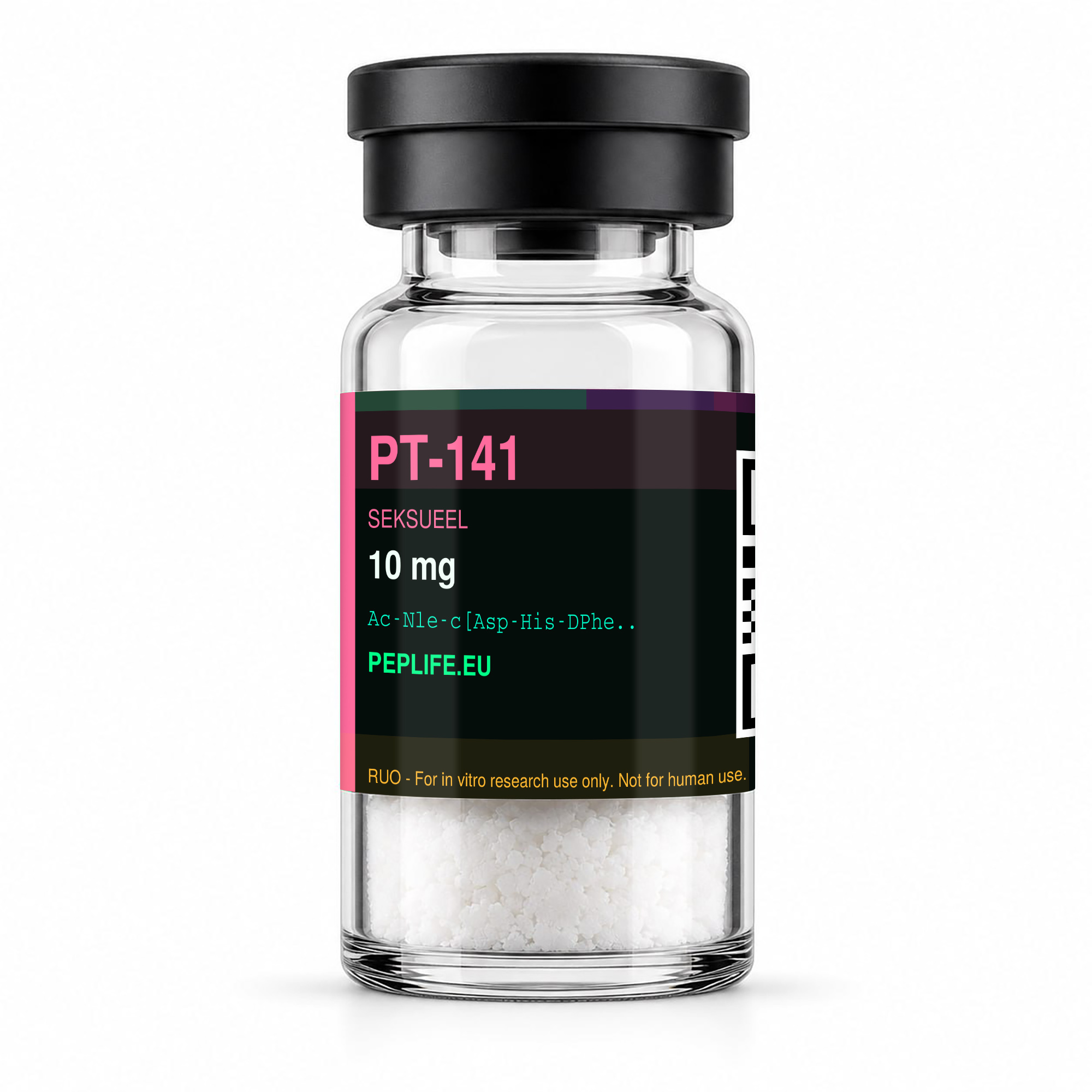
PT-141 research focuses on one of the most unusual peptides in the melanocortin family: a molecule that acts not via the blood vessels but via the central nervous system. Where most early studies of sexual arousal concentrated on blood flow, bremelanotide opened a completely different track — namely the question of how the brain itself drives sexual desire. That makes PT-141 a popular topic for researchers who want to map the neurobiology of libido and motivation.
What is PT-141 (bremelanotide)?
PT-141, also known as bremelanotide, is a small cyclic peptide (molecular formula C50H68N14O10, PubChem CID 9941379). It is chemically closely related to Melanotan 2: bremelanotide is in fact an active metabolite of Melanotan 2 in which the C-terminal amide group is replaced by a hydroxyl group. This small structural change has a major consequence — the pigmentation effects characteristic of Melanotan 2 largely disappear, while the action on the arousal-related melanocortin pathways is retained. In 2019, bremelanotide was approved under the brand name Vyleesi in the United States by the FDA for hypoactive sexual desire disorder (HSDD) in premenopausal women, which makes it one of the few melanocortin peptides with a formal clinical dossier.
How does PT-141 work? — the mechanism
The mechanism behind PT-141 revolves around the melanocortin receptors. Bremelanotide is a non-selective agonist that acts on several melanocortin receptor subtypes (MC1R through MC5R, with the exception of MC2R), with the strongest activity at the MC3 and MC4 receptor. The MC4 receptor (MC4R) is central to the research: this receptor subtype is strongly expressed in the hypothalamus and other brain regions involved in motivation, appetite and sexual behaviour. Researchers therefore describe the working principle as “central” — the peptide is studied for its ability to modulate brain circuits, in contrast to vasodilating substances that act peripherally on the blood vessels.
In a 2022 fMRI study, published in Journal of Clinical Investigation by Thurston et al., researchers reported that MC4R agonism in women with HSDD was associated with altered brain activity when viewing erotic stimuli. Specifically, they observed among other things that a decrease in connectivity between the amygdala and the insula was prevented, and that more participants reported increased sexual desire within 24 hours compared with placebo. The researchers interpreted this as a reduction in self-monitoring and an increased responsiveness to sexual cues.
What is PT-141 studied for?
PT-141 research focuses almost entirely on the neurobiology of sexual arousal and related melanocortin signalling. The following research directions recur in the literature:
- Sexual arousal in women: in a 2006 study (Diamond et al.), researchers reported an effect of bremelanotide on the subjective sexual response in premenopausal women with a sexual arousal disorder.
- Central versus peripheral action: studies investigate how a melanocortin agonist can influence arousal via the central nervous system rather than via vascular function, a model that differs from the classic PDE5 approach.
- MC4R signalling: researchers use bremelanotide as a pharmacological tool to unravel the role of the MC4 receptor in motivation and reward circuits.
- Neuroendocrine effects: in the 2022 fMRI study, slight increases in luteinising hormone, FSH and testosterone were observed, although the researchers considered these insufficient to explain the behavioural effects.
PT-141 in laboratory research: handling & dissolving
Like most research peptides, PT-141 is supplied as lyophilised (freeze-dried) powder that must be reconstituted before in-vitro use. In laboratory protocols, bacteriostatic or sterile water is usually used as the solvent, after which the peptide is stored refrigerated and dark to limit degradation. More background on reconstitution liquids and shelf life is in the knowledge base pillar dissolving peptides: which liquid and reconstitute peptides. This information is intended exclusively for laboratory operations, not for administration.
Quality & purity
Every relevant batch of PT-141 is independently HPLC-tested by an external laboratory; the certificate of analysis (CoA) is publicly verifiable per batch. For melanocortin peptides this is extra relevant, because the purity and the exact peptide identity are directly decisive for the reproducibility of in-vitro receptor research. Independent HPLC and mass spectrometry verification lets researchers check whether the delivered material is actually bremelanotide and free of relevant impurities.
Frequently asked questions about PT-141 research
What is the difference between PT-141 and Melanotan 2?
Bremelanotide is an active metabolite of Melanotan 2 without the C-terminal amide group. In research, Melanotan 2 is mainly associated with pigmentation via the MC1 receptor, whereas PT-141 is primarily studied in relation to arousal-related MC3/MC4 pathways. More comparison in the pillar Melanotan 2 research.
Which receptor does PT-141 act on?
PT-141 is a non-selective melanocortin agonist with the strongest activity at the MC3 and MC4 receptor. The MC4 receptor is central to research into sexual arousal.
Is PT-141 approved as a drug?
Bremelanotide was approved in the US by the FDA in 2019 as Vyleesi for HSDD in premenopausal women. However, the material supplied at Peplife is RUO only and not approved by the EMA or NVWA for human use.
Does PT-141 work differently from a PDE5 inhibitor?
In the scientific literature, bremelanotide is described as acting centrally via the nervous system, whereas PDE5 inhibitors act peripherally on the blood vessels. This distinction is precisely what makes PT-141 interesting as a research model.
How is PT-141 stored in the lab?
Lyophilised powder is stored cool and dark; after reconstitution with sterile or bacteriostatic water, it is kept refrigerated to limit degradation.
Why is PT-141 studied together with kisspeptin and oxytocin?
These peptides each intervene at a different level in the neuroendocrine regulation of sexual behaviour, which together makes them an interesting field of research. See the pillar PT-141, kisspeptin and oxytocin.
Read more & research at Peplife
- PT-141 (bremelanotide) research at Peplife
- View all sexual-research peptides
- PT-141, kisspeptin and oxytocin: the arousal triad
- Melanotan 2 research: pigmentation and melanocortin
- Research Melanotan 2 at Peplife
- Research Kisspeptin-10 at Peplife
- Research Oxytocin at Peplife
- Melanotan 2 vs PT-141
Sources: PubChem CID 9941379 — Bremelanotide · Thurston et al., J Clin Invest 2022 — MC4R agonism and sexual brain processing · Diamond et al., 2006 — subjective sexual response (PMID 16839319) · Bremelanotide: First Approval, Drugs 2019 (PMID 31429064)
Research Use Only. All products are supplied exclusively for in vitro laboratory research. Not intended for diagnostic or therapeutic use in humans or animals, and not approved by the EMA or FDA.
Peplife's PT-141 is HPLC-tested with a verifiable CoA per batch and is shipped discreetly within the EU.