




| Aliases | α-MSH 11-13 |
| Class | Anti-inflammatory tripeptide |
| Molecular weight (Da) | 342.4 |
| Half-life (indicative) | short (min–h) † |
| Research status | Preclinical / RUO |
Research context (RUO): KPV is a small tripeptide (Lys-Pro-Val), derived from the tail end of the hormone α-MSH, that researchers study for its anti-inflammatory properties. It is supplied exclusively for in-vitro laboratory research.
KPV research: the anti-inflammatory α-MSH fragment
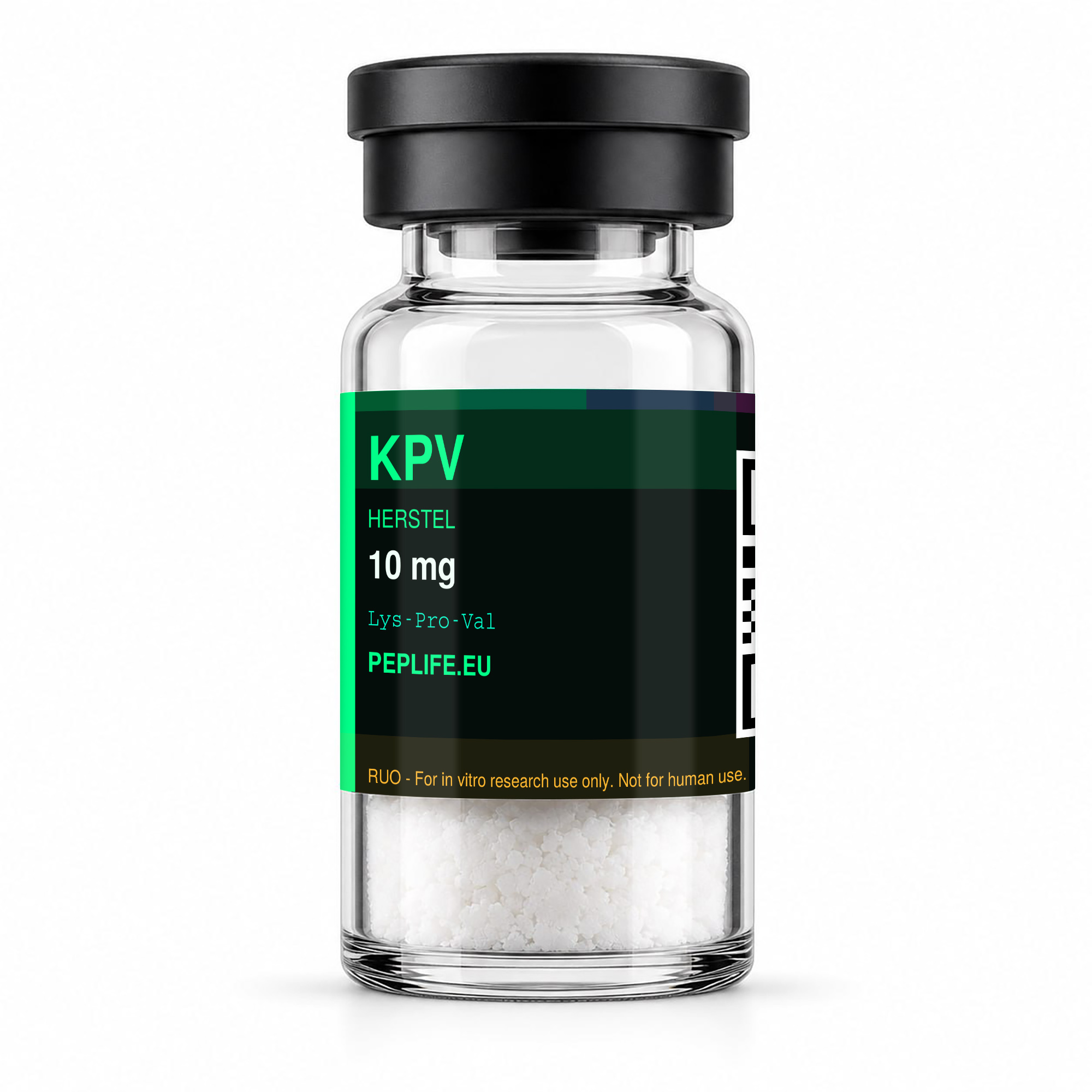
KPV research focuses on a strikingly simple molecule with a surprisingly broad profile of action: a tripeptide of just three amino acids that keeps turning up in laboratory studies as an inhibitor of inflammation signals. Where many peptides are large and complex, KPV is minimal — and precisely that simplicity makes it interesting for researchers who want to understand how the body keeps inflammation in check. This pillar sets out what KPV is, how it works according to studies and in which models it has been studied so far.
What is KPV?
KPV stands for the amino acid sequence lysine–proline–valine (Lys-Pro-Val), hence the abbreviation with the one-letter codes K-P-V. It is the tail piece of α-MSH (alpha-melanocyte-stimulating hormone), an endogenous signalling substance involved in, among other things, pigmentation and the dampening of inflammation. Specifically, KPV corresponds to residues 11 to 13 of α-MSH; in the PubChem database it is therefore registered under the name “Msh(11-13)”. Researchers isolated this fragment because it turned out that a large part of the anti-inflammatory action of the full α-MSH molecule is concentrated in these last three amino acids. This gives a minimal peptide that retains a large part of the effect without the melanocortin-receptor-bound side effects of the full hormone.
How does KPV work? — the mechanism
The most-studied mechanism revolves around the transporter PepT1. Normally PepT1 transports small peptides from food into the intestinal cell. In a study in Gastroenterology (2008), researchers showed that KPV is taken up via that same PepT1 route by human intestinal epithelial cells (Caco2-BBE and HT29-Cl.19A) and by immune cells (Jurkat T cells). Once inside, KPV inhibited — even at nanomolar concentrations — the activation of two central inflammation pathways: the NF-κB pathway and the MAP kinase pathway. The result in that cell model was a reduced release of pro-inflammatory cytokines (signalling substances that drive inflammation).
Unlike the full α-MSH, KPV appears to do this partly without depending on the classical melanocortin receptors, which suggests that the fragment follows its own, intracellular route to inflammation damping. That makes it an attractive model molecule for researchers to study inflammation signalling.
What is KPV studied for?
KPV research concentrates on a number of recurring themes. In every case it concerns preclinical studies — cell culture and animal models — and the effects are attributed to those studies, not to use by humans.
- Intestinal inflammation (IBD models): In mouse models of inflammatory bowel disease (DSS- and TNBS-induced colitis), administration of KPV was associated with less severe inflammatory symptoms. A study in Inflammatory Bowel Disease (2008) explicitly described this as “anti-inflammatory potential” in murine IBD models.
- Inflammatory signalling at the cellular level: Researchers use KPV to study how NF-κB and MAP kinase pathways in intestinal and immune cells are inhibited.
- Wound healing and skin/mucosa models: A review article on tripeptides in wound healing (2025) describes that KPV in hydrogel form was associated in animal models with fewer inflammatory cytokines (IL-1β, TNF-α) and more of the anti-inflammatory IL-10, plus repair of damaged mucosal tissue.
- Antimicrobial properties: In the same review, KPV in wound models was also studied for activity against bacteria such as MRSA, which points to a combined anti-inflammatory-antibacterial profile.
KPV in laboratory research: handling & dissolving
KPV is supplied as a freeze-dried (lyophilised) powder in a vial and must be reconstituted in the lab before use. The tripeptide is readily soluble in bacteriostatic or sterile water. Because a correct dissolving protocol determines the stability and reproducibility of experiments, we refer to the separate pillar reconstituting peptides and to the overview which liquid do you use to dissolve peptides. Reconstituted material is usually stored refrigerated and protected from light.
Quality & purity
Every relevant batch is independently HPLC-tested by an external laboratory; the certificate of analysis (CoA) is publicly verifiable per batch. For a small tripeptide like KPV, purity is extra important: by-products or incomplete sequences can cloud research results. How Peplife deals with batch control — including rejecting batches that do not meet the standard — is described in the pillar why we rejected a batch.
Frequently asked questions about KPV
What does the abbreviation KPV stand for?
KPV refers to the three amino acids that make up the peptide: lysine (K), proline (P) and valine (V). It is the C-terminal fragment (residues 11–13) of the hormone α-MSH.
Is KPV the same as α-MSH?
No. KPV is a small fragment of α-MSH. Researchers isolated this piece because much of the anti-inflammatory action of the full hormone turns out to be in these three amino acids, without the full receptor activity of α-MSH.
What is KPV studied for in research?
Primarily for anti-inflammatory action. In cell culture and mouse models it has been studied for intestinal inflammation (IBD models), for inhibition of NF-κB signalling and for wound healing and antibacterial effects in skin and mucosal models.
How is KPV taken up by cells in studies?
Via the peptide transporter PepT1. Studies show that both intestinal epithelial cells and certain immune cells take KPV up via this route, after which it inhibits inflammation pathways intracellularly.
How does KPV differ from BPC-157 or TB-500?
They are different research molecules with different profiles. KPV is mainly studied as an anti-inflammatory via α-MSH signalling, while BPC-157 and TB-500 are more often studied in tissue-repair and angiogenesis models. They are sometimes studied side by side within repair-focused protocols.
May KPV be used in humans or animals?
No. KPV is supplied exclusively for in-vitro laboratory research (Research Use Only) and is not intended or approved for diagnostic or therapeutic use in humans or animals.
Read more & research at Peplife
- Research KPV at Peplife
- View all recovery peptides
- Research BPC-157 at Peplife
- Research LL-37 at Peplife
- BPC-157 research: the repair peptide under the microscope
- TB-500 research: thymosin beta-4 and tissue repair
Sources: Dalmasso et al., Gastroenterology 2008 — PepT1-mediated tripeptide KPV uptake reduces intestinal inflammation · Kannengiesser et al., Inflamm Bowel Dis 2008 — Melanocortin-derived tripeptide KPV in murine IBD models · Int. J. Med. Sci. 2025 — Tripeptides in wound healing & skin regeneration (review) · PubChem CID 125672 — Lys-Pro-Val / Msh(11-13)
Research Use Only. All products are supplied exclusively for in vitro laboratory research. Not intended for diagnostic or therapeutic use in humans or animals, and not approved by the EMA or FDA.
KPV from Peplife: HPLC-tested by an external laboratory, CoA publicly verifiable per batch, discreet shipping within the EU.