




Research context (RUO): Lipotropic substances such as Lipo-C, MIC + B12 and L-carnitine are combinations of vitamins, amino acids and cofactors studied in laboratory research in the context of fat metabolism and lipolysis. They are supplied exclusively for in-vitro laboratory research (Research Use Only) and are not intended for human or animal use.
Lipotropic substances research: Lipo-C, MIC + B12 and L-carnitine
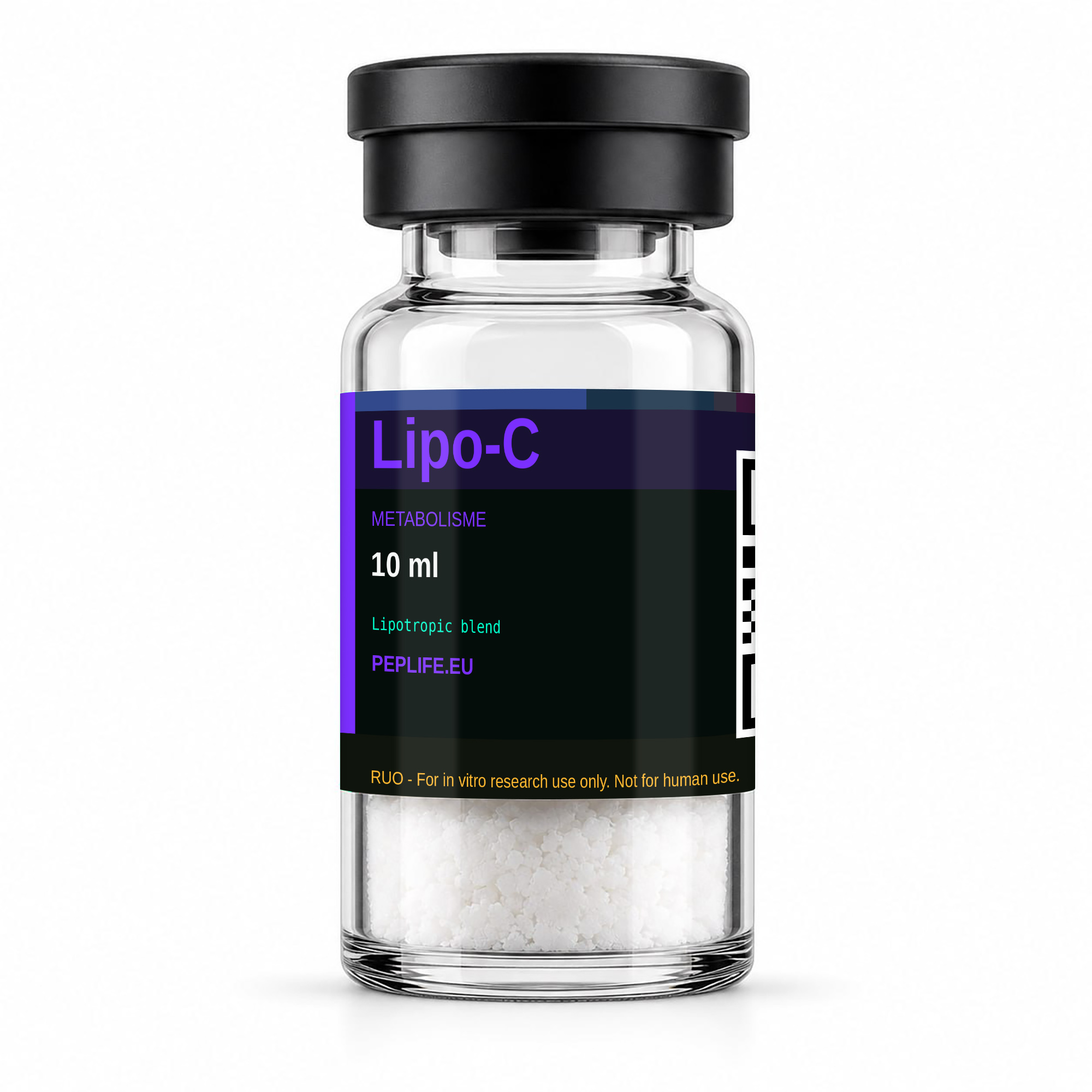
In lipotropic substances research, everything revolves around one biochemical question: how do cells process and move fat? “Lipotropic” literally means “fat-attracting” and refers to substances that in research are associated with the mobilisation, transport and combustion of fatty acids. In this pillar we discuss three compositions that often appear together in this field: Lipo-C, the MIC + B12 formula (methionine, inositol, choline plus vitamin B12) and L-carnitine. Each is studied at a different point in fat metabolism, and it is precisely that combination that makes them interesting for laboratory work around metabolism.
What are lipotropic substances?
Lipotropic substances are not a single molecule but a category: micronutrients and amino acid derivatives involved in the way the liver and fat cells (adipocytes) handle fat. Classic lipotropics are choline, methionine and inositol — substances studied in biochemistry for decades because they play a role in the transport of triglycerides out of the liver. MIC + B12 and Lipo-C are commercial names for formulas that bundle these classic lipotropics, while L-carnitine intervenes in a separate, complementary route: the transport of fatty acids into the mitochondria. Together they cover two sides of fat metabolism — moving fat out of the liver and supplying fatty acids for combustion.
How do lipotropic substances work? — the mechanism
Research into the mechanism splits neatly into two tracks. The first track is hepatic lipid transport. Choline is needed for the production of phosphatidylcholine, which according to the Linus Pauling Institute is indispensable for the assembly and secretion of VLDL particles with which the liver sends triglycerides into the bloodstream. In choline deficiency, fat accumulates in the liver. A classic 1968 study (Lombardi et al.) showed in an animal model that fatty liver in choline deficiency is not caused by more fat production, but by an impaired release of hepatic triglycerides to the plasma. Methionine participates in the same methylation cycle, and choline can, via betaine, convert homocysteine back into methionine — which is why they are together in the MIC formula.
The second pathway is mitochondrial fatty-acid transport. Long-chain fatty acids cannot simply enter the mitochondria to be burned; they need a “ferry”, and that ferry is carnitine. L-carnitine forms the carnitine shuttle system (via the enzymes CPT1 and CPT2) that transports fatty acids across the mitochondrial membrane, where beta-oxidation takes place. A review article from Frontiers in Nutrition (2025) therefore describes carnitine as a central link in fatty acid oxidation and energy metabolism. Vitamin B12 (cyanocobalamin) is present in these formulas as a cofactor in the broader energy and methionine metabolism.
What are lipotropic substances studied for?
In laboratory research these substances are studied in the context of fat metabolism, liver function and lipolysis. The most important research areas:
- Lipolysis in adipocytes: in a study in the Journal of Medicinal Food (2006), L-carnitine in 3T3-L1 fat cells stimulated the release of glycerol and free fatty acids (1.5- and 1.7-fold respectively at 100 nM), while it increased lipolytic gene expression and suppressed adipogenic genes.
- Hepatic triglyceride transport: choline and methionine are studied for their role in VLDL release and the prevention of fat accumulation in liver tissue, a classic lipotropic mechanism.
- Fatty-acid oxidation & energy metabolism: L-carnitine is studied as a key molecule in supplying fatty acids to the mitochondria for beta-oxidation.
- Methylation metabolism: the methionine-choline-betaine cycle is studied in the context of homocysteine regulation and liver health.
Those looking more broadly at this field can place lipotropic substances research alongside peptide research: in our pillar on fat-loss peptides we discuss how research peptides intervene in other routes of metabolism, and the metabolic fragment AOD-9604 is studied around lipolysis via yet another route.
Lipotropic substances in laboratory research: handling & dissolving
Lipo-C and MIC + B12 are supplied as liquid or as material to be dissolved; L-carnitine as powder or solution, depending on the batch. For lyophilised material the same reconstitution principle applies as for peptides: dissolve gently with a suitable fluid and store cool. For the general protocol, see our pillar on reconstituting peptides and the background on which liquid you use for reconstitution. Operations take place exclusively in a laboratory environment and never aimed at human or animal use.
Quality & purity
Every relevant batch is independently HPLC-tested by an external laboratory; the certificate of analysis (CoA) is publicly verifiable per batch. This makes it possible, for every Lipo-C-, MIC + B12- and L-carnitine-batch, to check what the composition and purity is before it is used in a research setup. Reliable identity and purity are crucial: only then are results from lipotropic substances research reproducible and interpretable.
Frequently asked questions about lipotropic substances research
What is the difference between Lipo-C and MIC + B12?
The terms overlap strongly. MIC stands for methionine, inositol and choline; with added vitamin B12 you get “MIC + B12”. Lipo-C is a related lipotropic composition studied in the same research context of fat metabolism. The precise composition per batch is on the CoA.
What exactly does “lipotropic” stand for?
Lipotropic means “fat-attracting” and refers to substances that in research are associated with the mobilisation and transport of fat, particularly from the liver. Choline, methionine and inositol are the classic lipotropics studied in biochemistry.
How is L-carnitine studied in relation to fat burning?
L-carnitine is studied as a transport molecule that brings long-chain fatty acids into the mitochondria for beta-oxidation. In cell research (3T3-L1 adipocytes, 2006) it was associated with increased lipolysis and altered gene expression around fat metabolism.
Why is vitamin B12 in these formulas?
In research, B12 (cyanocobalamin) functions as a cofactor in energy and methionine metabolism, which is closely connected to the methionine-choline cycle in which the other lipotropics are active.
Are lipotropic substances the same as weight-loss peptides?
No. Lipotropic substances are micronutrients and amino acid derivatives; research peptides are protein fragments studied on other routes of metabolism. They are sometimes placed in comparable research contexts, but act mechanistically differently.
May I use lipotropic substances myself?
No. All products are supplied exclusively for in-vitro laboratory research (Research Use Only) and are not intended for diagnostic or therapeutic use in humans or animals.
Read more & research at Peplife
- Research Lipo-C at Peplife
- Research L-carnitine (RUO) at Peplife
- View all other research substances
- Fat-loss peptides: research into metabolism & lipolysis
- Research AOD-9604 at Peplife
Sources: Lombardi et al., choline-deficiency fatty liver: impaired release of hepatic triglycerides (1968) · Linus Pauling Institute — Choline · L-carnitine stimulates lipolysis in 3T3-L1 adipocytes, J Med Food (2006) · L-carnitine review, Frontiers in Nutrition (2025)
Research Use Only. All products are supplied exclusively for in vitro laboratory research. Not intended for diagnostic or therapeutic use in humans or animals, and not approved by the EMA or FDA.
HPLC-tested by an external laboratory, CoA publicly verifiable per batch, discreet EU shipping.