




| Aliases | Victoza, Saxenda |
| Class | GLP-1 agonist |
| Molecular weight (Da) | 3751.2 |
| Half-life (indicative) | ~13 h |
| Research status | Approved drug |
Research context (RUO): Liraglutide is a daily GLP-1 receptor agonist that has been extensively studied for glucose regulation and body weight. This peptide is supplied by Peplife exclusively for in-vitro laboratory research (Research Use Only) and is not intended for human or animal use.
Liraglutide research: the daily GLP-1 agonist
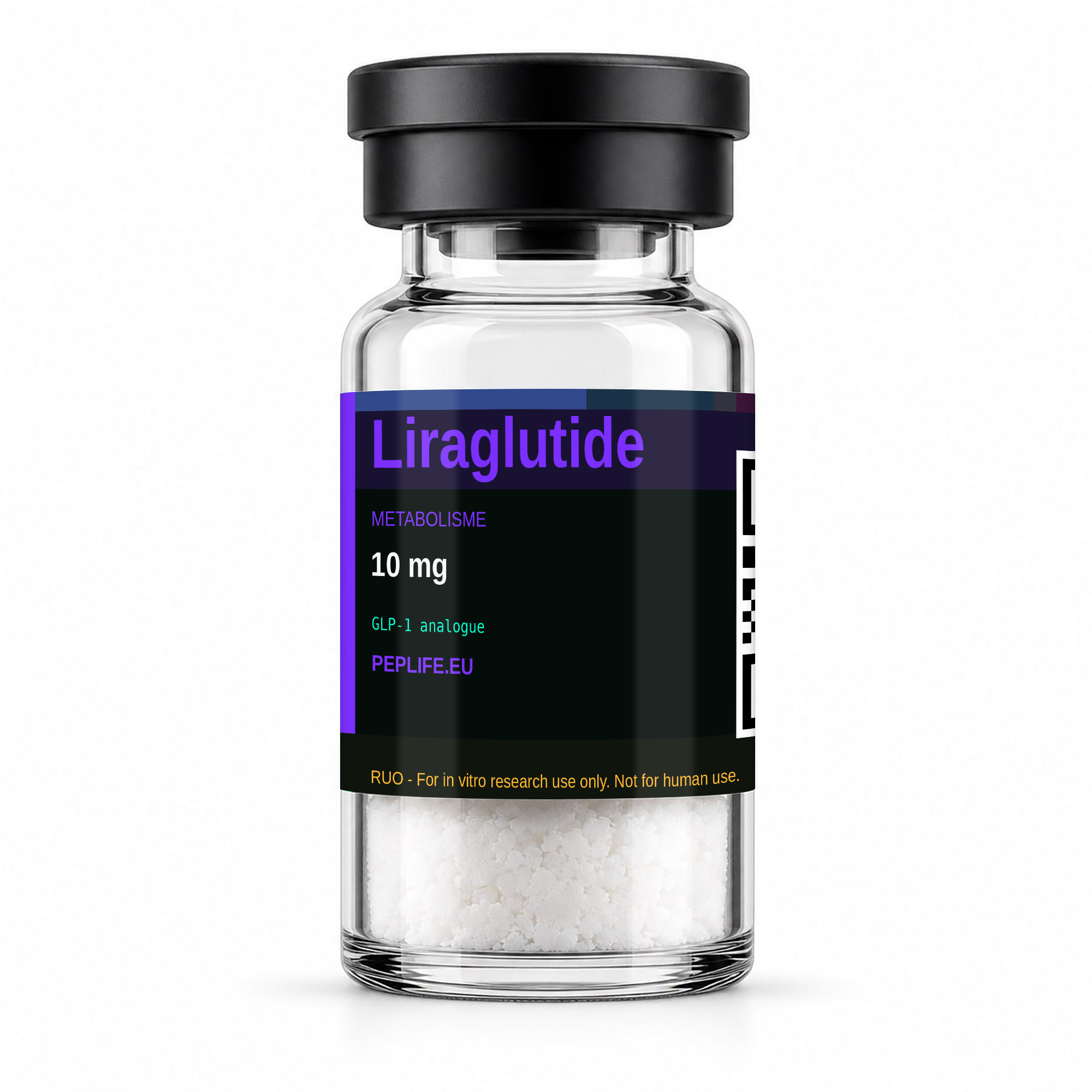
Liraglutide research forms an important chapter in the history of the GLP-1 receptor agonists: this daily-administered peptide was one of the first molecules to make the incretin mechanism clinically usable, and thereby laid the foundation for the later weekly successor semaglutide. In laboratory and preclinical research, liraglutide is a model for the question of how a small modification to the natural GLP-1 hormone can transform a short-lived signalling molecule into a stable research compound. Under the brand names Victoza (type 2 diabetes) and Saxenda (weight management) it has been intensively studied for metabolic endpoints.
What is liraglutide?
Liraglutide is a synthetic analogue of glucagon-like peptide-1 (GLP-1), a gut hormone released after a meal. According to review literature, the molecule shares about 97% of its amino acid sequence with the body's own GLP-1. The difference lies in two targeted modifications: one amino acid substitution (Lys34Arg) and the addition of a 16-carbon palmitic acid chain. That fatty acid tail lets the molecule bind, in research, to albumin in the blood, so that it is broken down much more slowly than native GLP-1 — which is broken down within a few minutes by the enzyme DPP-4. In studies, a plasma half-life of about 13 hours is reported for liraglutide, which forms the basis for the daily dosing schedule in clinical research. This distinguishes it from modern analogues such as semaglutide and tirzepatide, which are studied weekly.
How does liraglutide work? — the mechanism
The studied mechanism of action of liraglutide revolves around activation of the GLP-1 receptor. In the pancreas it binds to receptors on the beta cells, which increases the intracellular cyclic AMP concentration and, in preclinical models, stimulates a glucose-dependent insulin release. At the same time it suppresses the release of glucagon, the hormone that raises blood sugar. Because this effect is glucose-dependent, the insulin response in studies remained coupled to elevated sugar values.
In addition, researchers describe central effects in the brain. The GLP-1 receptor is expressed in hypothalamic nuclei that regulate appetite, including the arcuate nucleus and the paraventricular nucleus. In animal models, liraglutide activated POMC neurons (which signal satiety) while it inhibited appetite-stimulating routes. Research also reported a dampening effect on food-related reward signals in the mesolimbic system. A third peripheral mechanism is the delay of gastric emptying, which sends satiety signals to the brain via the vagus nerve.
What is liraglutide studied for?
Liraglutide research historically concentrates on two major metabolic questions, alongside a number of adjacent research lines:
- Glucose regulation: as a GLP-1 agonist, liraglutide (Victoza, approved in 2010) was extensively studied for the lowering of blood glucose and HbA1c in type 2 diabetes, with a glucose-dependent insulin profile.
- Fat loss and weight: in the SCALE Obesity and Prediabetes study (Pi-Sunyer et al., 2015, 3,731 participants), researchers reported after 56 weeks an average weight loss of 8.0% with liraglutide 3.0 mg versus 2.6% with placebo; 63.2% of the liraglutide group lost more than 5% of body weight compared to 27.1% in the placebo group.
- Cardiovascular outcomes: the LEADER study (Marso et al., NEJM 2016) investigated cardiovascular endpoints in participants with type 2 diabetes and a high risk.
- Appetite and satiety: mechanistic research into the central hypothalamic and reward-related routes that drive food intake.
Liraglutide in laboratory research: handling & dissolving
Liraglutide is supplied as a freeze-dried (lyophilised) powder that in a research setting is reconstituted with a suitable fluid, usually bacteriostatic or sterile water. Peptides with a fatty acid chain can behave differently on dissolving than smaller peptides, so a careful reconstitution protocol and cool, dark storage are common in laboratory work. More background is in our pillars on reconstituting peptides and which liquid you use to dissolve a peptide. This information is intended exclusively for in-vitro laboratory applications and not as instructions for use in humans.
Quality & purity
Every relevant batch of liraglutide is independently HPLC-tested by an external laboratory; the certificate of analysis (CoA) is publicly verifiable per batch. For a fatty-acid-acylated peptide like liraglutide, this verification is extra relevant, because purity and correct identity directly determine the reproducibility of research results. This way, researchers know exactly which compound and which concentration they are using in their in-vitro work.
Frequently asked questions about liraglutide
What is the difference between liraglutide and semaglutide?
Both are GLP-1 receptor agonists derived from the same natural hormone. Liraglutide was administered daily in research (half-life ~13 hours), while semaglutide, through structural modifications, has a much longer half-life and is studied weekly. Liraglutide is often described as the predecessor of semaglutide. See our pillar comparing GLP-1 peptides.
Why was liraglutide administered daily in studies?
The palmitic acid chain extends the duration of action compared to native GLP-1, but the half-life of about 13 hours is shorter than that of the newer analogues. In clinical research this translated into a daily dosing schedule.
Is liraglutide the same as Victoza and Saxenda?
Victoza and Saxenda are brand names under which liraglutide has been studied as a medicine — Victoza for glucose regulation in type 2 diabetes, Saxenda for weight management at a higher dose (up to 3.0 mg). The liraglutide supplied by Peplife is a research chemical, not a medicine, and is exclusively for laboratory research.
How does liraglutide compare to tirzepatide?
Tirzepatide acts on two receptors (GLP-1 and GIP), while liraglutide is a single GLP-1 agonist. In research these different working principles are compared; read more in semaglutide vs tirzepatide.
Can I buy liraglutide from Peplife for research?
Ja, liraglutide is available at Peplife as an HPLC-tested research peptide with a CoA per batch, exclusively for in-vitro laboratory use (RUO).
What was liraglutide originally developed for?
In clinical research, liraglutide has been studied along two lines of research: glucose regulation in type 2 diabetes and weight management. Both lines build on the incretin effect of GLP-1.
Read more & research at Peplife
- Research Liraglutide at Peplife
- View all metabolism peptides
- comparing GLP-1 peptides
- Semaglutide vs tirzepatide
- Fat-loss peptides in research
- Research Semaglutide · Research Tirzepatide
Sources: Liraglutide — StatPearls (NCBI) · Pi-Sunyer et al., SCALE Obesity and Prediabetes, NEJM 2015 (PMID 26132939) · Marso et al., LEADER — Liraglutide and Cardiovascular Outcomes, NEJM 2016 · The GLP-1 agonist liraglutide as pharmacotherapy for obesity, PMC4772342
Research Use Only. All products are supplied exclusively for in vitro laboratory research. Not intended for diagnostic or therapeutic use in humans or animals, and not approved by the EMA or FDA.
HPLC-tested liraglutide with a verifiable CoA per batch and discreet EU shipping.