




| Aliases | Cathelicidin |
| Class | Antimicrobial peptide |
| Molecular weight (Da) | 4493.3 |
| Half-life (indicative) | short † |
| Research status | In clinical research |
Research context (RUO): LL-37 is the only human cathelicidin peptide and is studied in laboratories for its antimicrobial action, role in wound healing and immune modulation. It is supplied exclusively for in-vitro laboratory research, not for use in humans or animals.
LL-37 research: the antimicrobial cathelicidin peptide
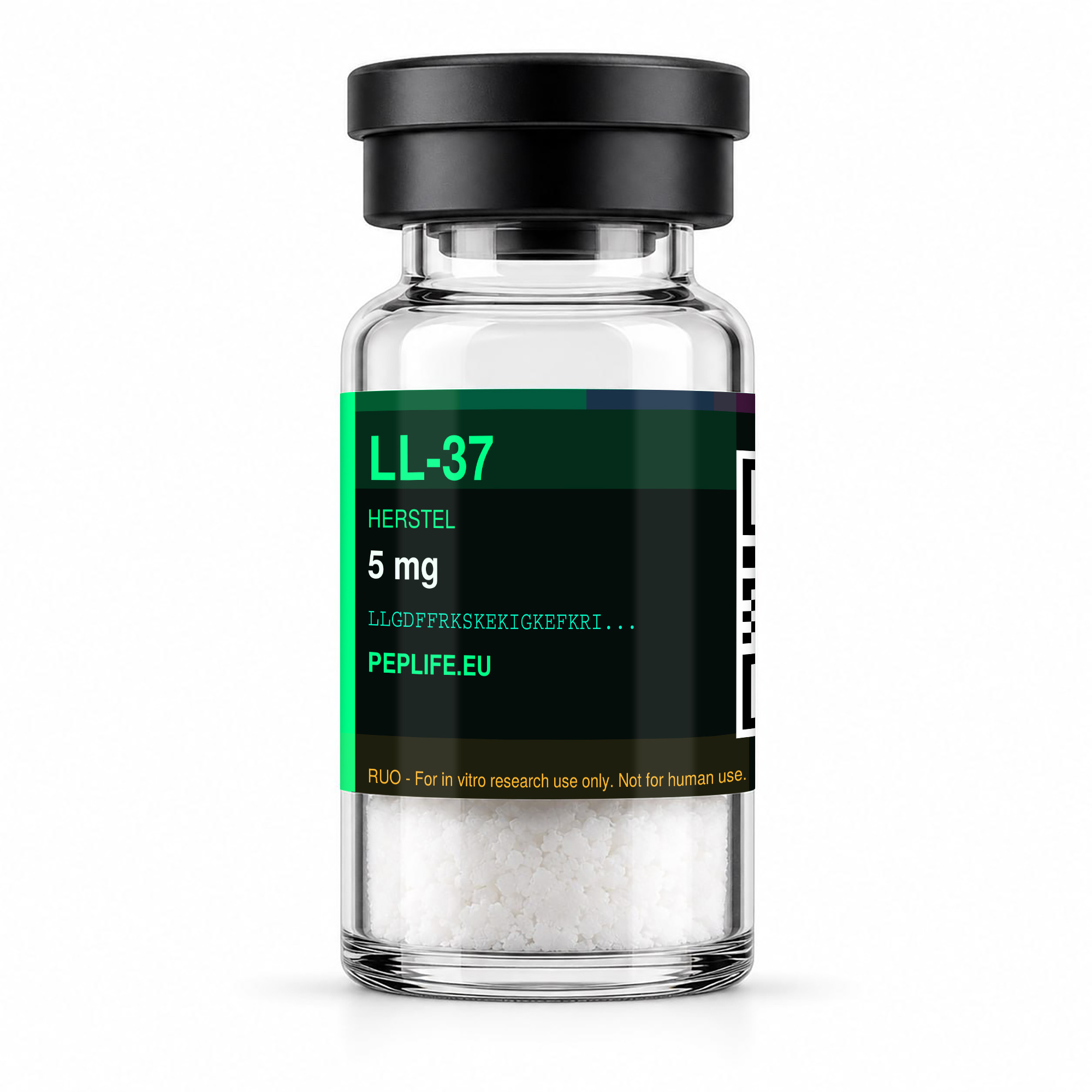
Het LL-37 research focuses on one of the most studied antimicrobial peptides of the human body. LL-37 is the only member of the cathelicidin family that occurs in humans, and has attracted attention in science for two decades because it appears to combine three functions in one molecule: it kills microbes, it directs the immune system and it plays a role in tissue repair. For researchers, that versatility — often called “pleiotropic” — makes LL-37 an interesting model peptide for studying innate defence and wound healing in vitro.
What is LL-37?
LL-37 is a small protein of 37 amino acids that owes its name to the two leucines (LL) with which the chain begins. It arises from a larger precursor protein, hCAP-18 (human cationic antimicrobial protein, 18 kDa), which is cleaved by the enzyme proteinase-3. The active LL-37 fragment carries a strong positive charge (net about +6) and folds, in a membrane environment, into an amphipathic alpha-helix — a spiral with water-loving amino acids on one side and fat-loving amino acids on the other. It is precisely this dual nature that underlies its action. In the body, LL-37 is produced by, among others, neutrophils (white blood cells), skin cells and the epithelium of the airways and intestines, where it forms part of the first line of defence of the innate immune system.
How does LL-37 work? — the mechanism
The positive charge of LL-37 draws the peptide to the negatively charged exterior of bacterial membranes. There the amphipathic helix attaches to the membrane and disrupts its structure. In a structural study in Scientific Reports (2020), researchers showed that LL-37 can oligomerise — from monomers to dimers and tetramers — and that the tetramers form a narrow channel of about 4 nanometres that conducts through lipid membranes. In E. coli it was observed that LL-37 first causes disruptions in the outer membrane, followed by damage to the cell wall and ultimately cell death. This membrane-disrupting mechanism explains why it is difficult for bacteria to develop resistance to it: there is no single protein target that can be “switched off” via a mutation.
In addition to this direct effect, LL-37 behaves as a signalling molecule. In a lower dose range it binds to receptors such as FPRL-1 on immune cells and attracts defence cells to the site of infection, while at the same time it can dampen inflammation signals by inhibiting the TLR4 route. Researchers therefore describe LL-37 as a bridge between innate defence and tissue repair.
What is LL-37 studied for?
LL-37 research concentrates around a number of clear themes:
- Antimicrobial action: studies report broad-spectrum activity against both gram-positive and gram-negative bacteria, including resistant strains. Notably, in research by Overhage et al. (2008), LL-37 already inhibited biofilm formation at concentrations (0.5 µg/ml) far below the dose needed to kill free-floating bacteria.
- Wound healing & re-epithelialisation: in healing skin tissue, hCAP-18/LL-37 is strongly present. In a study by Heilborn et al. (2003), blocking LL-37 with antibodies inhibited wound closure in a dose-dependent manner, pointing to a role in the regrowth of the epidermis.
- Immunomodulation: LL-37 acts as a chemoattractant that attracts immune cells and can have both pro-inflammatory and anti-inflammatory effects, depending on the concentration.
- Angiogenesis: researchers study whether LL-37 stimulates the formation of new blood vessels, a process relevant for tissue repair.
- Exploratory directions: because of its membrane activity, LL-37 is also used as a model molecule in preclinical anticancer and antiviral research.
LL-37 in laboratory research: handling & dissolving
LL-37 is supplied as a freeze-dried (lyophilised) powder that is reconstituted before in-vitro experiments. Because it is a cationic, amphipathic peptide, it can adhere to glass surfaces and be sensitive to the choice of solvent; researchers therefore pay attention to vial material and dissolving protocol. More background on choosing the right fluid is in our pillar dissolve peptide: which liquid and the step-by-step guide reconstitute peptides. After reconstitution, LL-37 is usually stored cool and protected against repeated freezing and thawing.
Quality & purity
Every relevant batch is independently HPLC-tested by an external laboratory; the certificate of analysis (CoA) is publicly verifiable per batch. For a membrane-active peptide like LL-37, purity is extra important: contaminants or degradation products can distort in-vitro experiments with membranes and bacterial cultures. Transparent batch data show researchers what they really have in the vial — also read why we rejected a batch.
Frequently asked questions about LL-37
What exactly is LL-37?
LL-37 is the only human cathelicidin peptide, a chain of 37 amino acids that arises from the precursor protein hCAP-18. In research it is studied for its antimicrobial, immunomodulatory and wound-healing-related properties.
How does LL-37 act against bacteria in research?
In studies, the positively charged, amphipathic peptide attaches to negatively charged bacterial membranes and disrupts them, among other things through channel formation. Because it acts on the membrane rather than on a single protein, resistance formation turns out to be difficult in research.
What is LL-37 studied for?
LL-37 research focuses mainly on antimicrobial action (including biofilms), wound healing and re-epithelialisation, immune modulation and angiogenesis, plus exploratory antiviral and anticancer research.
Is LL-37 the same as cathelicidin?
LL-37 is the active fragment of the human cathelicidin hCAP-18. “Cathelicidin” refers to the whole family; in humans, LL-37 is the only member.
How does LL-37 differ from other repair peptides?
Where peptides such as BPC-157 and TB-500 are studied mainly in tissue-repair models, with LL-37 the antimicrobial and immune function is central; it overlaps with repair through its role in wound healing.
May LL-37 be used in humans or animals?
No. LL-37 is supplied exclusively for in-vitro laboratory research (Research Use Only) and is not intended for diagnostic or therapeutic use.
Read more & research at Peplife
- Research LL-37 at Peplife
- View all recovery peptides
- BPC-157 research: the recovery peptide
- Research KPV at Peplife
- Research Thymosin Alpha-1 at Peplife
Sources: Ramos et al., Front. Immunol. (2013) — LL-37 in infected wounds · Sancho-Vaello et al., Sci. Rep. (2020) — structure & channel formation LL-37 · Int. J. Mol. Sci. (2025) — cathelicidin family & LL-37 review
Research Use Only. All products are supplied exclusively for in vitro laboratory research. Not intended for diagnostic or therapeutic use in humans or animals, and not approved by the EMA or FDA.
HPLC-tested by an external laboratory, CoA publicly verifiable per batch and discreet shipping within the EU.