




| Aliases | Afamelanotide, Scenesse |
| Class | Melanocortin (α-MSH) |
| Molecular weight (Da) | 1646.9 |
| Half-life (indicative) | ~30–60 min (peptide) |
| Research status | Approved drug |
Research context (RUO): Melanotan 1 (afamelanotide) is a synthetic, linear analogue of the body's own α-MSH that is studied in laboratories to investigate the melanocortin-1 receptor (MC1R) and pigment formation. This peptide is supplied exclusively for in-vitro laboratory research and is not intended for human or animal use.
Melanotan 1 (Afamelanotide) research: the MC1R peptide
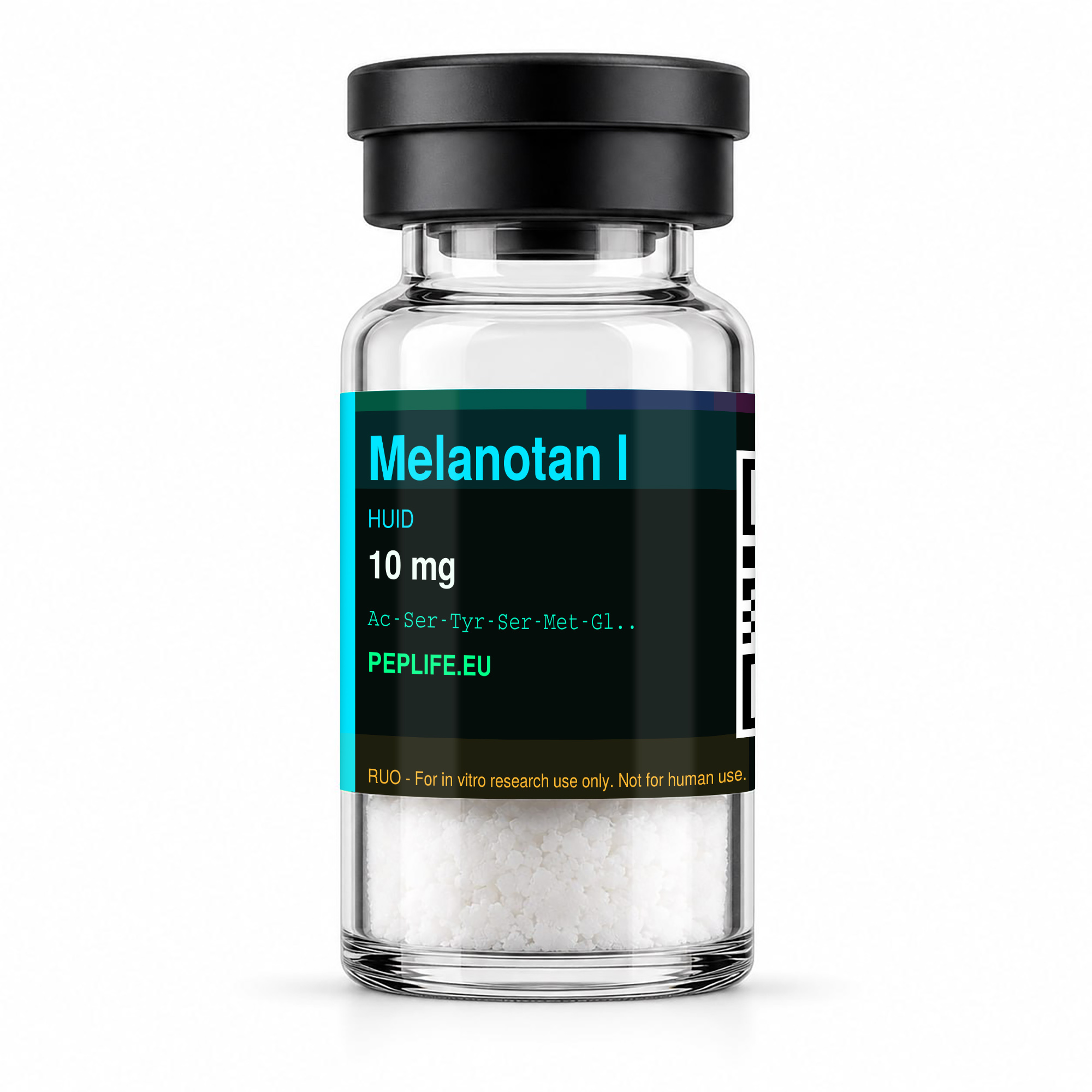
Het melanotan 1 research revolves around one central question: how does a small, linear peptide selectively switch on the skin's pigment machinery? Melanotan 1 — under the scientific name afamelanotide — is a synthetic copy of α-melanocyte-stimulating hormone (α-MSH) that specifically addresses the melanocortin-1 receptor. This makes it a popular probe in preclinical research into melanogenesis, photoprotection and receptor biology. Important to state upfront: at Peplife this peptide is exclusively a research material (Research Use Only), not a tanning product and not a medicine.
What is melanotan 1?
Melanotan 1 is a linear peptide of thirteen amino acids, structurally derived from the natural α-MSH. Researchers modified the molecule at two positions — in short the [Nle4, D-Phe7] substitution — which makes it more resistant to enzymatic breakdown and keeps it active longer than the volatile endogenous hormone. In chemical databases the compound is registered as afamelanotide with molecular formula C78H111N21O19 (PubChem CID 16197727). It differs from its better-known "brother" melanotan 2 in that melanotan 1 retains the full linear chain length, while melanotan 2 is a shortened, cyclic molecule with a broader receptor profile.
How does melanotan 1 work? — the mechanism
The mechanism in melanotan 1 research runs via the melanocortin-1 receptor (MC1R), which is located on melanocytes in the skin. When afamelanotide binds to MC1R, it activates the intracellular cAMP route, which in turn stimulates the enzyme tyrosinase and the transcription factor MITF. The net effect described in cell and animal models is a shift towards the production of eumelanin — the dark, UV-absorbing pigment form. Compared to melanotan 2, afamelanotide is positioned in the literature as relatively MC1R-selective : it focuses more strongly on the pigment receptor and less on the MC3R/MC4R receptors that are associated with other physiological routes. This selectivity makes it an attractive model molecule for studying melanogenesis separately from other melanocortin effects.
What is melanotan 1 studied for?
Because afamelanotide acts specifically on MC1R, research focuses mainly on pigment and light protection. The most important research areas that recur in the literature:
- Melanogenesis: in cell culture and animal models, afamelanotide was associated with increased eumelanin production via the MC1R–cAMP–tyrosinase route.
- Photoprotection: researchers study whether the melanin-increased pigmentation absorbs and scatters UV light and visible light better, thereby reducing light-induced damage in models.
- Erythropoietic protoporphyria (EPP): as a medicine, afamelanotide (brand name Scenesse, Clinuvel) was approved by the FDA on 8 October 2019 for the prevention of phototoxicity in adults with this rare hereditary condition — administered as a subcutaneous implant of 16 mg every two months. This concerns only the regulated medicine, not the RUO research material.
- Receptor biology: due to its selectivity, melanotan 1 serves as a reference agonist for characterising MC1R signalling in pharmacological studies.
Melanotan 1 in laboratory research: handling & dissolving
As a lyophilisate (freeze-dried powder), melanotan 1 in research protocols is usually reconstituted with bacteriostatic or sterile water before it is used in in-vitro assays. Peptides are sensitive to light, heat and repeated thawing, so cool, dark storage and careful aliquoting are part of good laboratory practice. Researchers who want to know which fluid and concentration are suitable for a given protocol will find the background in our pillar reconstituting peptides. This information is intended exclusively for laboratory handling, not for administration to humans or animals.
Quality & purity
Every relevant batch is independently HPLC-tested by an external laboratory; the certificate of analysis (CoA) is publicly verifiable per batch. For a research molecule like afamelanotide this is essential: the reported receptor selectivity and biological activity only apply with a well-defined, pure peptide. A high, documented purity and a correct mass check ensure that observations in the lab can be attributed to the peptide itself and not to contaminants or degradation products.
Frequently asked questions about melanotan 1 research
What is the difference between melanotan 1 and melanotan 2?
Melanotan 1 (afamelanotide) is the full, linear α-MSH analogue and is described as relatively MC1R-selective. Melanotan 2 is a shorter, cyclic compound with a broader melanocortin receptor profile. In research they are used side by side to compare selectivity; see our pillar on melanotan 2 research.
Is melanotan 1 the same as afamelanotide?
Yes. Afamelanotide is the scientific/drug name for the same peptide that in research is often called "melanotan 1" or "MT-1". As the drug Scenesse it is regulated; the RUO material at Peplife is exclusively for laboratory research.
Why is it called MC1R-selective?
In the literature, afamelanotide targets the melanocortin-1 receptor (the pigment receptor) more strongly than the MC3R/MC4R receptors, allowing researchers to study melanogenesis in relative isolation. Selectivity is always relative and context-dependent in preclinical models.
Is melanotan 1 approved by a regulatory authority?
As the drug afamelanotide (Scenesse), the FDA granted approval in 2019 for a very specific, rare indication (EPP). The RUO research powder is not, and is not approved by the EMA, NVWA or FDA for any use in humans or animals.
How is melanotan 1 stored in the lab?
Lyophilised, cool and dark; after reconstitution refrigerated and protected from light, with as few freeze-thaw cycles as possible. The exact conditions depend on the research protocol.
Can I buy melanotan 1 for research at Peplife?
Yes, exclusively as Research Use Only material with an accompanying CoA. It is not intended for human or animal use.
Read more & research at Peplife
- Research Melanotan 1 at Peplife
- View all skin peptides
- Melanotan 2 research: the broader melanocortin analogue
- Research Melanotan 2 at Peplife
- Research SNAP-8 at Peplife
Sources: NCBI LiverTox – Afamelanotide · FDA Scenesse (afamelanotide) label 2019 · PubChem CID 16197727 – Afamelanotide · Drugs.com – Scenesse FDA approval history
Research Use Only. All products are supplied exclusively for in vitro laboratory research. Not intended for diagnostic or therapeutic use in humans or animals, and not approved by the EMA or FDA.
HPLC-tested by an external laboratory, with a publicly verifiable CoA per batch and discreet EU shipping.