




| Class | Neuropeptide |
| Molecular weight (Da) | 848.8 |
| Half-life (indicative) | ~7–15 min |
| Research status | Preclinical / RUO |
Research context (RUO): DSIP (delta sleep-inducing peptide) is a small neuropeptide studied in science in relation to sleep, stress response and neuromodulation. It is supplied exclusively for in-vitro laboratory research and not for human or animal use. An overview of the broader group is given in the article sleep peptides.
DSIP research: the delta sleep-inducing peptide
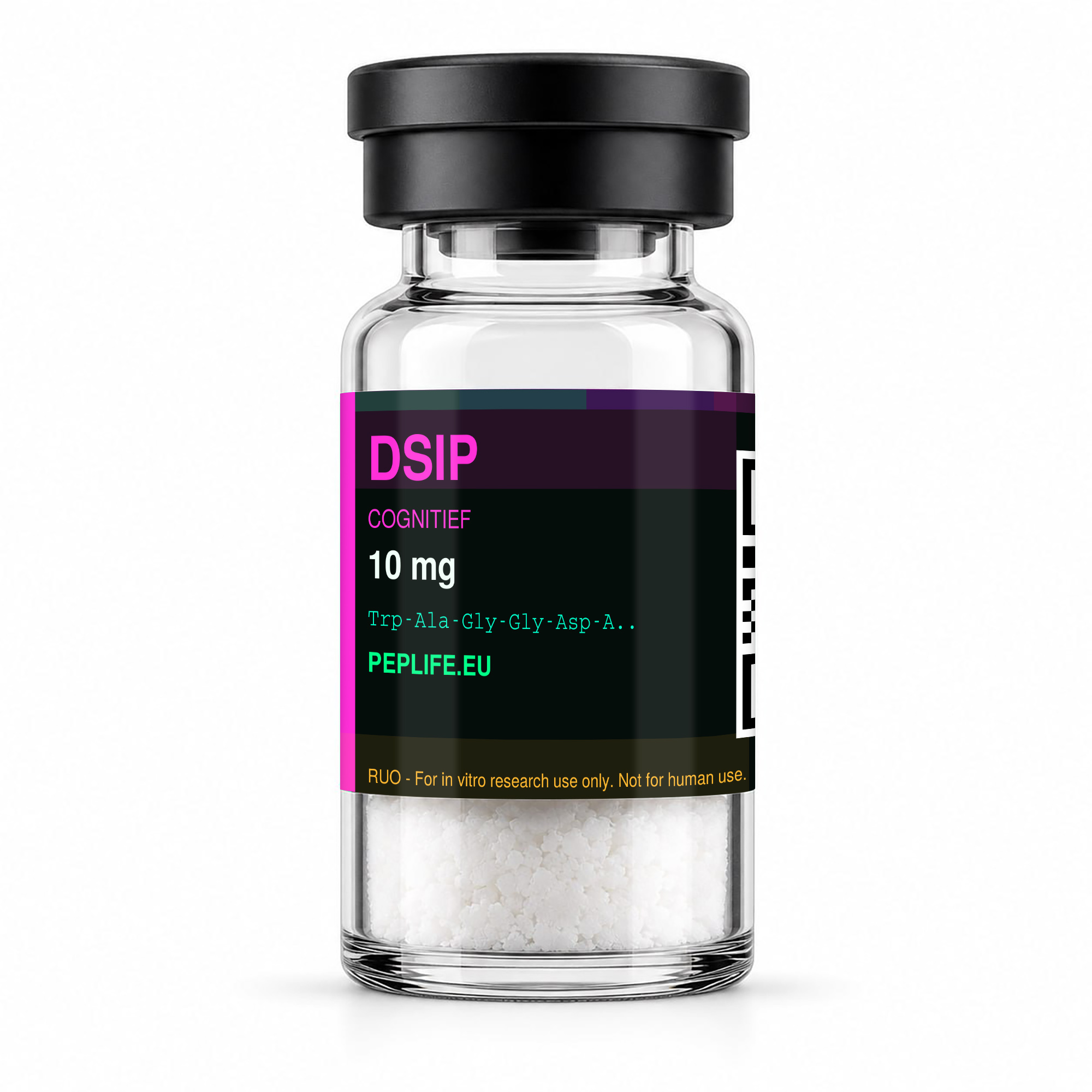
DSIP research revolves around one of the most enigmatic neuropeptides in sleep neurology: a protein fragment of nine amino acids that has occupied researchers since the 1970s. DSIP stands for delta sleep-inducing peptide, or the delta sleep-inducing peptide, and owes that name to the way it was first identified: as a substance that, in the blood, appeared to induce the slow, high-amplitude delta EEG pattern of deep sleep. In this article we set out what DSIP exactly is, which mechanisms researchers propose and in which research areas the peptide is studied today — always strictly within a laboratory framework.
What is DSIP?
DSIP is an amphiphilic neuropeptide with the amino acid sequence Trp-Ala-Gly-Gly-Asp-Ala-Ser-Gly-Glu (in one-letter code WAGGDASGE) and a molecular weight of approximately 850 daltons. It was first isolated in 1974 by the Swiss research group around Monnier and Schoenenberger, who extracted it from the cerebral venous blood of rabbits in a sleep state. An amino acid is a building block of proteins; a chain of nine of them, as in DSIP, is called a nonapeptide. In the body, DSIP is not neatly concentrated in one place: research describes it in both free and bound form, spread across the hypothalamus, the limbic system, the pituitary and even secretory cells in the gut and pancreas. This wide distribution, and the fact that DSIP co-occurs with hormones such as ACTH, MSH and TSH, is an important reason why scientists suspect that it plays a role in neuroendocrine regulation and not only in sleep.
How does DSIP work? — the mechanism
Frankly, the mechanism of action of DSIP is still largely open. Unlike classical neurotransmitters, DSIP does not appear to have a single, clearly delineated receptor. Research suggests that the peptide may interact with NMDA receptors and with α1-adrenergic receptors, and it has been proposed that it can act on the MAPK signalling cascade via a GILZ-like route (glucocorticoid-induced leucine zipper) — routes involved in stress and inflammation regulation. A practical obstacle that colours DSIP research is the striking instability of the molecule: in-vitro studies report a half-life of only around fifteen minutes, because aminopeptidases break it down quickly. That explains why many laboratories study synthetic DSIP analogues that are more stable, and why part of the clinical findings are so contradictory: the bioavailability of the natural peptide is simply low and short-lived.
What is DSIP studied for?
DSIP research fans out more broadly than the name suggests. Besides sleep, stress response and neuromodulation are recurring themes. The most important research areas at a glance, each attributed to the study and not to a user:
- Sleep architecture: researchers study whether DSIP strengthens the slow delta waves of deep sleep and suppresses REM sleep. The findings are contradictory — some studies see a link, others none — and it is precisely that contradiction that keeps the field lively.
- Stress response: in preclinical models DSIP was associated with a dampened stress response, normalisation of blood pressure and relief of hypothermia, which fits the idea of a “stress-limiting” peptide.
- Neuromodulation & neuroendocrine: because of its co-localisation with pituitary hormones, scientists investigate whether DSIP functions as a modulator of hormone release rather than as a classical messenger.
- Antioxidant effects: rat studies suggest that DSIP may influence mitochondrial oxidative phosphorylation, which places the peptide in a broader longevity and cellular-stress framework.
Illustrative is a 2024 study in which researchers tested a DSIP fusion peptide (coupled to a blood-brain-barrier-crossing fragment) in a mouse model of PCPA-induced insomnia. The treated group showed a clearly lower average waking time than the insomnia model, and the improvement was associated with a restored balance of serotonin, melatonin and dopamine. Precisely this kind of mechanistic, model-based work shows how DSIP is approached in the lab today.
DSIP in laboratory research: handling & dissolving
Like most research peptides, DSIP is supplied as a freeze-dried (lyophilised) white powder that must be reconstituted in the lab before use. With an unstable, short-lived peptide like DSIP, sterile technique and the right reconstitution fluid are extra important to limit degradation. In our separate pillar on reconstituting peptides we explain step by step how researchers use bacteriostatic or sterile water, how concentrations are calculated and how reconstituted solutions are stored. All operations take place exclusively in vitro and never on humans or animals.
Quality & purity
The reproducibility of any DSIP research stands or falls with the purity of the starting material — and that counts double for a peptide already sensitive to degradation. Every relevant batch is therefore independently HPLC-tested by an external laboratory; the certificate of analysis (CoA) is publicly verifiable per batch, so that a laboratory knows exactly what purity it has in hand. Why this control is not a formality, we illustrate in why we rejected a batch.
Frequently asked questions about DSIP
What does the abbreviation DSIP stand for?
DSIP stands for delta sleep-inducing peptide, the delta sleep-inducing peptide. The name refers to the slow delta waves of deep sleep that were associated with the peptide in the original experiments.
Is DSIP the same as a sleep aid?
No. DSIP is a research peptide and not a registered medicine or sleeping aid. It is studied exclusively in laboratory research and is not approved for human or animal use.
Why are the study results on DSIP so contradictory?
An important explanation is the instability of the molecule: with a half-life of about fifteen minutes in vitro, the bioavailability varies greatly between experiments, causing outcomes on sleep and stress to diverge.
What else is DSIP studied for besides sleep?
Besides sleep architecture, researchers study DSIP in connection with stress response, blood pressure regulation, neuroendocrine modulation and antioxidant effects in preclinical models.
How does DSIP compare to other cognitive peptides?
DSIP falls within the broader group of neuroactive and cognitive peptides. Researchers regularly compare it with peptides such as Selank and Semax, which are studied on the central nervous system for other reasons. See our pillar on cognitive peptides for context.
In what form is DSIP supplied for research?
As a freeze-dried powder that is reconstituted in the laboratory. Quality is confirmed per batch with HPLC via a public CoA.
Read more & research at Peplife
- Research DSIP at Peplife
- View all cognitive peptides
- Knowledge base: cognitive peptides — overview
- Research Selank at Peplife
- Research Semax at Peplife
- Research Pinealon at Peplife
Sources: Delta-sleep-inducing peptide — Wikipedia · PubChem CID 68816 (DSIP) · Schoenenberger & Monnier, amino acid sequence & synthesis of the nonapeptide (PubMed) · DSIP fusion peptide in a PCPA-induced insomnia model, Front. Pharmacol. 2024
Research Use Only. All products are supplied exclusively for in vitro laboratory research. Not intended for diagnostic or therapeutic use in humans or animals, and not approved by the EMA or FDA.
DSIP from Peplife is HPLC-tested with a publicly verifiable CoA per batch and is shipped discreetly within the EU.