




| Class | Myostatin antagonist (protein) |
| Molecular weight (Da) | ~38–49 kDa |
| Half-life (indicative) | ~4 min · ~2 h (rat, biphasic) |
| Research status | Preclinical / RUO |
Research context (RUO): Follistatin-344 is a recombinant form of the body's own protein follistatin, which in preclinical research binds the muscle-growth inhibitor myostatin and the protein activin. It is supplied exclusively for in-vitro laboratory research and is not intended for human or animal use.
Follistatin-344 research: the myostatin inhibitor under the microscope
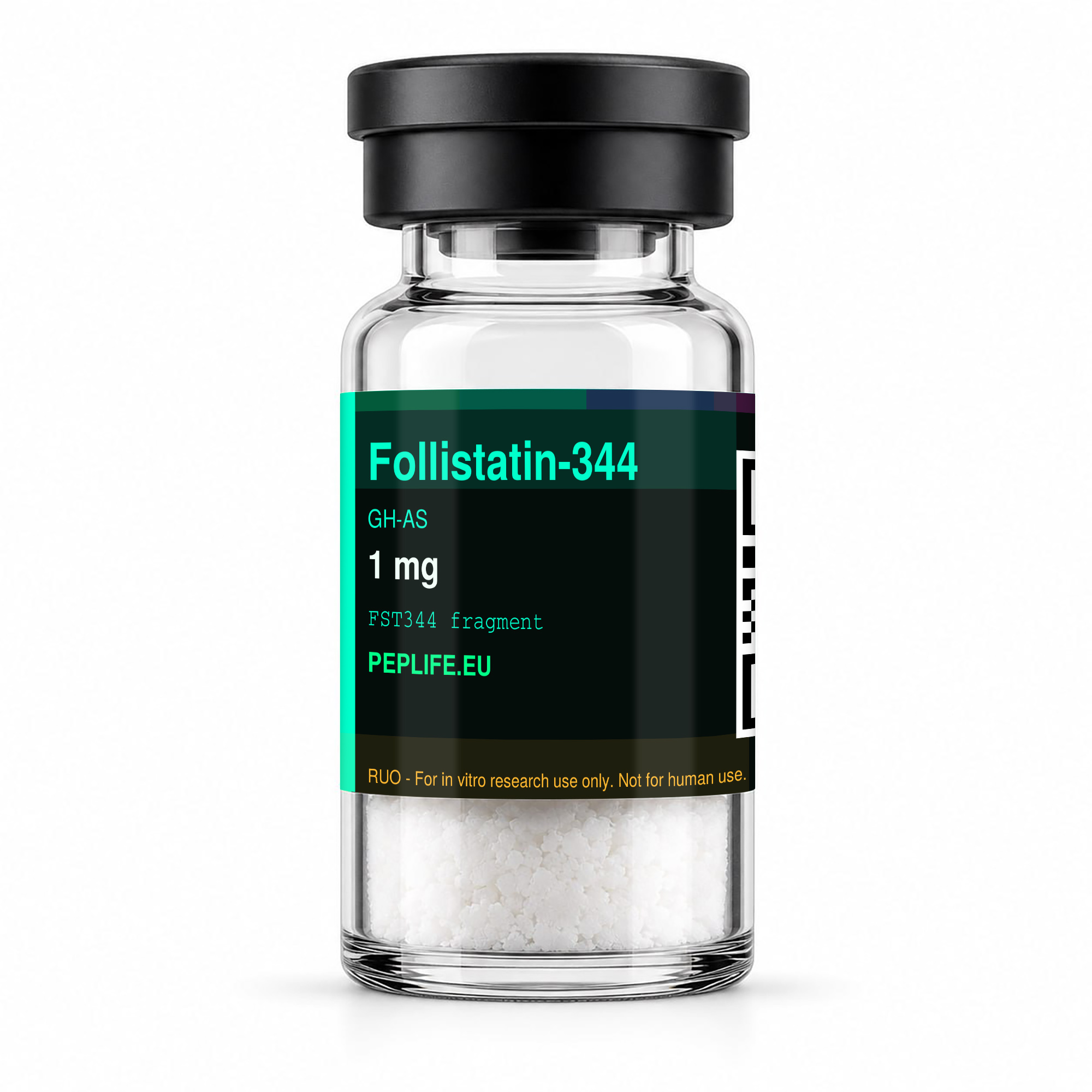
Anyone delving into follistatin-344 research quickly runs into one central question: what happens to muscle tissue when the natural “brake” on muscle growth is released? Follistatin is precisely such a brake-inhibitor. The protein binds myostatin (also known as GDF-8), the factor that limits growth in skeletal muscle, and additionally neutralises activin. In animal models this led to striking increases in muscle mass. On this page, researchers, mechanism and the key studies are set out — strictly within the frameworks of laboratory research.
What is follistatin-344?
Follistatin is a glycoprotein that occurs naturally in virtually all tissues and belongs to the family of inhibitors of the TGF-β superfamily. The human follistatin gene produces several forms through alternative splicing. The designation “344” refers to the full precursor protein of 344 amino acids, including the signal peptide — the form used as cDNA (referred to as FS344) in the best-known gene therapy experiments. The shorter, more cell-surface-bound forms (such as FS288) and the circulating form (FS315) arise from the same gene. In research, follistatin-344 is valued because the full sequence reflects the protein's full inhibitory range.
How does follistatin-344 work? — the mechanism
The mechanism revolves around binding and neutralisation. Myostatin is a member of the TGF-β family that actively signals muscle cells not to grow further. Follistatin binds myostatin with high affinity and thereby prevents it from coupling to its receptors. Structural research on the follistatin-activin complex showed that follistatin simultaneously blocks binding to both type I and type II receptors; it envelops the target protein, as it were. Because follistatin binds not only myostatin but also activin, it intervenes in two inhibitory signalling routes at once. Researchers suspect that precisely this dual action explains why follistatin showed more powerful muscle-growth effects in studies than switching off myostatin alone.
A study published in American Journal of Physiology-Endocrinology and Metabolism (Gilson et al., 2009) reported that increased follistatin expression in mice induced muscle hypertrophy via two tracks: proliferation of satellite cells (the stem-cell-like reserve cells of muscle tissue) and inhibition of both myostatin and activin. The combination of more cell nuclei and less growth restraint forms the core of the proposed mechanism model.
What is follistatin-344 studied for?
The research concentrates on scenarios in which muscle mass and muscle strength are central. The most important research areas:
- Muscle hypertrophy and muscle strength: in animal models, increased follistatin expression was associated with increases in muscle mass; researchers study the magnitude and durability of that effect.
- Neuromuscular disorders: follistatin gene therapy is studied preclinically and in early clinical phases as a possible strategy in muscular dystrophy models, where muscle breakdown is the problem.
- Satellite-cell biology: studies investigate how follistatin influences the activation and proliferation of satellite cells, which is relevant for muscle repair and regeneration.
- Metabolism and body composition: because muscle mass is metabolically active tissue, researchers look at the indirect effects on fat mass and energy metabolism in animal models.
A frequently cited example is the work of Kaspar and Mendell (Nationwide Children’s Hospital, published in Science Translational Medicine, 2009). In non-human primates, administration of an AAV1-FS344 gene therapy in the quadriceps led to pronounced and lasting increases in muscle size and strength, without observed side effects over a period of 15 months. This work formed the basis for later early clinical studies, including a phase 1/2a trial of follistatin gene therapy in Becker muscular dystrophy (Mendell et al., 2015), in which muscle biopsies and walking distance were followed.
Follistatin-344 in laboratory research: handling & dissolving
Follistatin-344 is supplied as a freeze-dried (lyophilised) powder that is reconstituted in the lab before use. As a protein it is sensitive to repeated freezing and thawing; researchers usually work with bacteriostatic or sterile water and make aliquots to limit freeze cycles. More about the choice of reconstitution fluid and method is in the pillar reconstitute peptides and which liquid do you use to dissolve peptides.
Quality & purity
Every relevant batch is independently HPLC-tested by an external laboratory; the certificate of analysis (CoA) is publicly verifiable per batch. For a protein like follistatin-344 this is extra important, because correct identity and purity are decisive for reproducible in-vitro research. For the approach behind batch control and rejection, Peplife describes that process in the pillar why we rejected a batch.
Frequently asked questions about follistatin-344
What is the difference between follistatin-344 and follistatin-315?
The numbers refer to the number of amino acids of different follistatin forms. FS344 is the full precursor including the signal peptide; FS315 is the main circulating form and FS288 the form that binds more strongly to the cell surface. In research the 344 form is used because it comprises the complete sequence.
How does follistatin-344 relate to myostatin?
Follistatin binds and inhibits myostatin (GDF-8). Researchers often study both proteins together; the separately available GDF-8 (myostatin) is used in vitro as the target protein against which follistatin's inhibitory action is tested.
Does follistatin-344 work together with other growth-hormone-axis peptides?
In research setups, follistatin is sometimes studied alongside anabolic factors such as IGF-1 LR3, because both influence muscle-growth signalling in different ways. Peplife makes no claims about combined use outside the research context.
Is follistatin-344 the same as a myostatin-inhibitor medicine?
No. Follistatin-344 is a research substance, not an approved medicine. Pharmaceutical myostatin inhibitors go through separate clinical development; follistatin-344 is supplied exclusively for laboratory research.
Why is follistatin-344 studied so much?
Because it intervenes in two inhibitory routes at once (myostatin and activin) and showed substantial muscle-growth effects in animal models, it is regarded as an interesting model protein for studying muscle regulation.
Read more & research at Peplife
- Research Follistatin-344 at Peplife
- View all GH axis peptides
- Growth-hormone peptides: overview of the GH axis
- Research GDF-8 (myostatin)
- Research IGF-1 LR3
Sources: Kota/Kaspar/Mendell, Science Translational Medicine 2009 (follistatin gene therapy in primates) · Gilson et al., Am J Physiol Endocrinol Metab 2009 (satellite cells, myostatin & activin) · Mendell et al., phase 1/2a follistatin gene therapy in Becker muscular dystrophy · Follistatin — isoforms & mechanism of action (overview)
Research Use Only. All products are supplied exclusively for in vitro laboratory research. Not intended for diagnostic or therapeutic use in humans or animals, and not approved by the EMA or FDA.
Follistatin-344 from Peplife is HPLC-tested with a per-batch verifiable CoA and is shipped discreetly within the EU.