




| Class | Senolytic |
| Molecular weight (Da) | ~4827 † |
| Half-life (indicative) | short † |
| Research status | Preclinical / RUO |
Research context (RUO): FOXO4-DRI is a synthetic senolytic peptide studied in laboratory research because it disrupts the FOXO4-p53 interaction. It is supplied exclusively for in-vitro laboratory research and is not intended for human or animal use.
FOXO4-DRI research: the senolytic peptide
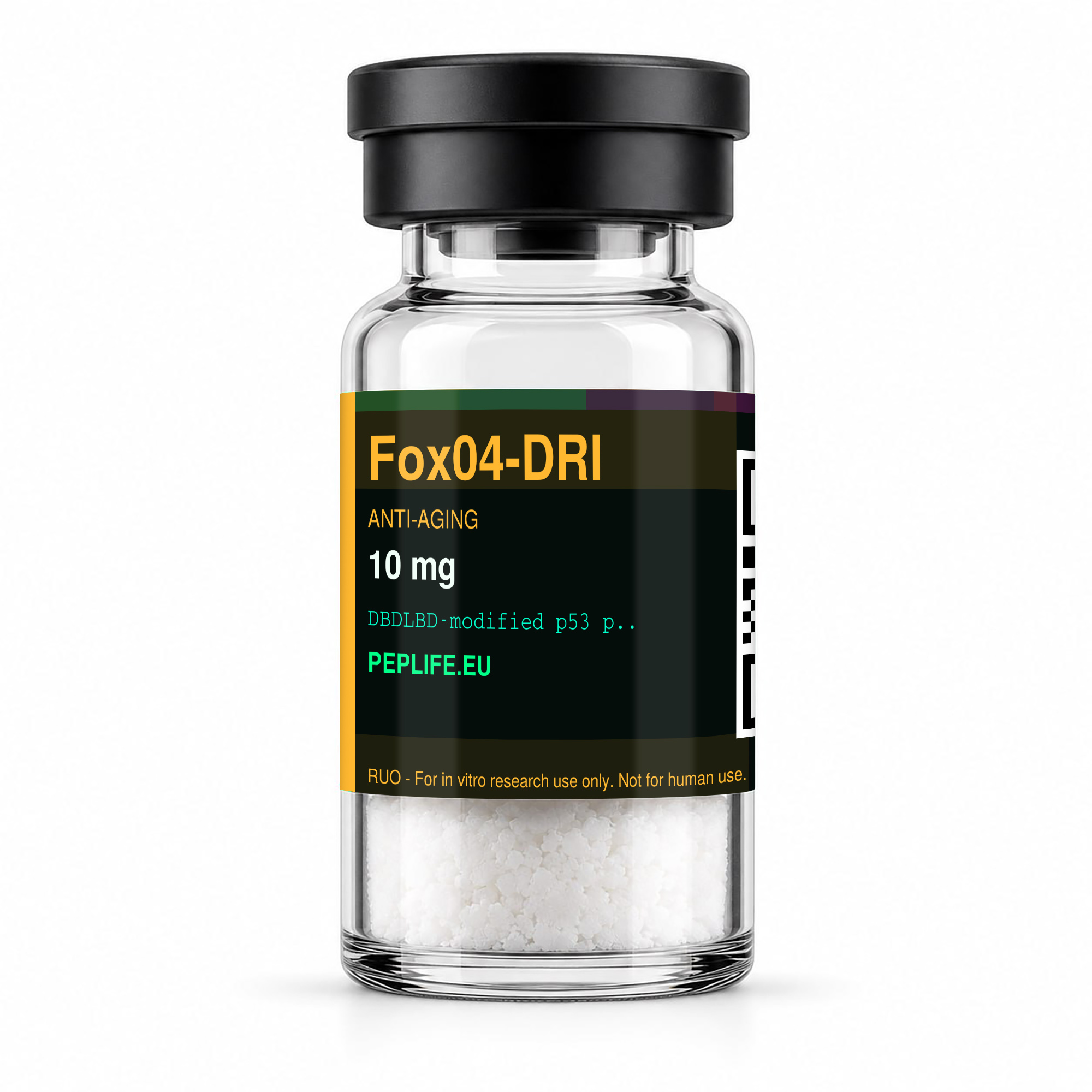
FOXO4-DRI research is central to one of the most discussed branches of ageing biology: the targeted clearance of senescent cells, also called “zombie cells”. This peptide was designed in the laboratory of Peter de Keizer and described in a groundbreaking study in the journal Cell (Baar et al., 2017). Since then, FOXO4-DRI has grown into a model compound with which researchers study how to selectively eliminate aged cells without affecting healthy cells. Below we set out the mechanism, the key studies and the frequently asked questions — strictly in the context of laboratory research.
What is FOXO4-DRI?
FOXO4-DRI is a small, cell-penetrating peptide. The name refers to two things: “FOXO4” because the amino acid sequence is derived from the transcription factor FOXO4, and “DRI” (D-Retro-Inverso) because it is built from mirror-image amino acids (D-form) in reverse order. This DRI structure makes the peptide much more stable against breakdown by enzymes and increases the affinity for the target, while retaining the three-dimensional shape it recognises. In addition, a cell-penetrating part (derived from the HIV-TAT domain) is coupled to the peptide, allowing it to enter the cell in cell culture models. FOXO4-DRI is also referred to by the project name Proxofim.
How does FOXO4-DRI work? — the mechanism
To understand FOXO4-DRI research, one protein-protein interaction is the key: that between FOXO4 and p53. In senescent cells, p53 — a classic “guardian” protein that can drive cell death (apoptosis) — is normally kept in check. FOXO4 binds to p53 and holds it in the cell nucleus, so that the senescent cell remains in a kind of survival mode instead of clearing itself away. FOXO4-DRI intervenes at exactly this point: it mimics a piece of FOXO4 and displaces the real FOXO4 from p53.
A study in Nature Communications (2025) mapped this mechanism at the molecular level. Researchers showed that the unstructured transactivation domain of p53 (p53TAD2) is the binding target, and that FOXO4-DRI binds to the same site with a higher affinity than the natural FOXO4. Both the peptide and this p53 domain are unfolded when loose in solution, but fold together upon binding. The consequence in the studied models: p53 is kept out of the cell nucleus, relocated to the mitochondria and there sets in motion a cell-intrinsic apoptosis programme — selectively in cells where the FOXO4-p53 axis is elevated in activity, that is, senescent cells.
What is FOXO4-DRI studied for?
FOXO4-DRI is studied almost exclusively as a senolytic: a compound that selectively clears senescent cells. The most important research areas:
- Ageing (longevity): in the original Cell-study by Baar et al. (2017), FOXO4-DRI was administered to both fast-ageing and naturally aged mice. Researchers reported restoration of fitness (running-wheel activity), coat density and kidney function, without clear toxicity in the models used.
- Chemotherapy damage: in the same study it was investigated whether FOXO4-DRI could counteract the damage from doxorubicin (a chemotherapeutic that induces senescence) in animal models.
- Joint research: a 2021 study investigated whether FOXO4-DRI could selectively remove senescent cells from in-vitro cultured human cartilage cells (chondrocytes), relevant for osteoarthritis research.
- Endocrine ageing: a study in Aging (2020) studied senescent Leydig cells in aged mice and the role of the FOXO4-p53 axis in age-related testosterone production.
For a broader overview of how senolytics and other anti-ageing peptides relate to each other, our pillar on longevity peptides and ageing research a good starting point.
FOXO4-DRI research in the lab: handling & dissolving
FOXO4-DRI is supplied as a freeze-dried (lyophilised) powder in a vial. For in-vitro work it is usually reconstituted with bacteriostatic or sterile water, after which it is diluted according to the research protocol. Because it is a relatively large and sensitive peptide, researchers pay attention to gentle mixing (do not shake), cool and dark storage and avoiding repeated freeze-thaw cycles. A practical explanation of fluid choice and method is in our pillar reconstitute peptides and which liquid you use to dissolve a peptide. All handling takes place exclusively within a laboratory environment.
Quality & purity
For reliable research, the identity and purity of the peptide are decisive. Every relevant batch is independently HPLC-tested by an external laboratory; the certificate of analysis (CoA) is publicly verifiable per batch. For a complex DRI peptide like FOXO4-DRI this is extra important, because synthesis and purification steps affect the purity and thereby the reproducibility of experiments. How we deal with batch control — including when we reject a lot — you can read in why we rejected a batch.
Frequently asked questions about FOXO4-DRI
What does the “DRI” in FOXO4-DRI mean?
DRI stands for D-Retro-Inverso: the peptide is built from D-amino acids in reverse order. This design choice makes the peptide more stable against enzymatic breakdown and increases the binding affinity for p53 in research, while retaining the recognised spatial shape.
What is a senolytic?
A senolytic is a compound that, in research, selectively drives senescent cells into apoptosis (cell death). Senescent cells are cells that no longer divide but do not disappear; they secrete pro-inflammatory substances and are associated with ageing in the literature. FOXO4-DRI is studied as an example of such a senolytic compound.
Is FOXO4-DRI the same as Proxofim?
Yes, Proxofim is the project name given to FOXO4-DRI by the original research group. Both refer to the same FOXO4-derived senolytic peptide.
How does FOXO4-DRI research differ from other anti-ageing peptides?
Peptides such as Epitalon and compounds around NAD⁺ are studied for other mechanisms (respectively telomere- and pineal-related processes and cellular energy metabolism). FOXO4-DRI specifically targets the elimination of already senescent cells via the FOXO4-p53 route, not the adjustment of the metabolism of healthy cells.
Are there human studies with FOXO4-DRI?
Most FOXO4-DRI research is preclinical: carried out in cell culture (in vitro) and in animal models. There are no approved human applications. FOXO4-DRI is therefore offered exclusively as a research compound.
Why does FOXO4-DRI, in theory, affect only senescent cells?
In the studied models, the FOXO4-p53 interaction is mainly elevated in senescent cells. By disrupting precisely that interaction, the apoptosis signal is selectively activated in cells where this axis is active, while healthy cells remain largely unaffected — an explanation that researchers are testing further.
Read more & research at Peplife
- Research FOXO4-DRI at Peplife
- View all anti-aging peptides
- Longevity peptides: the research into ageing
- NAD+ and glutathione in research
- Research Epitalon & Research NAD+
Sources: Baar et al., Cell 2017 — Targeted Apoptosis of Senescent Cells · Nature Communications 2025 — p53 transactivation domain as target of FOXO4-DRI · Nature Reviews Drug Discovery 2017 — FOXO4 inhibition eliminates senescent cells · Aging 2020 — FOXO4-DRI and senescent Leydig cells
Research Use Only. All products are supplied exclusively for in vitro laboratory research. Not intended for diagnostic or therapeutic use in humans or animals, and not approved by the EMA or FDA.
FOXO4-DRI from Peplife: HPLC-tested, a publicly verifiable CoA per batch and discreet shipping within the EU.