




| Aliases | Tβ4 core |
| Class | Repair/tissue |
| Molecular weight (Da) | ~889 ‡ |
| Half-life (indicative) | short † |
| Research status | Preclinical / RUO |
Research context (RUO): Frag 17-23 is a short peptide fragment (Ac-LKKTETQ) that corresponds to the actin-binding core of Thymosin Beta-4 (TB-500) and is studied within tissue-repair research. It is supplied exclusively for in vitro laboratory research and is not intended for human or animal use.
Frag 17-23 research: the repair-peptide fragment dissected
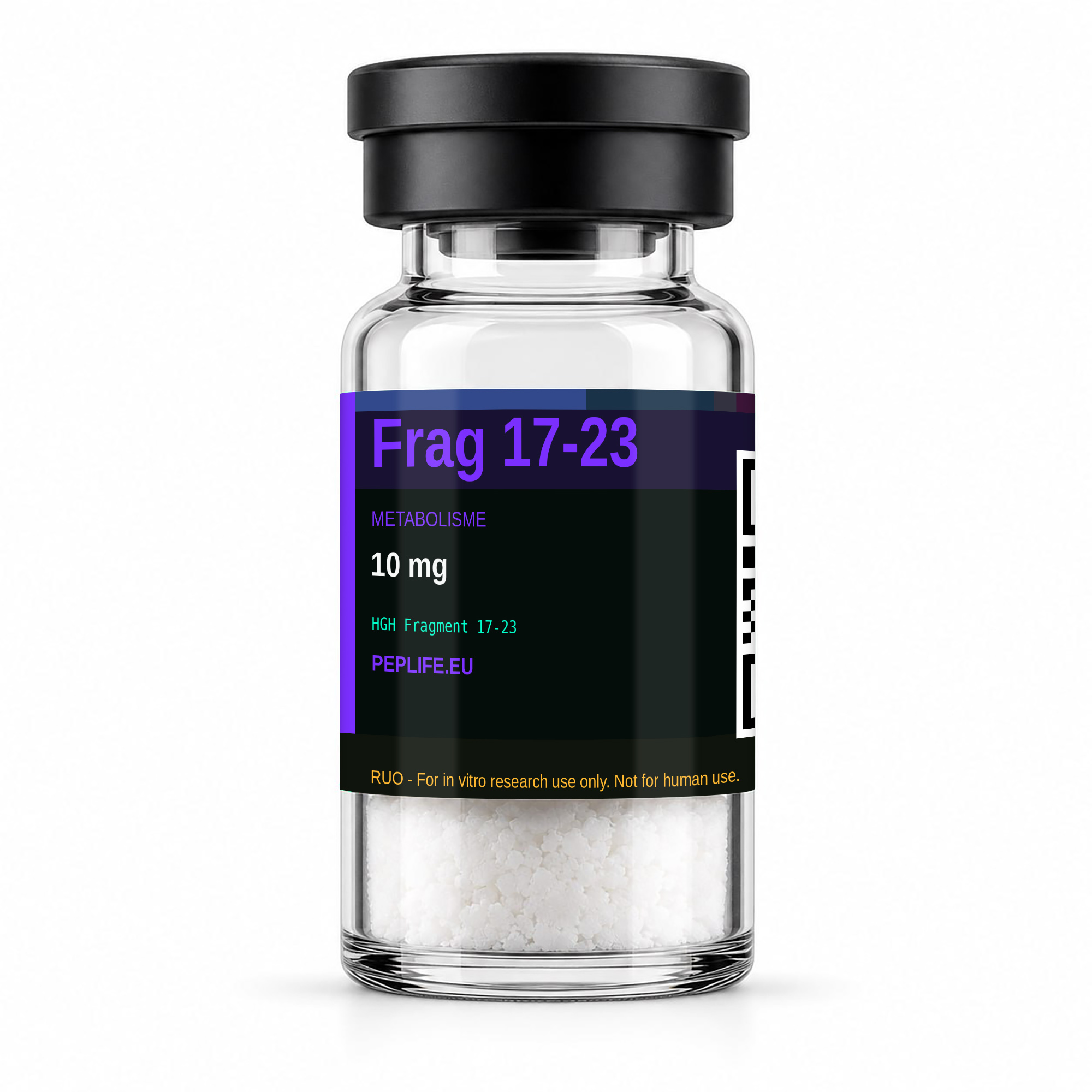
Anyone who delves into Frag 17-23 research quickly arrives at a fascinating question: can a tiny piece of a larger repair peptide already be biologically active on its own? Frag 17-23 is exactly such a piece. It is not a stand-alone new molecule, but a fragment of seven amino acids that corresponds exactly to amino acids 17 through 23 of Thymosin Beta-4 — the protein better known in the peptide world as TB-500. Researchers are particularly interested in this segment because it contains the so-called actin-binding site of the full protein, the part that is linked in studies to cell migration, blood-vessel formation and tissue repair.
What is Frag 17-23?
Frag 17-23 is a heptapeptide with the sequence Ac-LKKTETQ (leucine-lysine-lysine-threonine-glutamic acid-threonine-glutamine, with an acetyl group at the start). The name simply refers to the position in the chain: it is residues 17 to 23 of the 43-amino-acid Thymosin Beta-4. Within that full protein, the shorter sequence LKKTET (residues 17-22) is highly conserved across all beta-thymosins and is usually called the actin-binding motif. Frag 17-23 adds one residue (glutamine) to it. In research on repair peptides, Frag 17-23 is therefore regarded as the "working core" of TB-500, isolated and studied separately to determine which part of the large molecule is responsible for which observed effects.
How does Frag 17-23 work? — the mechanism
To understand the mechanism, it helps to know what the parent protein does. Thymosin Beta-4 is the most important actin-binding protein in the cell: it binds free G-actin proteins (globular actin) and thereby maintains a reserve of building blocks that the cell needs to build up and break down its skeleton (the F-actin filaments). This cytoskeleton directs the shape and movement of cells. Researchers suspect that it is precisely the actin-binding segment — the region that Frag 17-23 coincides with — that plays a key role in the effects associated with TB-500. In a much-cited study by Philp and colleagues (FASEB Journal, 2003), researchers showed that an actin-binding motif of seven amino acids is essential for the angiogenic (blood-vessel-forming) activity of Thymosin Beta-4. In migration experiments with human endothelial cells (HUVEC), this short motif showed activity comparable to the full protein at around 50 nM, whereas peptides from which part of the actin motif had been cut out proved inactive. This makes Frag 17-23 an interesting subject for research into which part of TB-500 carries the biological activity.
What is Frag 17-23 researched for?
Frag 17-23 research moves almost entirely within the context of tissue repair, and therefore overlaps strongly with the broader research on Thymosin Beta-4. In a review study by Sosne and colleagues (FASEB Journal, 2010), the biological activity of Thymosin Beta-4 was broken down into short, active peptide sequences. In it, the authors described that the sequence LKKTETQ, coinciding with the actin-binding region (amino acids 17-23), was associated in research with angiogenesis, wound healing and cell migration. Important focus areas within this research are:
- Angiogenesis (blood vessel formation): in endothelial-cell and vascular-sprouting models (including chicken-aorta segments), the actin-binding fragment was associated with the outgrowth of new vascular structures, comparable to the full protein.
- Cell migration: researchers study whether the fragment facilitates the directed movement of cells such as endothelial cells, keratinocytes and fibroblasts — a process central to the closing of tissue damage in laboratory models.
- Tissue repair & wound healing: as the "active site" of TB-500, Frag 17-23 is investigated for the extent to which it reproduces the repair-related effects of the parent protein.
- Structure-function research: a large part of the interest is fundamental — researchers use the fragment to unravel which part of Thymosin Beta-4 is responsible for which observed activity.
To be fair: the published literature that specifically carries the name "Frag 17-23" is more limited than that of many better-known peptides. Most of the evidence comes indirectly, from research on Thymosin Beta-4 and its actin-binding motif. This is therefore emphatically a preclinical, laboratory-oriented research field; there are no approved applications.
Frag 17-23 in laboratory research: handling & dissolving
Like most research peptides, Frag 17-23 is supplied as a freeze-dried (lyophilised) powder that is reconstituted in the laboratory, usually with bacteriostatic or sterile water. Short peptides such as this heptapeptide are sensitive to repeated freeze-thaw cycles and prolonged exposure to room temperature; research protocols therefore recommend cool, dark storage of the reconstituted material. For the practical steps involved in preparing a stock solution, the knowledge-base page reconstitute peptides useful, and for choosing the right solvent, the pillar dissolve peptide: which liquid.
Quality & purity
Because short fragments come with their own challenges in synthesis and purification, analytical control is essential for reliable research. Every relevant batch is independently HPLC-tested by an external laboratory; the certificate of analysis (CoA) is publicly verifiable per batch, so the identity and purity of the supplied Frag 17-23 can be verified before it is used in a research setup. Why this control is not a formality is shown by the pillar why we rejected a batch.
Frequently asked questions about Frag 17-23
Is Frag 17-23 the same as TB-500?
No, but they are closely related. Frag 17-23 is a seven-amino-acid fragment (Ac-LKKTETQ) that corresponds exactly to residues 17-23 of Thymosin Beta-4, i.e. TB-500. It is therefore the isolated actin-binding core of the larger molecule, not a separate protein. In research, it is studied to determine which part of TB-500 carries the biological activity.
Is Frag 17-23 a BPC-157 fragment?
No. In some repair contexts, Frag 17-23 and BPC-157 are mentioned together because both fall within tissue-repair research and are sometimes offered in blends. Structurally, however, Frag 17-23 is a fragment of Thymosin Beta-4 (TB-500), not of BPC-157. BPC-157 is a separate pentadecapeptide with its own sequence.
What does the name “17-23” stand for?
The numbers refer to the position of the amino acids in the chain of the parent protein Thymosin Beta-4: they denote residues 17 through 23. This region contains the conserved actin-binding motif (LKKTET), which is linked in studies to angiogenesis and cell migration.
What is Frag 17-23 used for in research?
It is studied in preclinical, in vitro research in the context of angiogenesis, cell migration and tissue repair, and as a tool in structure-function research on TB-500. There are no approved applications; it is intended exclusively for laboratory research.
Is there much literature specifically on Frag 17-23?
Limited. Most of the supporting evidence comes indirectly from research on Thymosin Beta-4 and its actin-binding motif, such as the studies by Philp et al. (2003) and Sosne et al. (2010). The fragment itself is mainly the subject of fundamental structure-function research.
How is Frag 17-23 stored in the lab?
As a lyophilised powder, cool and dark; after reconstitution with bacteriostatic or sterile water, research protocols recommend refrigerated storage and avoiding repeated freeze-thaw cycles, as short peptides are sensitive to these.
Read more & research at Peplife
- Research Frag 17-23 at Peplife
- View all recovery peptides
- TB-500 research: the parent peptide of Frag 17-23
- BPC-157 research: the repair peptide in context
- Research TB-500 at Peplife
- Research BPC-157 at Peplife
Sources: Philp et al., FASEB J 2003 — The actin binding site on thymosin β4 promotes angiogenesis · Sosne et al., FASEB J 2010 — Biological activities of thymosin β4 defined by active sites in short peptide sequences · Progress on the Function and Application of Thymosin β4 (review, 2021) · Thymosin beta-4 — overview
Research Use Only. All products are supplied exclusively for in vitro laboratory research. Not intended for diagnostic or therapeutic use in humans or animals, and not approved by the EMA or FDA.
HPLC-tested by an external laboratory, with a per-batch verifiable CoA and discreet EU shipping.