




| Aliases | Pralmorelin |
| Class | GH secretagogue (GHRP) |
| Molecular weight (Da) | 817.9 |
| Half-life (indicative) | ~15–60 min |
| Research status | Preclinical / RUO |
Research context (RUO): GHRP-2 (pralmorelin) is a synthetic growth hormone-releasing peptide that, as a ghrelin receptor agonist, stimulates the release of growth hormone. This material is supplied exclusively for in vitro laboratory research and is not intended for human or animal use.
GHRP-2 research: the growth hormone-releasing peptide that drives the GH axis
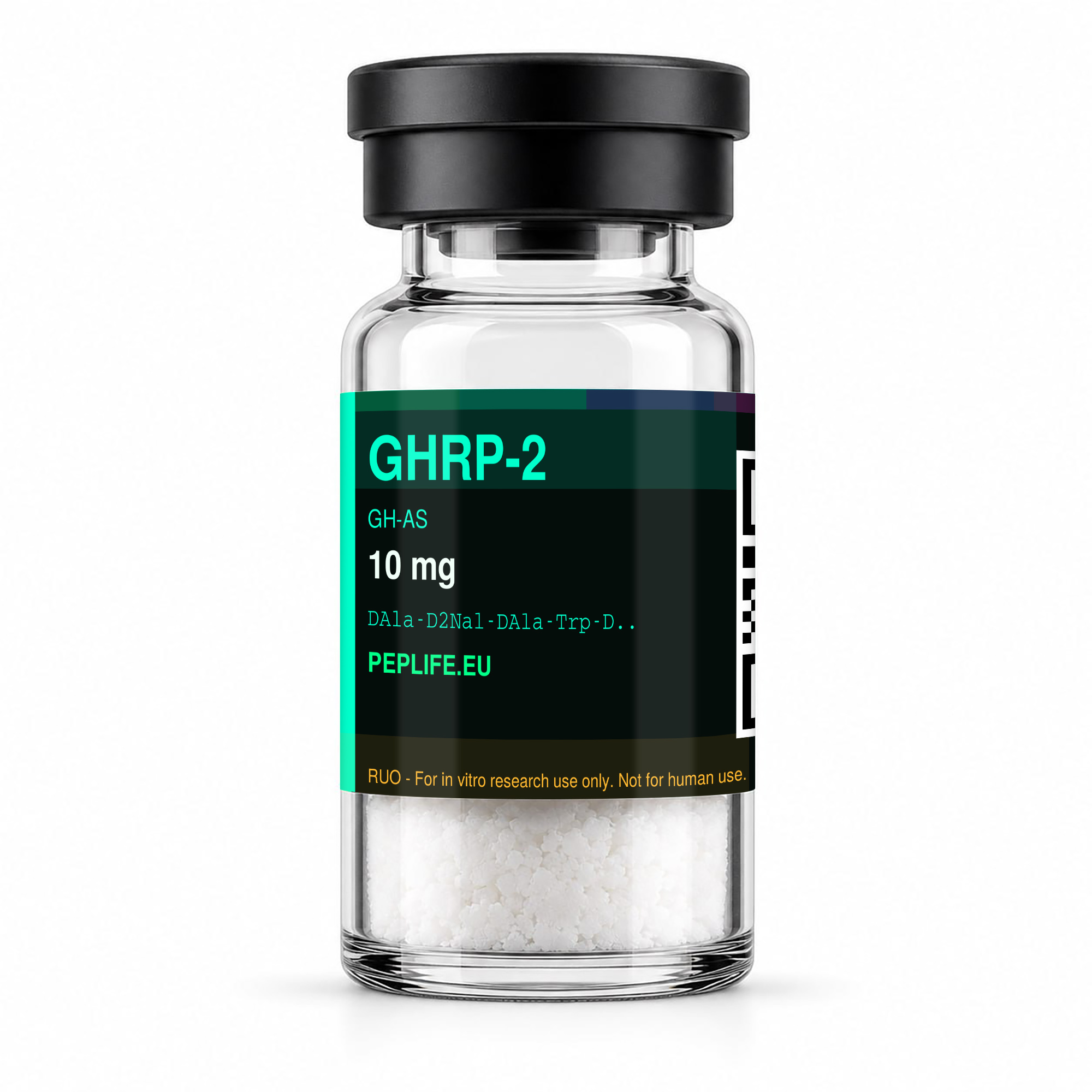
GHRP-2 research focuses on one of the best-studied growth hormone-releasing peptides (GHRPs): a short synthetic peptide that activates the ghrelin receptor and thereby triggers the pituitary's own growth hormone release. Whereas many other GH-axis peptides behave as an analogue of a single natural signal, GHRP-2 mimics the hunger signal ghrelin — and it is precisely this dual role (growth hormone plus appetite) that makes the peptide interesting to researchers. On this page, we set out exactly what GHRP-2 is, how the mechanism works via the GHS receptor and what the substance is studied for in preclinical and clinical studies.
What is GHRP-2?
GHRP-2, also known by the generic name pralmorelin, is a synthetic hexapeptide with the sequence D-Ala-D-(β-naphthyl)-Ala-Trp-D-Phe-Lys-NH2 (molecular formula C45H55N9O6, PubChem CID 6918245). The substance belongs to the family of growth hormone secretagogues (GHS): molecules that prompt the pituitary to secrete growth hormone (GH). GHRP-2 was historically one of the first compounds of this class to be studied clinically, and is registered in Japan as a diagnostic agent (GHRP Kaken 100) to assess growth hormone deficiency. Within GHRP-2 research, the peptide often serves as a reference against which newer secretagogues such as ipamorelin and hexarelin are compared.
How does GHRP-2 work? — the mechanism
The mechanism of action is central to almost every GHRP-2 study. GHRP-2 is an agonist of the growth hormone secretagogue receptor (GHS-R), better known as the ghrelin receptor. This is the same receptor on which the body's own "hunger hormone" ghrelin acts. By activating this receptor, GHRP-2 effectively does two things at once: it stimulates the somatotropic cells in the pituitary to release growth hormone, and at the same time it suppresses somatostatin's brake on that release. The result in research is a pronounced, pulsatile peak in plasma GH.
Important for researchers is that this mechanism is complementary to that of the GHRH analogues (such as sermorelin, CJC-1295 or tesamorelin), which act via a different receptor. Because GHRP-2 and GHRH act on the GH axis through different routes, studies often show a synergistic, more-than-additive effect when the two are combined. In addition, it has been described in animal research that GHRP-2, like ghrelin, influences appetite and food intake — a direct consequence of its affinity for the ghrelin receptor.
What is GHRP-2 researched for?
GHRP-2 research spans several directions. In each, the peptide is viewed as a tool to unravel the biology of the GH axis and ghrelin signalling:
- Growth hormone release: in studies, GHRP-2 is used to test the pituitary's capacity for GH secretion; acute administration clearly and reliably increased plasma growth hormone in research.
- Diagnostics of GH deficiency: researchers study GHRP-2 as a provocation test, because the GH response is lower in deficiency than in healthy references, which yields a distinguishing signal.
- Appetite and metabolism: in a study in healthy men (Laferrère et al., 2005), GHRP-2 increased food intake, comparable to ghrelin — a starting point for research into cachexia and appetite regulation.
- GH axis in GHRH deficiency: in animal models, including GHRH-knockout mice, it was studied whether prolonged GHRP-2 administration can influence somatotropic function and growth, in order to unravel the role of the ghrelin route separately from GHRH.
GHRP-2 in laboratory research: handling & dissolving
GHRP-2 is supplied as a lyophilised (freeze-dried) powder and must be reconstituted before in vitro use, usually with bacteriostatic or sterile water. Careful reconstitution determines the stability and reliability of every experiment; a wrong choice of liquid or mixing too roughly can degrade the peptide. Researchers working with GHRP-2 therefore consult our pillar on reconstituting peptides and the guide which liquid you choose to dissolve a peptide. Storage is ideally done freeze-dried at low temperature and, after reconstitution, refrigerated and protected from light.
Quality & purity
The reliability of GHRP-2 research stands or falls with the purity of the starting material. Every relevant batch is independently HPLC-tested by an external laboratory; the certificate of analysis (CoA) is publicly verifiable per batch, so the identity and purity of the peptide are reproducible. For a realistic picture of what quality control means, we describe in why we rejected a batch how a batch fails against our own standard.
Frequently asked questions about GHRP-2
What is the difference between GHRP-2 and GHRP-6?
Both are growth hormone-releasing peptides that activate the ghrelin receptor. In research, GHRP-2 is known as more potent per microgram, whereas GHRP-6 gives a stronger appetite-stimulating signal in studies. They are often studied side by side to compare nuances in the GHS receptor response.
Is GHRP-2 the same as pralmorelin?
Yes. Pralmorelin is the generic (INN) name for GHRP-2. Under that name, the peptide is registered in Japan as a diagnostic agent for the assessment of growth hormone deficiency.
Why is GHRP-2 combined with GHRH peptides in research?
Because GHRP-2 (via the ghrelin receptor) and GHRH analogues (via the GHRH receptor) act on the pituitary through different routes. Studies report that the combined GH response is greater than the sum of the two individually — a synergistic effect that sheds light on GH-axis physiology.
How does GHRP-2 differ from ipamorelin?
Ipamorelin is a newer, more selective GHS agonist that in research shows less influence on cortisol, prolactin and appetite than GHRP-2. GHRP-2 gives a more powerful GH peak but is less selective; the two are therefore regularly compared in studies on receptor selectivity.
Is GHRP-2 supplied in solid or liquid form?
GHRP-2 is supplied as a freeze-dried powder and must be reconstituted before in vitro experiments. See our reconstitution pillar for the points of attention.
May GHRP-2 be used for human use?
No. All GHRP-2 supplied by Peplife is intended exclusively for in vitro laboratory research (Research Use Only) and not for diagnostic or therapeutic use in humans or animals.
Read more & research at Peplife
- Research GHRP-2 at Peplife
- View all GH axis peptides
- Growth hormone peptides: the complete guide
- Ipamorelin research: the selective GH secretagogue
- Research GHRP-6
- Research Ipamorelin
- Research Hexarelin
Sources: Pralmorelin (Wikipedia) · PubChem CID 6918245 · Laferrère et al., JCEM 2005 (PMID 15699539) · GHRP-2 in the GHRH-knockout mouse, Am J Physiol Endocrinol Metab 2005
Research Use Only. All products are supplied exclusively for in vitro laboratory research. Not intended for diagnostic or therapeutic use in humans or animals, and not approved by the EMA or FDA.
GHRP-2 for laboratory research: HPLC-tested by an external laboratory, CoA publicly verifiable per batch and discreet shipping within the EU.