




| Class | Growth factor (IGF-1 analogue) |
| Molecular weight (Da) | ~9111 |
| Half-life (indicative) | ~20–30 h |
| Research status | Preclinical / RUO |
Research context (RUO): IGF-1 LR3 is a long-acting analogue of insulin-like growth factor 1 (IGF-1) that is studied to better understand cell proliferation and muscle growth via the IGF-1 receptor. It is supplied exclusively for in vitro laboratory research and is not intended for human or animal use.
IGF-1 LR3 research: the long-acting IGF-1 analogue
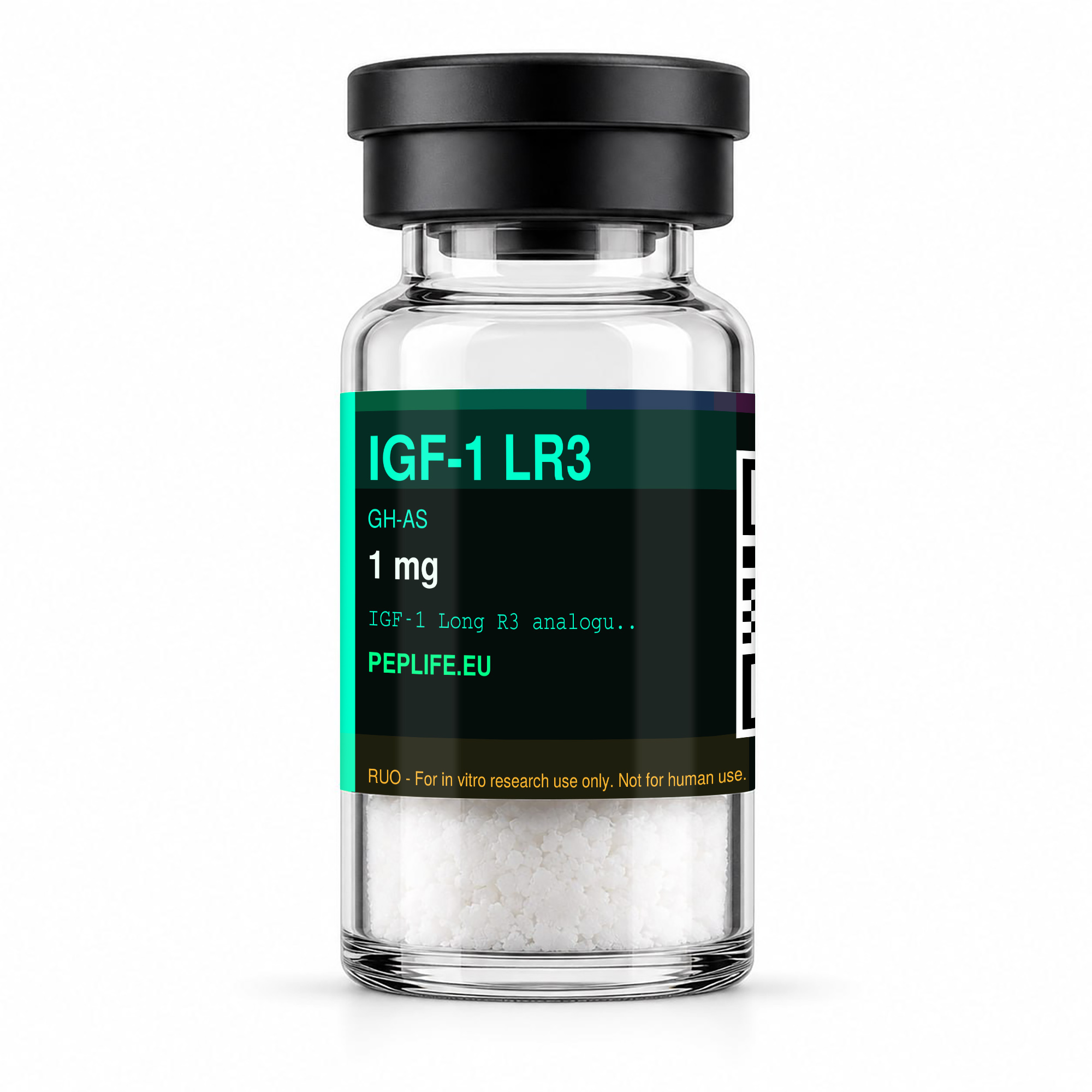
Het IGF-1 LR3 research revolves around one central question: what happens if you modify natural IGF-1 so that it stays active much longer and is barely captured by binding proteins? IGF-1 LR3 (Long [Arg3]-IGF-I) is exactly such a molecule. Researchers use it as a model compound to unravel the role of the IGF-1 signalling route in cell growth, tissue build-up and repair, precisely because the extended half-life makes long-term experiments more practical than with short-lived IGF-1.
What is IGF-1 LR3?
IGF-1 LR3 is a synthetic, recombinant analogue of human IGF-1. Whereas natural IGF-1 consists of 70 amino acids, IGF-1 LR3 has 83. According to the descriptions of this compound, this is due to two modifications: the amino acid at position 3 (glutamic acid) has been replaced by arginine — the "Arg3" substitution — and an additional thirteen-amino-acid extension has been added to the N-terminus, which explains the "Long" in the name. These two changes together give the molecule its characteristic properties. In the literature it is also referred to as Long R3 IGF-I or LR3-IGF-I; PubChem catalogues it as "Long-(arg3)insulin-like growth factor-I".
How does IGF-1 LR3 work? — the mechanism
Like natural IGF-1, IGF-1 LR3 acts as an agonist of the IGF-1 receptor (IGF-1R), a receptor that drives cell division, protein synthesis and cell survival. The difference lies in availability. In the body, natural IGF-1 is largely bound by IGF-binding proteins (IGFBPs), which regulate it and limit the active fraction. Because of the Arg3 substitution, IGF-1 LR3 has a strongly reduced affinity for those binding proteins. As a result, a larger part remains free and available to activate the receptor, and in descriptions of the analogue a considerably longer half-life is reported than that of natural IGF-1. In research, this makes IGF-1 LR3 an attractive tool to study long-term IGF-1R activation without having to re-dose each time.
When IGF-1R is activated, intracellular signalling routes such as the PI3K/Akt and the MAPK route are set in motion. In reviews on IGF-1 and skeletal muscle, these routes are described as central switches between muscle build-up (hypertrophy) and muscle breakdown (atrophy). That mechanistic framework explains why researchers use IGF-1 LR3 to study proliferation and protein metabolism in cell models.
What is IGF-1 LR3 researched for?
IGF-1 LR3 research focuses mainly on processes in which the IGF-1 signalling route plays a directing role. Effects are consistently attributed below to the studies and models concerned, not to any application by the reader.
- Cell proliferation in vitro: IGF-1 LR3 is studied and used on a large scale in biotechnology as a growth supplement in cell-culture media, because it can support cell division and survival of cultured cells at lower concentrations than natural IGF-1.
- Muscle growth and protein metabolism: reviews on IGF-1-mediated regulation of skeletal muscle describe how activation of IGF-1R influences the balance between hypertrophy and atrophy; IGF-1 LR3 serves here as a long-acting model to study those routes.
- Organ and tissue growth in animal models: in a 1995 study, researchers reported that infusion of Long R3 IGF-I in guinea pigs stimulated the growth of organs, while the plasma concentrations of IGF-I, IGF-II and IGF-binding proteins actually decreased — an illustration of how the analogue influences the endogenous system.
- Metabolism and catabolic states: researchers have studied LR3-IGF-I in models of food restriction and muscle breakdown to understand how IGF-1R activation influences body weight and tissue preservation.
IGF-1 LR3 in laboratory research: handling & dissolving
IGF-1 LR3 is supplied as a freeze-dried (lyophilised) powder that is reconstituted in a suitable liquid before use. Which liquid researchers choose and how they dissolve a peptide depends on the research protocol; background on this is in our pillars on reconstituting a peptide and which liquid is suitable for dissolving a peptide. As a protein, IGF-1 LR3 is sensitive to repeated thawing and freezing; the literature points to careful storage to limit degradation and loss of biological activity.
Quality & purity
Every relevant batch is independently HPLC-tested by an external laboratory; the certificate of analysis (CoA) is publicly verifiable per batch. For a sensitive protein analogue such as IGF-1 LR3 this is important, because misfolded or degraded variants can distort the outcomes of in vitro experiments. Reproducible research starts with a raw material of known purity and identity.
Frequently asked questions about IGF-1 LR3
What is the difference between IGF-1 LR3 and ordinary IGF-1?
IGF-1 LR3 is an extended analogue of IGF-1 with an arginine at position 3 and an additional N-terminal sequence. As a result, it has a much lower affinity for IGF-binding proteins and a longer half-life, while activating the same IGF-1 receptor. That makes it more suitable in research for long-term experiments.
Why is the half-life of IGF-1 LR3 longer?
Because the Arg3 substitution greatly reduces binding to IGF-binding proteins, the analogue is captured and regulated less quickly. In descriptions of the compound, a considerably longer half-life is therefore reported than for natural IGF-1.
What is IGF-1 LR3 used for in research?
It is studied in connection with cell proliferation in vitro, muscle-protein metabolism via the IGF-1R route and, in animal models, organ and tissue growth. In biotechnology it is also used as a growth supplement in cell-culture media.
Does IGF-1 LR3 work via the same receptor as MGF or IGF-1 DES?
IGF-1 LR3, IGF-1 DES and MGF are all related to the IGF-1 family and act on the IGF-1 signalling route, but differ in structure, half-life and receptor affinity. Researchers compare these analogues precisely to map those differences.
Is IGF-1 LR3 suitable for human use?
No. IGF-1 LR3 is supplied exclusively for in vitro laboratory research. It is not intended for human or animal use and not approved for diagnostic or therapeutic purposes.
How is IGF-1 LR3 stored and reconstituted?
It is supplied as a freeze-dried powder and, before use, dissolved in a suitable liquid according to the research protocol. As a protein, it is sensitive to repeated freezing and thawing; careful storage helps limit degradation.
Read more & research at Peplife
- Research IGF-1 LR3 at Peplife
- View all GH axis peptides
- Growth hormone peptides: the GH axis in research
- Research IGF-1 DES at Peplife
- MGF (Mechano Growth Factor) research at Peplife
- Research Follistatin-344 at Peplife
- IGF-1 LR3 vs IGF-1 DES
Sources: IGF-1 LR3 — overview (Wikipedia) · Long-(arg3)IGF-I — PubChem · Long R3 IGF-I infusion & organ growth — PubMed (1995) · IGF-1 & regulation of skeletal muscle — review (PMC)
Research Use Only. All products are supplied exclusively for in vitro laboratory research. Not intended for diagnostic or therapeutic use in humans or animals, and not approved by the EMA or FDA.
HPLC-tested by an external laboratory, CoA publicly verifiable per batch, discreet shipping within the EU.