




| Class | GH secretagogue (GHRP) |
| Molecular weight (Da) | 873.0 |
| Half-life (indicative) | ~15–60 min |
| Research status | Preclinical / RUO |
Research context (RUO): GHRP-6 (Growth Hormone-Releasing Peptide-6) is a synthetic growth hormone-releasing peptide that is studied as a ghrelin receptor agonist. It is supplied exclusively for in vitro laboratory research and is not intended for human or animal use.
GHRP-6 research: ghrelin agonist and GH release
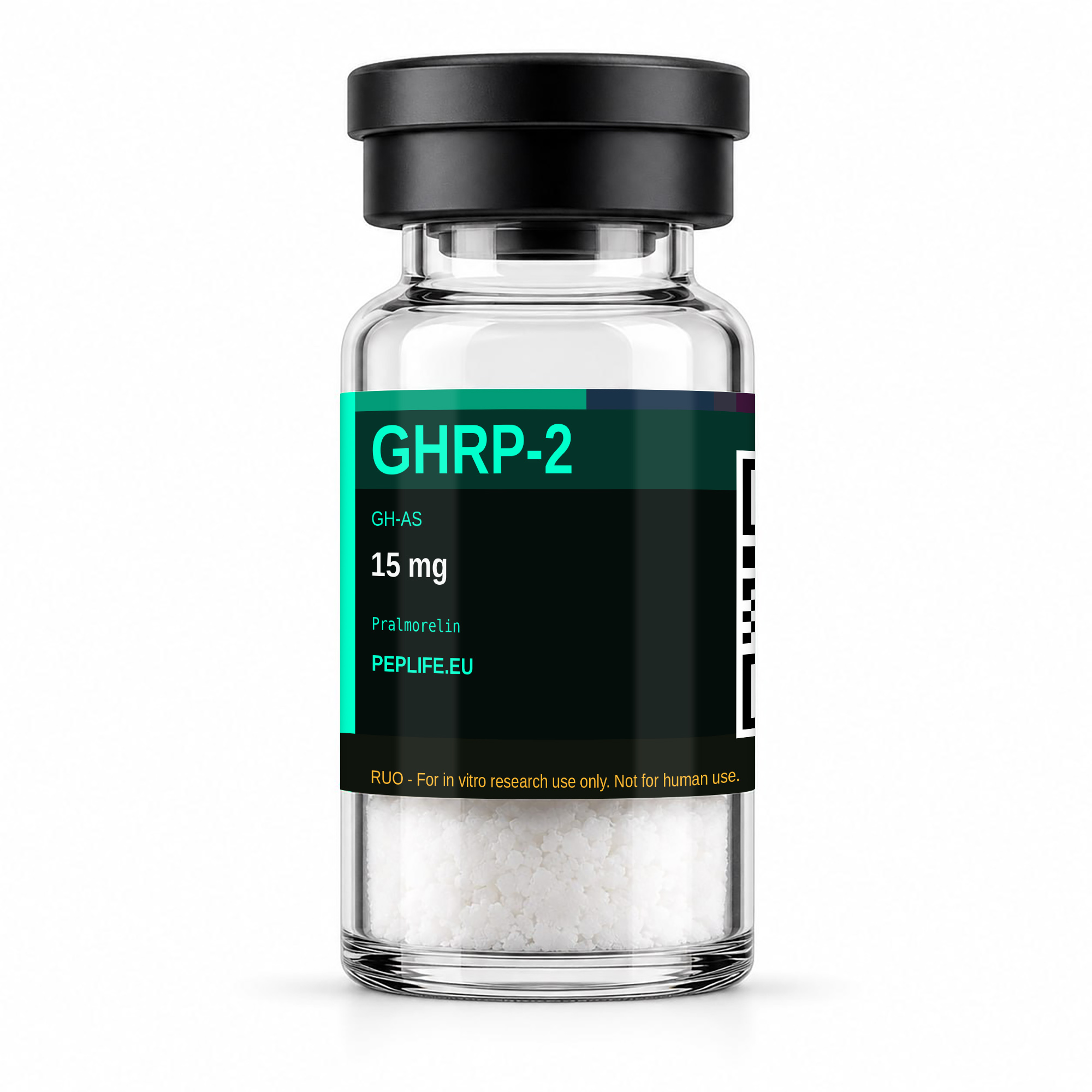
GHRP-6 research centres on one of the first synthetic growth hormone secretagogues: a small hexapeptide that in preclinical studies stimulates the release of growth hormone (GH) from the pituitary. GHRP-6 was already developed in the 1980s and used by researchers to understand how the body regulates the GH axis. The discovery that it acted on a hitherto unknown receptor ultimately led to the identification of ghrelin, the body's own hunger hormone. This makes GHRP-6 not only a research tool but also a historical turning point in neuroendocrinology.
What is GHRP-6?
GHRP-6 is a synthetic peptide consisting of six amino acids (His-D-Trp-Ala-Trp-D-Phe-Lys). It belongs to the class of growth hormone secretagogues (GHS): molecules that prompt the pituitary to secrete growth hormone. Unlike natural growth hormone-releasing hormone (GHRH), GHRP-6 acts on the ghrelin receptor, also called the growth hormone secretagogue receptor type 1a (GHS-R1a). When researchers in the 1990s tried to determine which endogenous substance this receptor responded to, they discovered ghrelin. GHRP-6 is therefore often described in the literature as a ghrelin mimetic or ghrelin receptor agonist.
Within the broader family of GHS peptides — with relatives such as GHRP-2, hexarelin and ipamorelin — GHRP-6 is regarded as the classic reference molecule against which the other compounds are compared. A striking feature in the research is that GHRP-6, unlike the more selective ipamorelin, also shows a clear appetite-stimulating component in animal models.
How does GHRP-6 work? — the mechanism
The mechanism of GHRP-6 revolves around activation of the GHS-R1a receptor, which is present in both the pituitary and the hypothalamus. When GHRP-6 binds to this receptor, a signalling cascade is activated in preclinical models that leads to pulsatile release of growth hormone. Researchers describe that GHRP-6 thereby works at two levels: directly on the somatotropic cells in the pituitary, and indirectly via the hypothalamus, where it can influence the release of GHRH and counteract the inhibitory action of somatostatin.
A key study (Bowers and colleagues, published in 1998) reported that GHRP-6 depends on endogenous hypothalamic GHRH for maximal GH stimulation — the two systems thus work synergistically rather than independently. This explains why GHRP peptides are often combined with GHRH analogues in research: together they produced a stronger GH peak in models than each separately. In addition, studies showed that GHRP-6, via the ghrelin/GHS-R route, also activates neurons in the hypothalamic appetite centres, which explains the observed effect on food intake.
What is GHRP-6 researched for?
In the scientific literature, GHRP-6 is mainly studied as a model compound to unravel the ghrelin/GH axis. The main research areas are:
- Growth hormone regulation: in preclinical studies, GHRP-6 was associated with an increased, pulsatile GH release via the pituitary, and with synergy when combined with GHRH.
- Appetite and food intake: in animal models — from rodents to goldfish — GHRP-6 mimicked the ghrelin effect and stimulated food intake, while suppressing locomotor activity. Researchers use this to map the central appetite circuits.
- IGF-1 signalling and neuronal models: in cell studies it was reported that GHRP-6 increased the mRNA levels of IGF-1 and activated the Akt signalling pathway in a neuronal cell model.
- Cytoprotection: researchers study whether GHRP-6 has protective effects on, among others, cardiac and liver cells in tissue models, independent of GH release.
GHRP-6 in laboratory research: handling & dissolving
GHRP-6 is supplied as a freeze-dried (lyophilised) powder that is reconstituted in a suitable liquid before in vitro use. For the right choice of solvent and the handling of lyophilised powder in a research setting, we refer to the knowledge-base pillar on reconstituting peptides and the overview dissolve peptide: which liquid. As with all GHS peptides, reconstituted material is stored cool and dark to safeguard stability within the research protocol.
Quality & purity
Every relevant batch of GHRP-6 is independently HPLC-tested by an external laboratory; the certificate of analysis (CoA) is publicly verifiable per batch. For research into the GH axis, a high, documented purity is essential, because contaminants or degradation products can distort the measurable outcomes in an in vitro model. A verifiable CoA makes it possible to link the identity and purity of the material used to the results — a basic condition for reproducible research.
Frequently asked questions about GHRP-6
What is the difference between GHRP-6 and GHRP-2?
Both are ghrelin receptor agonists from the same peptide family. In research it stands out that GHRP-6 shows a stronger appetite-stimulating component, whereas GHRP-2 showed a relatively more powerful GH release per dose in studies. Compare the two on the GHRP-2page.
Is GHRP-6 the same as ghrelin?
No. Ghrelin is an endogenous hormone; GHRP-6 is a synthetic peptide that acts on the same receptor (GHS-R1a) and mimics the ghrelin effect in models. GHRP-6 is therefore called a ghrelin mimetic.
Why is GHRP-6 often studied together with a GHRH analogue?
Because studies have shown that GHRP-6 and GHRH work synergistically: GH release was greater in models with the combination than with each peptide separately. Related GHRH analogues are discussed in the pillar on growth hormone peptides.
Why does GHRP-6 stimulate appetite in research?
Because it activates the ghrelin/GHS-R route, including neurons in the hypothalamic appetite centres. In animal models, administration was accompanied by increased food intake — an effect researchers use to study central hunger circuits.
May I use GHRP-6 myself?
No. GHRP-6 is supplied exclusively for in vitro laboratory research and is not intended for diagnostic or therapeutic use in humans or animals.
How is GHRP-6 stored in a laboratory?
The lyophilised powder is stored cool and dry; after reconstitution it is kept refrigerated and protected from light to preserve stability within the research protocol.
Read more & research at Peplife
- Research GHRP-6 at Peplife
- View all GH axis peptides
- Growth hormone peptides: the complete GH axis explained
- Research GHRP-2 at Peplife
- Research Hexarelin at Peplife
- Research Ipamorelin at Peplife
Sources: Bowers et al., GH-releasing peptide-6 requires endogenous hypothalamic GHRH for maximal GH stimulation (PubMed, 1998) · Actions of Agonists and Antagonists of the ghrelin/GHS-R Pathway on GH Secretion, Appetite, and cFos Activity (PMC) · Acute central ghrelin and GH secretagogues induce feeding and activate brain appetite centers (PubMed) · GHRP-6 increases IGF-I mRNA levels and activates Akt in a neuropeptide Y neurone model (PubMed)
Research Use Only. All products are supplied exclusively for in vitro laboratory research. Not intended for diagnostic or therapeutic use in humans or animals, and not approved by the EMA or FDA.
GHRP-6 for laboratory research: HPLC-tested by an external laboratory, CoA publicly verifiable per batch, discreet EU shipping.