




| Aliases | GnRH, LHRH |
| Class | GnRH decapeptide |
| Molecular weight (Da) | 1182.3 |
| Half-life (indicative) | ~2–10 min |
| Research status | Approved drug |
Research context (RUO): Gonadorelin is a synthetic form of gonadotropin-releasing hormone (GnRH) that in laboratory research drives the release of LH and FSH from the pituitary. It is supplied exclusively for in vitro laboratory research and is not intended for human or animal use.
Gonadorelin research: synthetic GnRH and the LH/FSH axis
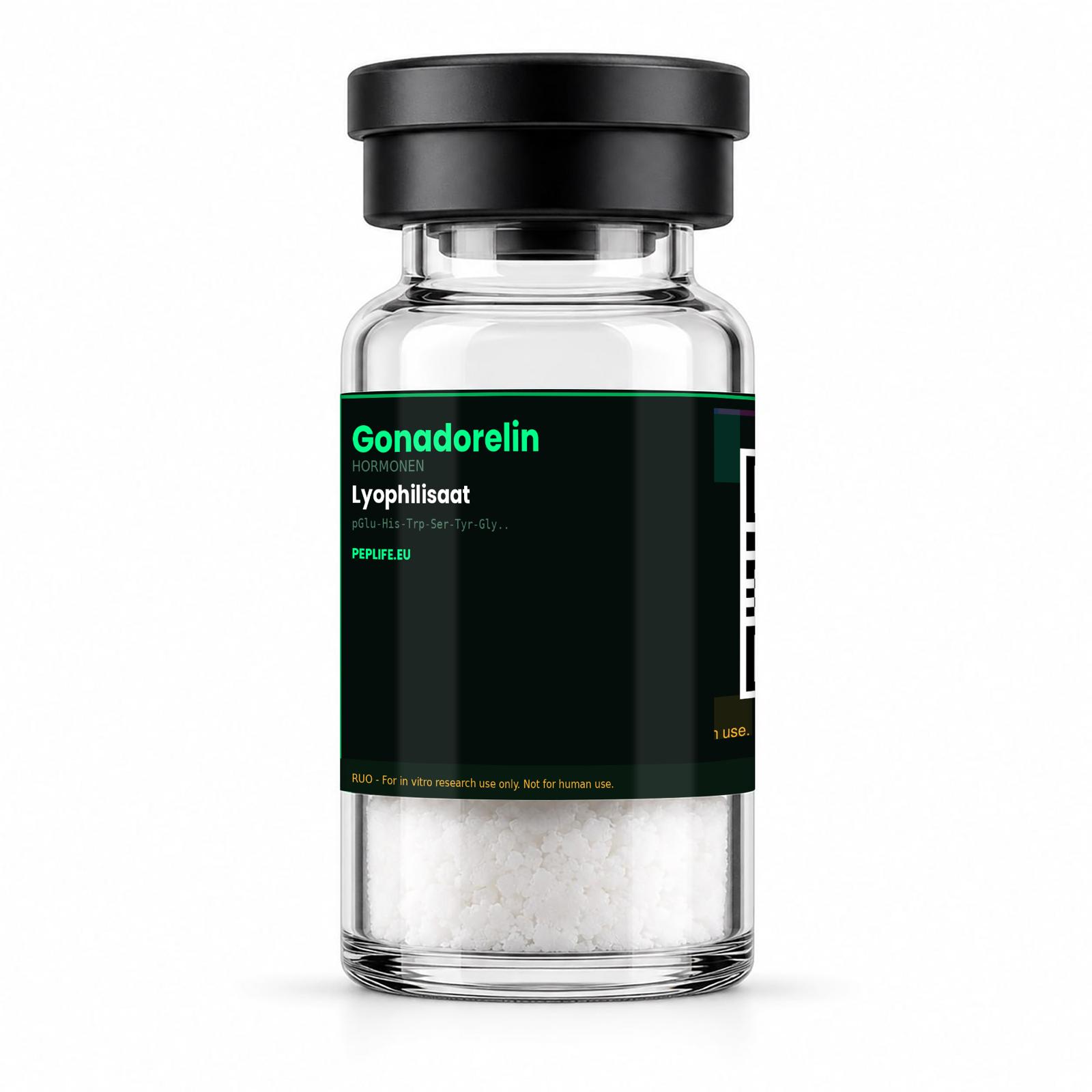
Gonadorelin research revolves around one central question: how does a small signalling peptide drive the entire reproductive hormone axis? Gonadorelin is the synthetic, chemically identical counterpart of the natural gonadotropin-releasing hormone (GnRH) that the hypothalamus produces. In research models it functions as the "start button" of the hypothalamic-pituitary-gonadal axis (the HPG axis): it binds to receptors on the pituitary and there triggers the release of luteinizing hormone (LH) and follicle-stimulating hormone (FSH). It is precisely because of this pivotal position that gonadorelin has for decades been a sought-after tool in endocrine research and as a diagnostic reagent to map pituitary function.
What is gonadorelin?
Gonadorelin is a decapeptide: a chain of ten amino acids with the molecular formula C55H75N17O13 (PubChem CID 638793). That sequence is identical to endogenous GnRH, also called LHRH (luteinizing-hormone-releasing hormone), which was identified in 1971. In the body, GnRH is made by a small group of specialised neurons in the hypothalamus and transported directly to the anterior lobe of the pituitary via the hypophyseal portal system. There it binds to G-protein-coupled GnRH receptors on the gonadotropic cells. Gonadorelin mimics this signal in research. Characteristic is the very short half-life: the distribution half-life is around 2 to 10 minutes and the molecule is rapidly broken down via hydrolysis into smaller fragments. That volatility makes it eminently suitable for studies in which researchers want to administer a sharp, short-lived signal.
How does gonadorelin work? — the mechanism
The most fascinating aspect emerging from gonadorelin research is that not the quantity but the rhythm of the signal is decisive. GnRH is physiologically released not continuously but in pulses. Researchers discovered that the pulse frequency governs which gonadotropin the pituitary releases: fast pulses promote the transcription and release of LH, whereas slow pulses instead favour FSH. In studies of men with a GnRH deficiency, mean LH rose with an increasing pulse frequency, whereas FSH barely changed — a fine illustration of this frequency-dependent switch.
Equally important is the flip side. When GnRH is instead continuous instead of being offered pulsatile, the opposite occurs after a brief initial stimulation: the GnRH receptors are downregulated and the gonadotropic cells become insensitive (desensitisation). In classic experiments in rhesus monkeys, pulsatile administration fully restored gonadotropin release, whereas continuous administration gave only a transient reaction. This explains why GnRH agonists, on prolonged, non-pulsatile exposure, paradoxically suppress the HPG axis rather than stimulate it. For researchers, gonadorelin is thereby a dual instrument: dosing pulsatile to drive the axis, or continuous to study desensitisation.
What is gonadorelin researched for?
Because gonadorelin touches the entry point of the reproductive axis, its field of application in research is broad:
- Pituitary function & diagnostics: in the GnRH stimulation test, gonadorelin is administered and the LH and FSH response is then measured. Studies of delayed puberty and gonadotropin deficiency use this test to distinguish whether a problem lies in the pituitary or in the gonads.
- Reproductive axis & fertility: researchers study how pulsatile GnRH signals drive the cycle, ovulation and spermatogenesis, and how disruptions in the pulse pattern are associated with reduced fertility.
- Neuroendocrine signal regulation: gonadorelin serves as a model compound to unravel GnRH receptor signalling, gene transcription and desensitisation at the cellular level.
- Puberty research: in studies of central precocious puberty, the GnRH stimulation response is used to objectively measure activation of the axis.
Gonadorelin in laboratory research: handling & dissolving
As a lyophilisate (freeze-dried powder), gonadorelin is sensitive to moisture and repeated temperature fluctuations. In research protocols it is usually reconstituted with bacteriostatic or sterile water, after which the solution is kept refrigerated and dark to limit degradation. Because of the short half-life, accurate concentration determination and fresh preparation are important for reproducible results. In our knowledge-base pillar on reconstituting peptides it is explained how researchers coordinate solvent, volume and storage.
Quality & purity
For reliable gonadorelin research, everything stands or falls with the purity of the starting material: contaminants or degradation products can distort the LH/FSH response in an assay. Every relevant batch is therefore independently HPLC-tested by an external laboratory; the certificate of analysis (CoA) is publicly verifiable per batch, so the mass, purity and identity of the peptide can be verified before it is used in a research setup.
Frequently asked questions about gonadorelin
What is the difference between gonadorelin and GnRH?
There is no chemical difference: gonadorelin is the synthetically made, identical copy of the natural gonadotropin-releasing hormone (GnRH/LHRH). The name "gonadorelin" refers to the manufactured research and reagent form of the same decapeptide.
Why is the pulse frequency so important in gonadorelin research?
Because the pulse pattern determines which gonadotropin the pituitary releases. In studies, fast pulses promote LH and slow pulses FSH, whereas continuous exposure, after a brief stimulation, instead leads to receptor desensitisation and suppression.
What does the GnRH stimulation test involve?
That is a diagnostic research protocol in which gonadorelin is administered and the rise in LH and FSH is then measured. Researchers use this response to assess the function of the pituitary-gonadal axis, for example in studies of delayed or precocious puberty.
How does gonadorelin relate to kisspeptin?
Kisspeptin lies one step "higher" in the axis than gonadorelin: it stimulates the GnRH neurons to release GnRH, whereas gonadorelin acts directly on the pituitary. Both are the subject of reproductive research; see our pillar on PT-141, kisspeptin and oxytocin.
Why does gonadorelin have such a short half-life?
The molecule is rapidly broken down via hydrolysis; the distribution half-life is around 2 to 10 minutes. This makes it suitable for giving a short, sharply defined signal in research without prolonged after-effect.
Is gonadorelin an agonist or antagonist?
Gonadorelin is a GnRH receptor agonist: it activates the receptor. Whether the result is stimulation or suppression depends in research on the administration pattern (pulsatile versus continuous).
Read more & research at Peplife
- Research Gonadorelin at Peplife
- View all GH axis peptides
- PT-141, kisspeptin & oxytocin: the reproductive axis investigated
- Research Kisspeptin-10 at Peplife
- Research Oxytocin at Peplife
Sources: StatPearls — Physiology, Gonadotropin-Releasing Hormone · Endotext — Physiology of GnRH and Gonadotrophin Secretion · PubChem — Gonadorelin (CID 638793) · Gonadorelin — overview
Research Use Only. All products are supplied exclusively for in vitro laboratory research. Not intended for diagnostic or therapeutic use in humans or animals, and not approved by the EMA or FDA.
Gonadorelin for the HPG axis: HPLC-tested, a publicly verifiable CoA per batch and discreet EU shipping.