




| Class | GH secretagogue (GHRP) |
| Molecular weight (Da) | 887.0 |
| Half-life (indicative) | ~1 h |
| Research status | Preclinical / RUO |
Research context (RUO): Hexarelin is a synthetic hexapeptide that, as a ghrelin analogue, activates the growth hormone secretagogue receptor. It is supplied exclusively for in vitro laboratory research and is not intended for human or animal use.
Hexarelin research: the potent ghrelin agonist
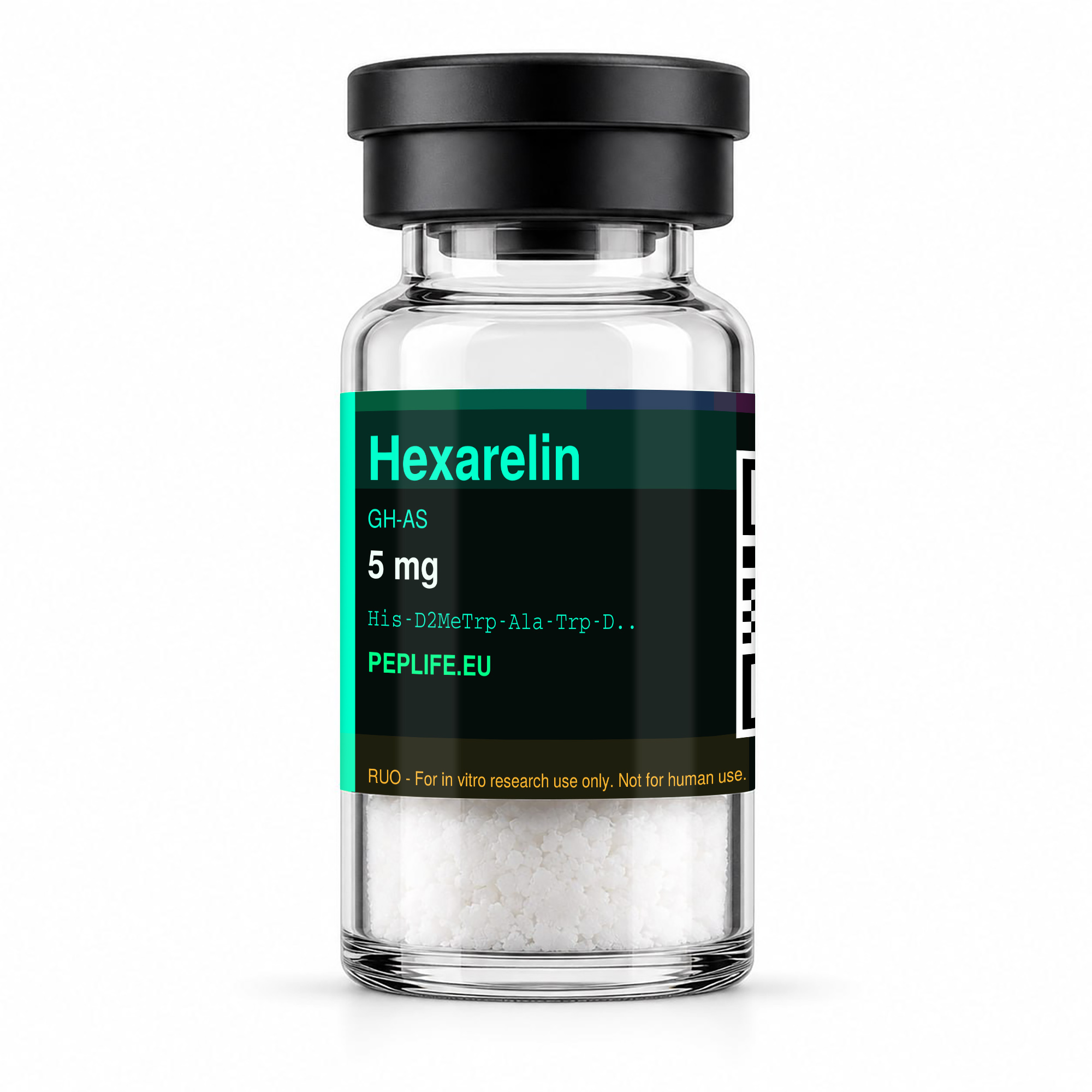
Hexarelin research revolves around one of the most powerful synthetic growth hormone-releasing peptides described to date. Hexarelin — chemically also known as examorelin — is a hexapeptide (a chain of six amino acids) that was developed as an analogue of GHRP-6 and that stood out in preclinical and clinical studies for how efficiently it triggered the release of growth hormone (GH). What makes hexarelin extra interesting to researchers is that it does not stop at one receptor route: besides the classic GH axis, it also touches a second route via the membrane protein CD36, which drew the attention of cardiovascular research groups.
What is hexarelin?
Hexarelin belongs to the family of growth hormone-releasing peptides (GHRPs). It is a small, synthetic molecule with the amino acid sequence His-D-2-methyl-Trp-Ala-Trp-D-Phe-Lys-NH2. Unlike growth hormone itself, which is a large and fragile protein, hexarelin is a compact peptide that is stable and easy to handle in laboratory research. In the catalogue it is offered as hexarelin acetate, the acetate salt form customary for research peptides. Chemically, the compound is documented in public databases such as PubChem, where hexarelin can be found under the name examorelin.
Within the broader group of GH-axis peptides, hexarelin is often compared with related secretagogues such as GHRP-2, GHRP-6 and ipamorelin. Each of these peptides acts on the same receptor route but differs in potency, selectivity and secondary routes — precisely the properties that researchers study in comparative studies.
How does hexarelin work? — the mechanism
Hexarelin is an agonist of the growth hormone secretagogue receptor (GHS-R1a), the same receptor on which the body's own hunger hormone ghrelin acts. When hexarelin binds to this receptor, it triggers a signalling cascade in the pituitary that leads to the release of stored growth hormone. In an early characterisation study, researchers described the mechanism of hexarelin as a specific, dose-dependent GH release in rats, with the peptide turning out to work via a route that is partly independent of the classic growth hormone-releasing hormone (GHRH).
Interestingly, in cell studies hexarelin was able to stimulate GH release in cell lines that were precisely insensitive to GHRH — an indication that the peptide works via its own, additional mechanism. In addition, researchers identified a second target: the scavenger receptor protein CD36. Via this CD36 route, hexarelin appears to exert effects that are independent of growth hormone release and that were studied mainly in the cardiovascular system. This dual action (GHS-R1a and CD36) is an important reason why hexarelin research is not limited to endocrinology.
What is hexarelin researched for?
In the scientific literature, hexarelin recurs in various research areas. Effects are consistently attributed to the studies and models, not to users:
- Growth hormone release: in rat and cell models, hexarelin showed a powerful, dose-dependent GH release; researchers use the peptide as a tool to study the GH axis and the GHS-R1a receptor.
- Cardiovascular pathway (CD36): in a 2002 study in Circulation Research, researchers demonstrated that CD36 mediates the cardiovascular action of growth hormone-releasing peptides in the heart — an effect that was absent in CD36-deficient animals.
- Cardioprotection: in animal models of ischemia/reperfusion, it was investigated whether hexarelin could protect cardiac muscle cells, with researchers pointing to a role for interleukin-1 signalling.
- Endocrine diagnostics: in clinical research, hexarelin was used as a stimulus to test the GH-releasing capacity of the pituitary, including in different age groups.
Hexarelin in laboratory research: handling & dissolving
Hexarelin acetate is supplied as a freeze-dried (lyophilised) powder in a vial. For in vitro applications it is in practice reconstituted with a suitable liquid, after which it is processed according to the research protocol. Which liquid is customary for this and why is covered extensively in the knowledge-base pillar on reconstituting peptides and the overview of which liquid you choose to dissolve a peptide. As with most peptides, freeze-dried material is stored cool and dark, and a reconstituted solution is kept refrigerated.
Quality & purity
Every relevant batch of hexarelin is independently HPLC-tested by an external laboratory; the certificate of analysis (CoA) is publicly verifiable per batch. For research, that verifiable purity is crucial: only with a known identity and concentration are results reproducible and mutually comparable. In our knowledge base we also explain why we rejected a batch — a concrete example of how quality control works in practice.
Frequently asked questions about hexarelin research
What is the difference between hexarelin and GHRP-6?
Hexarelin was developed as an analogue of GHRP-6 and shares the same operating principle via the GHS-R1a receptor. In research, hexarelin is known as one of the more potent secretagogues within this group. Those who compare the family often also look at GHRP-6 and GHRP-2 side by side.
Why is the CD36 route so interesting with hexarelin?
Because it demonstrates that hexarelin does more than just release growth hormone. Via CD36, the peptide acts on a route in the cardiovascular system, which has produced a separate branch of hexarelin research. These effects are attributed to the studies, not to users.
Is hexarelin the same as examorelin?
Yes. Examorelin is the official international name (INN) for the compound usually called hexarelin in research and catalogues. In databases such as PubChem, the substance is registered under that name.
How does hexarelin compare to ipamorelin?
Both are synthetic GHS-R1a agonists, but they differ in profile: ipamorelin is known in research as a more selective secretagogue, whereas hexarelin stands out precisely for its potency and the additional CD36 route. In comparative research they are therefore often studied together.
May hexarelin be used for anything other than research?
No. Hexarelin is supplied exclusively for in vitro laboratory research (Research Use Only) and is not intended for diagnostic or therapeutic use in humans or animals.
Where does hexarelin fit within the GH axis peptides?
Hexarelin falls under the secretagogues that prompt the pituitary to release GH. A broader overview of this group, including GHRH analogues and ghrelin agonists, is in the pillar on growth hormone peptides.
Read more & research at Peplife
- Research Hexarelin at Peplife
- View all GH axis peptides
- Growth hormone peptides: the complete overview
- Research GHRP-2
- Research GHRP-6
- Research Ipamorelin
Sources: Bodart et al., CD36 mediates the cardiovascular action of GHRPs (Circ Res, 2002) · Mechanism of action of Hexarelin — GH-releasing activity in the rat (PubMed) · Hexarelin protects cardiomyocytes from ischemia/reperfusion via IL-1 signaling (PubMed) · PubChem — Examoreline (Hexarelin)
Research Use Only. All products are supplied exclusively for in vitro laboratory research. Not intended for diagnostic or therapeutic use in humans or animals, and not approved by the EMA or FDA.
Hexarelin acetate, HPLC-tested by an external laboratory with a per-batch verifiable CoA and discreet EU shipping.