




| Class | GH fragment (lipolytic) |
| Molecular weight (Da) | ~1817 |
| Half-life (indicative) | short (~30 min) † |
| Research status | Preclinical / RUO |
Research context (RUO): HGH Fragment 176-191 is a synthetic C-terminal fragment of human growth hormone that is studied in laboratory research for lipolysis and fat metabolism. It is supplied exclusively for in vitro laboratory research and is not intended for human or animal use.
HGH Fragment 176-191 research: the lipolytic GH fragment
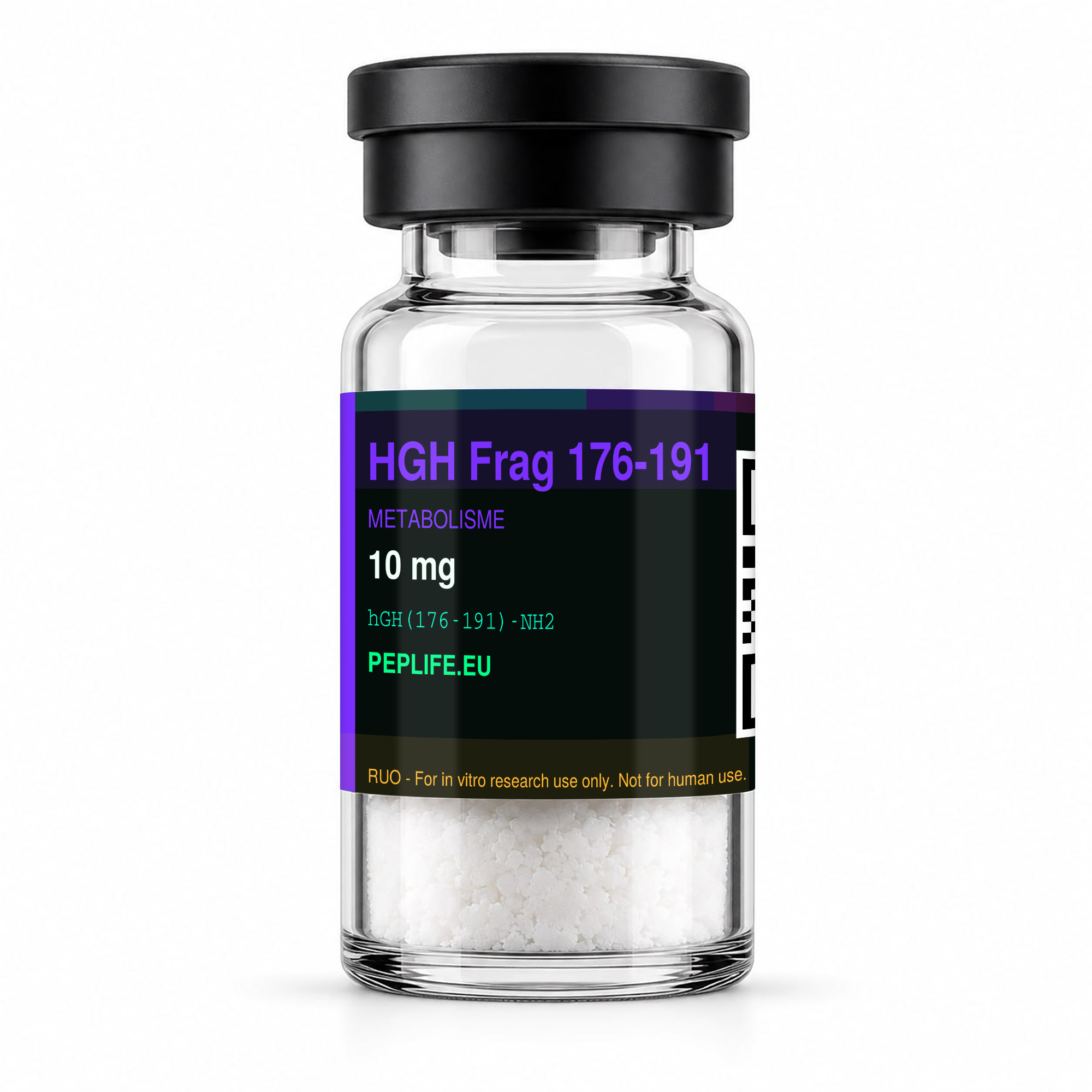
Het HGH Fragment 176-191 research revolves around a fascinating question: can you isolate the fat-burning part of growth hormone without taking along the rest of the growth hormone action? Growth hormone (GH) influences both fat metabolism and blood sugar, muscle growth and IGF-1 production. HGH Fragment 176-191 is precisely that small tail piece of the GH molecule in which researchers have localised the lipolytic (fat-breaking) activity. As a result, it has grown into a much-studied model peptide within metabolic research.
What is HGH Fragment 176-191?
HGH Fragment 176-191 is a synthetic peptide that mimics amino acids 176 through 191 — the last sixteen building blocks on the C-terminal side of the full growth hormone molecule (191 amino acids in total). Researchers identified this region as the part responsible for the fat-metabolism effects of GH. Because the fragment is only a small piece of the full protein, it lacks the receptor binding and growth signalling that the intact hormone has. In studies, the fragment does not bind to the growth hormone receptor and causes no change in IGF-1 levels.
An important derivative is AOD-9604 (Anti-Obesity Drug 9604): a modified version in which a tyrosine group is added on the N-terminal side for better stability. AOD-9604 and HGH Fragment 176-191 are often treated together in the literature because they essentially share the same lipolytic domain. Anyone following the research on one inevitably encounters the other.
How does HGH Fragment 176-191 work? — the mechanism
The central idea behind this peptide is selective lipolysis: the breakdown of stored fat without the side effects that full growth hormone brings. In a much-cited study by Heffernan and colleagues (2001, published in Endocrinology) the action of both human GH and AOD-9604 was studied in obese mice and in beta(3)-adrenergic-receptor knockout mice. The researchers found that both substances, after fourteen days of chronic administration, lowered body weight and fat percentage, and that they restored the suppressed expression of the beta(3)-adrenergic receptor (beta3-AR) in obese mice to levels comparable to those of lean mice.
Interestingly, in the knockout mice — which lack the beta3-AR — the long-term effects on weight and lipolysis were absent, whereas in acute experiments AOD-9604 still increased energy expenditure and fat oxidation. The researchers concluded that the lipolytic action does not proceed directly via the beta3-AR, but that the increased beta3-AR expression can indeed contribute to a greater lipolytic sensitivity. In short: in animal models the fragment appears to stimulate fat metabolism via an indirect, multiple route.
HGH Fragment 176-191 without the glucose effects of GH
What sets HGH Fragment 176-191 research apart is the emphasis on what the fragment not does. Full growth hormone can raise blood sugar and adversely affect insulin sensitivity. As early as a 1978 study (Ng and colleagues, American Journal of Physiology) various synthetic C-terminal GH fragments were compared for their influence on blood sugar; the 176-191 fragment stood out in terms of metabolic properties. In later research, the fragment showed no negative influence on insulin sensitivity in obese Zucker rats (2000), and no reduction in insulin secretion or hyperglycaemia in obese mice. In the human AOD-9604 studies, no changes in IGF-1 or glucose metabolism were reported. This separation between lipolysis and glucose effects is precisely what makes the fragment so attractive as a research model.
What is HGH Fragment 176-191 researched for?
Research interest concentrates around a number of clear themes:
- Lipolysis and fat metabolism: in animal models the fragment was associated with increased fat breakdown and reduced fat storage, without promoting the growth of adipose tissue.
- Obesity models: AOD-9604 was tested in clinical research in overweight. A 12-week randomised study showed a modest additional weight loss (about 1.8 kg more than placebo), but a longer 24-week study showed insufficient efficacy, after which development was discontinued in 2007.
- Selectivity: researchers study why lipolytic effects are stronger in obese models than in lean ones — which points to a context-dependent mechanism.
- Cartilage and repair: in a rabbit model of osteoarthritis (Kwon and Park, 2015), AOD-9604 combined with hyaluronic acid was studied for cartilage regeneration, with the combination appearing more effective than each separately.
It is important to emphasise that no approved human application exists; the vast majority of the data comes from animal and in vitro studies, and a few discontinued clinical trials.
HGH Fragment 176-191 in laboratory research: handling & dissolving
HGH Fragment 176-191 is supplied as a freeze-dried (lyophilised) powder that is reconstituted in the laboratory, usually with bacteriostatic or sterile water. Correct reconstitution and cold storage are decisive for the stability of the peptide during research. For the correct procedure and choice of solvent we refer to our knowledge-base pillars reconstitute peptides and which liquid do you use to dissolve peptides. These contain the customary laboratory protocols that researchers use.
Quality & purity
Every relevant batch is independently HPLC-tested by an external laboratory; the certificate of analysis (CoA) is publicly verifiable per batch. For peptides such as HGH Fragment 176-191, that verification is extra relevant: the purity and the correct amino acid sequence determine whether research results are reproducible. In our pillar why we rejected a batch we show how strictly this process is handled at Peplife.
Frequently asked questions about HGH Fragment 176-191
What is the difference between HGH Fragment 176-191 and AOD-9604?
Both share the lipolytic C-terminal domain of growth hormone. AOD-9604 is a modified derivative with an additional tyrosine group for stability; in research they are often treated together because they show a similar mechanism. See Research AOD-9604 at Peplife.
Why do researchers call this a "selective" GH fragment?
Because in studies it mimics the fat-metabolism effects of growth hormone without binding to the GH receptor, and without causing the blood-sugar or IGF-1 effects of the full hormone. That separation makes it a popular research model.
Does HGH Fragment 176-191 raise blood sugar?
In the described animal studies (obese mice, Zucker rats) and in the human AOD-9604 trials, no hyperglycaemia or reduced insulin sensitivity was reported — one of the most studied features of this fragment. This concerns research data only.
Is HGH Fragment 176-191 approved for use?
No. There is no approval by the EMA or FDA for human use. The clinical development of the derivative AOD-9604 was discontinued in 2007 due to insufficient long-term efficacy. The peptide is offered exclusively for laboratory research.
What else is HGH Fragment 176-191 researched for?
In addition to lipolysis, studies appear around cartilage and repair models (for example a 2015 osteoarthritis model in rabbits). Human trials for this are, however, lacking.
How is HGH Fragment 176-191 stored in the lab?
As a freeze-dried powder, cool and dry; refrigerated after reconstitution. See our reconstitution pillar for the customary protocols.
Read more & research at Peplife
- HGH fragment 176-191 research at Peplife
- View all metabolism peptides
- Fat-loss peptides: research into metabolic peptides
- AOD-9604 — the modified derivative
- MOTS-c — mitochondrial metabolism peptide
- AOD-9604 vs HGH fragment 176-191
Sources: Heffernan et al., Endocrinology 2001 (PubMed 11713213) · AOD9604 — Wikipedia · Ng et al., Am J Physiol 1978 (C-terminal GH fragments) · Fragment 176-191 research review — Peptides.org
Research Use Only. All products are supplied exclusively for in vitro laboratory research. Not intended for diagnostic or therapeutic use in humans or animals, and not approved by the EMA or FDA.
HGH Fragment 176-191 at Peplife: HPLC-tested, CoA verifiable per batch and discreetly shipped within the EU.