




| Class | Growth factor (IGF-1 analogue) |
| Molecular weight (Da) | ~7371 |
| Half-life (indicative) | ~20–30 min |
| Research status | Preclinical / RUO |
Research context (RUO): IGF-1 DES is a shortened, highly active variant of insulin-like growth factor 1 (IGF-1) studied in science for cell proliferation and local muscle growth. This peptide is supplied exclusively for in-vitro laboratory research and is not intended for human or animal use.
IGF-1 DES research: the shortened, potent IGF-1 variant
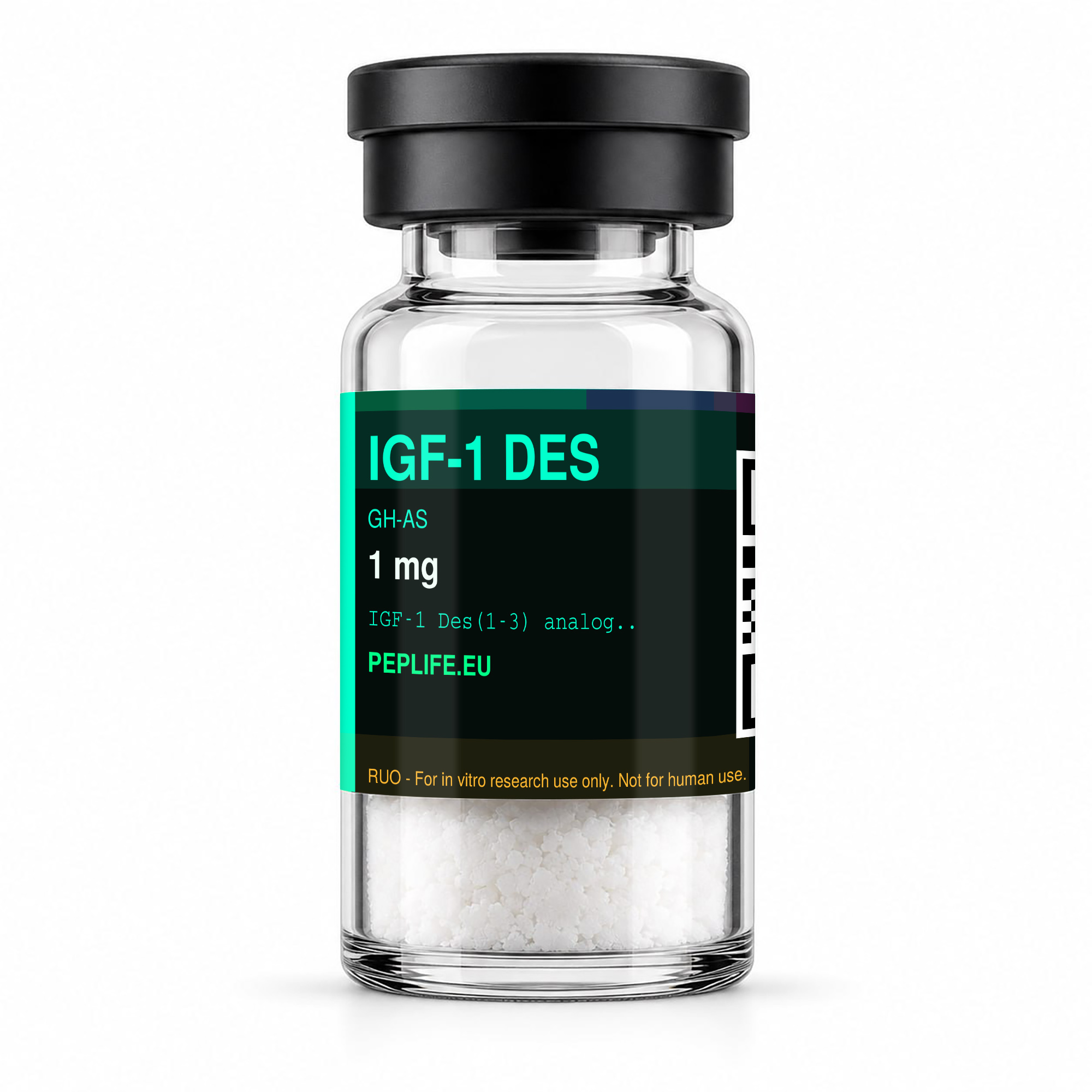
IGF-1 DES research revolves around an intriguing question: what happens if you remove the first three amino acids of IGF-1? The answer turns out to be surprising. This “destripeptide” variant — hence the name DES — loses a small piece at the N-terminus, but as a result becomes considerably more potent than the full IGF-1 molecule in various preclinical models. For researchers studying the IGF-1 signalling route, muscle-cell growth and tissue regeneration, IGF-1 DES has therefore become a widely used tool.
What is IGF-1 DES?
IGF-1 DES, in full des(1-3)IGF-1, is a naturally occurring, shortened form of IGF-1. Whereas the complete IGF-1 molecule consists of 70 amino acids, IGF-1 DES lacks the first three residues at the N-terminus (glycine-proline-glutamic acid) and thus has 67. This variant is not an artificial invention: researchers have found des(1-3)IGF-1 in, among other things, brain tissue and colostrum, and it has been described that IGF-1 can be enzymatically converted into this form in tissue (Yamamoto & Murphy, 1995). The molecule has CAS number 112603-35-7 and a molar mass of approximately 7,371 g/mol.
The special thing lies not in the size, but in the behaviour. Because of that small truncation, the way the peptide interacts with its environment changes — and that is precisely what makes IGF-1 DES research so interesting.
How does IGF-1 DES work? — the mechanism
To understand IGF-1 DES, you first need to know what holds IGF-1 back. In the body and in cell-culture media, IGF-1 is largely held by IGF-binding proteins (IGFBPs). As long as IGF-1 is attached to such a binding protein, it cannot engage its receptor. The IGFBPs therefore function as a kind of brake or buffer.
Here the core of IGF-1 DES research comes to the fore. Because the first three amino acids are missing, des(1-3)IGF-1 binds much more weakly to the IGFBPs. In a classic study, researchers reported that IGF-binding proteins strongly inhibit the biological activity of IGF-1 and IGF-2, but barely that of des-(1-3)-IGF-1 (Biochemical Journal). The result: more free, active peptide remains that can directly seek out the IGF-1 receptor (IGF-1R).
Once IGF-1 DES activates the IGF-1R, the same intracellular cascade is set in motion as with regular IGF-1: the PI3K/Akt route and downstream mTOR, which in muscle tissue are associated with protein synthesis and cell growth, plus the MAPK route associated with cell division (see the review article on IGF-1 in skeletal muscle, Cells 2020). Because the brake of the binding proteins largely falls away, an approximately tenfold stronger action in vivo is described in preclinical models compared with intact IGF-1.
IGF-1 DES research: what is it studied for?
In the laboratory, IGF-1 DES is mainly used as a potent, “IGFBP-insensitive” agonist of the IGF-1 receptor. The research areas therefore vary:
- Local muscle growth & hypertrophy: in muscle-cell models, it is studied how activation of IGF-1R via the Akt/mTOR route influences protein synthesis and muscle-fibre growth. Because des(1-3)IGF-1 has a short duration of action, it is of interest for research into local, tissue-bound effects.
- Cell proliferation: in myoblast and fibroblast cultures (such as L6 cells), the stimulation of proliferation and differentiation via the IGF-1 receptor is studied, with DES often serving as a potent reference.
- Satellite cells & regeneration: researchers study the role of IGF-1 signalling in the activation and division of satellite cells, the stem cells involved in muscle repair.
- IGFBP biology: precisely because DES bypasses the binding proteins, it is used to unravel the role of IGFBPs in the regulation of IGF signalling.
Important to emphasise: all these findings come from in-vitro and animal models. They describe what was observed in a research setting, not what an individual would “get”.
IGF-1 DES in laboratory research: handling & reconstitution
IGF-1 DES is supplied as freeze-dried (lyophilised) powder in a vial. For use in research it is reconstituted with a suitable liquid; which liquid and which concentration depend on the research protocol. Peptides of the IGF family are sensitive to repeated thawing and freezing, so careful aliquoting and cold storage are standard practice in the lab. More about the correct procedure can be read in our pillar on reconstituting peptides and the choice of the correct solvent liquid.
Quality & purity
Reliable research stands or falls with the purity of the starting material. Every relevant batch of IGF-1 DES at Peplife is independently HPLC-tested by an external laboratory; the certificate of analysis (CoA) is publicly verifiable per batch. This way a researcher knows exactly what is in the vial — crucial when you use a potent, IGFBP-insensitive peptide like DES as a reference or intervention.
Frequently asked questions about IGF-1 DES
What does “DES” mean in IGF-1 DES?
DES stands for “destripeptide”: the molecule lacks the first three amino acids (a tripeptide) at the N-terminus of IGF-1. Hence also the scientific name des(1-3)IGF-1.
Why is IGF-1 DES more potent than ordinary IGF-1?
Because it lacks the first three amino acids, IGF-1 DES binds much more weakly to the IGF-binding proteins (IGFBPs) that normally hold IGF-1. As a result, more free peptide remains in research models to activate the IGF-1 receptor, which yields an approximately tenfold stronger in-vivo action.
What is the difference between IGF-1 DES and IGF-1 LR3?
Both are IGF-1 variants that bypass the IGFBPs, but via a different structure. IGF-1 LR3 is elongated and modified and has a much longer duration of action, whereas IGF-1 DES is a short, more locally acting variant. In research they are therefore used for different questions.
Does IGF-1 DES bind to the same receptor as IGF-1?
Yes. IGF-1 DES binds and activates the IGF-1 receptor (IGF-1R), just like intact IGF-1, and thereby sets in motion the same intracellular signalling routes (PI3K/Akt/mTOR and MAPK).
Does IGF-1 DES occur naturally?
Yes. Des(1-3)IGF-1 has been identified in, among other things, brain tissue and colostrum, and can arise enzymatically from IGF-1 in tissue. It is therefore a natural variant and not a purely synthetic construct.
May I use IGF-1 DES?
No. IGF-1 DES is supplied exclusively for in-vitro laboratory research (Research Use Only). It is not intended for human or animal use and not approved for diagnostic or therapeutic application.
Read more & research at Peplife
- Research IGF-1 DES at Peplife
- View all GH axis peptides
- Growth hormone peptides: the complete guide
- IGF-1 LR3: the long-acting IGF-1 variant
- Research MGF (Mechano Growth Factor)
- IGF-1 LR3 vs IGF-1 DES
Sources: des(1-3)IGF-1 — overview & references (Wikipedia) · IGF-binding proteins inhibit IGF-1 and IGF-2, but not des-(1-3)-IGF-1 (Biochemical Journal) · Mechanisms of IGF-1-Mediated Regulation of Skeletal Muscle Hypertrophy and Atrophy (Cells, 2020) · Natural and synthetic forms of IGF-1 and the potent derivative, destripeptide IGF-1 (Biochem Biophys Res Commun)
Research Use Only. All products are supplied exclusively for in vitro laboratory research. Not intended for diagnostic or therapeutic use in humans or animals, and not approved by the EMA or FDA.
IGF-1 DES from Peplife: HPLC-tested, with a publicly verifiable CoA per batch and discrete shipping within the EU.