




| Aliases | EDR |
| Class | Bioregulator (Khavinson) |
| Molecular weight (Da) | 418.4 |
| Half-life (indicative) | very short † |
| Research status | Preclinical / RUO |
Research context (RUO): Pinealon (Glu-Asp-Arg / EDR) is an ultrashort Khavinson tripeptide studied in cell and animal models for neuroprotection, cognition and antioxidation. It is supplied exclusively for in-vitro laboratory research and is not intended for human or animal use.
Pinealon research: the neuroprotective Khavinson tripeptide
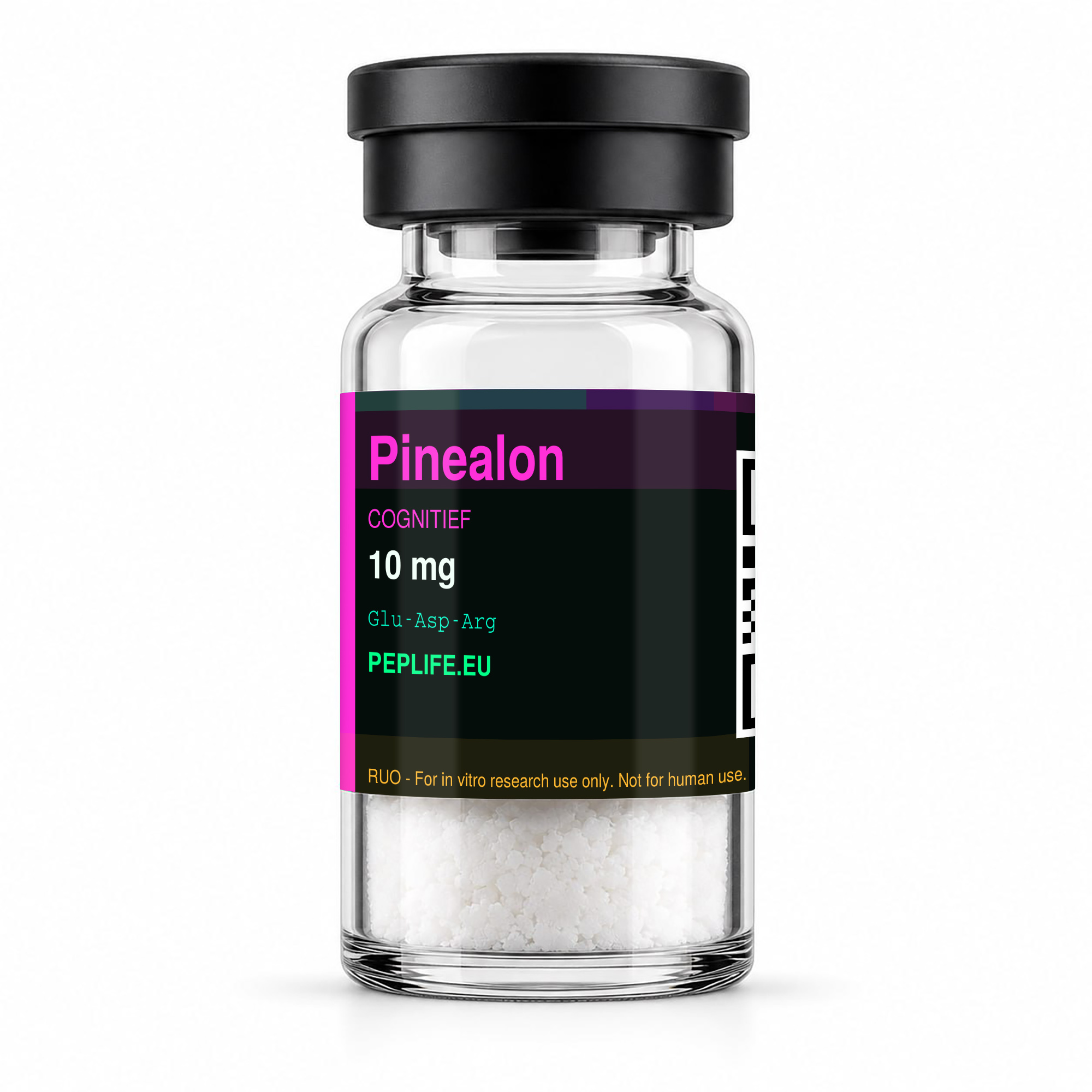
Pinealon research centres on a strikingly small molecule with a long research tradition: a tripeptide of just three amino acids studied by the group of Russian gerontologist Vladimir Khavinson as a so-called peptide bioregulator. Despite its minimal size, Pinealon is associated in preclinical studies with neuroprotection, preservation of cognitive performance and protection of cells against oxidative stress. In this knowledge-base article, researchers, mechanisms and the key findings are set out — factual, verifiable and entirely within the framework of laboratory research.
What is Pinealon?
Pinealon is a synthetic tripeptide with the sequence glutamic acid–aspartic acid–arginine (Glu-Asp-Arg), often abbreviated in the literature as “EDR” after the single-letter codes of the amino acids. In databases it is registered as PubChem CID 10273502 with the molecular formula C15H26N6O8. It belongs to the family of “short peptide bioregulators” that Khavinson and colleagues originally derived from animal pineal and brain tissues, after which they reduced the active fragments to minimal, chemically synthesizable sequences.
The underlying hypothesis is that these ultra-short peptides are small enough to reach cell membranes and even the cell nucleus, where they may modulate gene expression. In that context Pinealon is often mentioned in the same breath as other Khavinson peptides such as Epitalon (the pineal tetrapeptide) and the cognitive peptides that researchers regard as related objects of study.
How does Pinealon work? — the mechanism
The proposed mechanism of action in pinealon research is epigenetic in nature. In a study published in Molecules (Khavinson, Linkova et al., 2021), researchers modelled how the EDR tripeptide might bind to specific nucleotide sequences in DNA and thereby influence the expression of genes involved in the pathogenesis of neurodegeneration. The hypothesis: by interacting with promoter regions, the peptide steers the production of proteins involved in cell survival, signal transduction and protection against neurotoxicity.
In addition, Pinealon is associated in cell experiments with the suppression of free radicals and the stimulation of proliferative processes, which researchers interpret as an antioxidant and anti-hypoxic signature. In studies with brain-cortex cells, the tripeptide was moreover linked to the expression of serotonin — an indication that the effects are not limited to pure cell survival, but also touch neurotransmitter-related routes.
What is Pinealon researched for?
The research field around Pinealon is broad but consistent: it always revolves around the question of whether this tripeptide can protect nerve tissue under stressful or damaging conditions. The main areas of research:
- Neuroprotection against prenatal damage: In a widely cited animal-model study (Arutjunyan et al., 2012), Pinealon was administered around pregnant rats with experimentally induced hyperhomocysteinemia — a condition that harms the brain development of the offspring. Researchers reported that the offspring of treated animals showed fewer markers of oxidative stress and performed better on learning and behavioural tasks.
- Cognition and learning ability: In animal models with disturbed metabolism (among others experimental diabetes), Pinealon was associated with the preservation of learning retention, which makes the peptide an object of study within the broader group of cognitive peptides.
- Antioxidation and anti-hypoxia: Cell studies link the EDR tripeptide to suppression of free-radical levels and increased cell vitality under low-oxygen conditions.
- Neurodegeneration / ageing: Mechanistic and review articles (among others on the neuro-epigenetic action of ultrashort peptides, 2022) place Pinealon in research into age-related decline of the nervous system and longevity.
Pinealon in laboratory research: handling & reconstitution
Pinealon is usually supplied as freeze-dried (lyophilised) powder that researchers reconstitute before in-vitro use. Because of the small peptide size, the choice of solvent and careful handling of the lyophilisate are relevant to reliable results. Researchers setting up their protocol will find practical background in our pillar on reconstituting peptides and the comparison of which liquid you choose to dissolve a peptide. This information is intended exclusively for the laboratory context, not for administration.
Quality & purity
Reliable pinealon research stands or falls with a pure, correctly identified starting material. Every relevant batch is independently HPLC-tested by an external laboratory; the certificate of analysis (CoA) is publicly verifiable per batch, so that researchers can check the identity and purity of the tripeptide before starting an experiment. For a small molecule like EDR — where deviating fragments can distort your data — that verifiable purity is not a luxury but a precondition. Also read why we rejected a batch for a concrete example of how that control works in practice.
Frequently asked questions about Pinealon
What does the abbreviation EDR mean for Pinealon?
EDR stands for the single-letter codes of the three amino acids in the sequence: E (glutamic acid), D (aspartic acid) and R (arginine). Pinealon and “EDR peptide” therefore refer to the same molecule, Glu-Asp-Arg.
Is Pinealon the same as Epitalon?
No. Both are Khavinson bioregulators, but Epitalon is a tetrapeptide (Ala-Glu-Asp-Gly) studied mainly in telomerase and longevity research, whereas Pinealon is a tripeptide central to neuroprotection research. They are sometimes studied side by side; see our Epitalon-research material.
What is Pinealon studied for in studies?
Mainly for neuroprotection, preservation of cognition and antioxidant cell protection in cell and animal models. Effects have consistently been observed in research settings and are attributed to those studies, not to human use.
How does Pinealon relate to other cognitive peptides?
Researchers place Pinealon within the same research group as peptides such as Semax and Selank, which are likewise studied for neuroprotection and cognition. The mechanism differs: Pinealon is studied mainly as an epigenetic bioregulator.
In which models has Pinealon been studied?
Among others in rats with prenatal hyperhomocysteinemia, animal models with disturbed metabolism and in-vitro cell cultures of brain-cortex tissue. Human clinical data are limited and largely derive from Russian gerontology literature.
May Pinealon be used by humans?
No. Pinealon is supplied exclusively for laboratory research (Research Use Only) and is not approved for diagnostic or therapeutic use in humans or animals.
Read more & research at Peplife
- Research Pinealon at Peplife
- View all cognitive peptides
- Cognitive peptides: overview of the research
- Longevity peptides and ageing
- Epitalon — the related Khavinson bioregulator
- Semax — cognitive research peptide
Sources: Khavinson et al., EDR Peptide, Molecules 2021 · Arutjunyan et al., Pinealon & prenatal hyperhomocysteinemia, 2012 · Neuro-epigenetic action of ultrashort peptides, IJMS 2022 · PubChem CID 10273502 (Pinealon)
Research Use Only. All products are supplied exclusively for in vitro laboratory research. Not intended for diagnostic or therapeutic use in humans or animals, and not approved by the EMA or FDA.
Pinealon for your laboratory: HPLC-tested, with a publicly verifiable CoA per batch and discrete EU shipping.