




| Class | Mitochondrial (anti-apoptosis) |
| Molecular weight (Da) | 2687.3 |
| Half-life (indicative) | short † |
| Research status | Preclinical / RUO |
Research context (RUO): Humanin is a mitochondrial-derived peptide (MDP) studied in laboratories in the field of cytoprotection, ageing and neuroprotection. All products on this page are supplied exclusively for in-vitro laboratory research and are not intended for human or animal use.
Humanin research: the mitochondrial-derived peptide
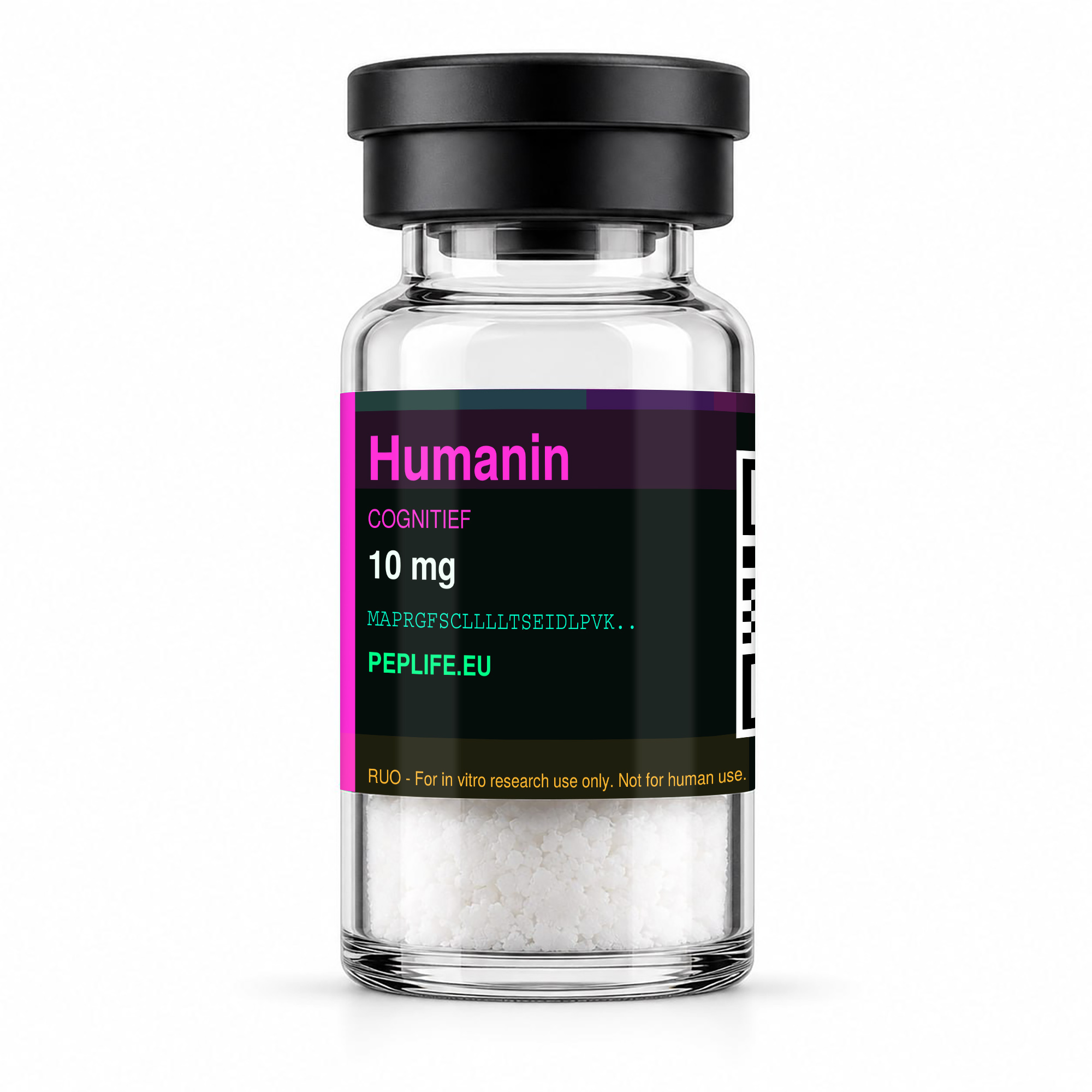
Het humanin research focuses on one of the most striking discoveries from mitochondrial biology: a small peptide encoded not in the cell nucleus but in the DNA of the mitochondria. Since its identification in 2001, humanin has grown into one of the most studied mitochondrial-derived peptides, with hundreds of preclinical publications on cytoprotection, ageing, metabolism and neuroprotection. This page summarises what researchers have reported about this peptide — strictly in the context of laboratory research.
What is humanin?
Humanin is a small peptide of 24 amino acids (or 21 amino acids in mitochondrial translation) encoded within the 16S ribosomal RNA gene (MT-RNR2) of the mitochondrial genome. It thereby belongs to the family of the mitochondria-derived peptides (MDPs) — signalling molecules produced by the mitochondria themselves and functioning as a kind of communication system between the mitochondria and the rest of the cell. Humanin was discovered in 2001 by the research group of Nishimoto in brain tissue of an Alzheimer's patient, during the search for factors that could inhibit the cell death caused by amyloid-beta. In addition to the natural peptide, researchers also study more potent analogues, of which HNG (S14G-humanin) is the best known; in some assays this analogue was described as considerably more potent than the natural molecule.
How does humanin work? — the mechanism
Humanin research describes several targets. Extracellularly, the peptide binds to various receptors: the insulin-like growth factor binding protein IGFBP-3, the formyl peptide receptor FPR2 (FPRL1) and a trimeric receptor complex consisting of CNTFR, WSX-1 and gp130. Via that last complex, humanin activates in studies the JAK2/STAT3 signalling route, and via other routes the ERK1/2 and AKT signalling. Intracellularly, a pronounced anti-apoptotic effect described: humanin binds and inhibits pro-apoptotic proteins such as Bax, BID and Bim, thereby inhibiting programmed cell death. In addition, researchers reported that the peptide helps maintain the mitochondrial membrane potential, reduces the formation of reactive oxygen species (ROS) and stimulates chaperone-mediated autophagy — processes associated with cellular stress resistance.
What is humanin researched for?
The research field around humanin is broad. The main directions that recur in the literature:
- Cytoprotection & apoptosis: in numerous cell models, humanin was associated with protection against toxic stimuli and with inhibition of apoptosis via binding to Bax and IGFBP-3.
- Ageing & longevity: circulating humanin levels decline with age in mice and humans. Notably, children of centenarians showed significantly higher levels, and in the naked mole-rat — an animal with negligible ageing — levels barely declined.
- Neuroprotection: in transgenic Alzheimer's models, Yen et al. (2018) reported that the analogue HNG improved spatial learning and memory and reduced amyloid-beta plaque formation. Other studies described protection of synapses and reduction of astrocytic inflammation.
- Metabolism: humanin is regulated by — and itself influences — the insulin/IGF-1 signalling pathway. In rodent models, central administration of humanin improved insulin sensitivity via hypothalamic STAT-3 activation.
- Cardiovascular: chronic treatment with humanin prevented age-related myocardial fibrosis in a mouse model (2018); in other models the peptide was associated with smaller infarcts and less cardiomyocyte apoptosis.
Humanin in laboratory research: handling & reconstitution
As a peptide, humanin in research is usually supplied as freeze-dried (lyophilised) powder and reconstituted before use. Correct reconstitution, storage at low temperature and avoiding repeated freeze-thaw cycles are standard conditions for reliable in-vitro results. For background on solvents and procedure, our pillars reconstitute peptides and dissolve peptide: which liquid a good starting point. Because humanin and related MDPs form an active research field, new protocols appear regularly — it is worth consulting the primary literature.
Humanin, MOTS-c and SS-31: the broader mitochondrial field
Humanin does not stand alone. It is part of a growing group of molecules that have mitochondrial function as their target. MOTS-c is another mitochondrial-derived peptide that is described in research as an “exercise mimetic” and that is studied for metabolism and insulin sensitivity — see our pillar MOTS-C research. SS-31 (Elamipretide) approaches the mitochondria via a different route, namely stabilisation of cardiolipin in the inner membrane. Anyone who wants to place humanin in the broader context of ageing will find in our pillar longevity peptides an overview.
Quality & purity
Reliable peptide research stands or falls with the purity of the starting material. Every relevant batch is independently HPLC-tested by an external laboratory; the accompanying certificate of analysis (CoA) is publicly verifiable per batch. This allows researchers to check the identity and purity of the supplied humanin before they begin their in-vitro protocol. Why this matters, we illustrate in the pillar why we rejected a batch.
Frequently asked questions about humanin
What exactly is humanin?
Humanin is a mitochondrial-derived peptide of 24 amino acids encoded within the MT-RNR2 gene of the mitochondrial DNA. It is studied in laboratories for cytoprotection, ageing, metabolism and neuroprotection.
Is humanin the same as MOTS-c?
No. Both are mitochondrial-derived peptides, but they are encoded by different parts of the mitochondrial genome and have different research foci: humanin mainly on cytoprotection and neuroprotection, MOTS-c mainly on metabolism and exercise.
What is the difference between humanin and HNG?
HNG (S14G-humanin) is a synthetic analogue in which one amino acid has been replaced. In various assays HNG was described as more potent than the natural peptide; it is therefore often used in preclinical studies.
Why does humanin decline with age?
Research associates the decline with increasing mitochondrial damage and mtDNA ageing. Children of centenarians, by contrast, showed higher levels, which explains the interest in humanin within ageing research.
Can I buy humanin for personal use?
No. Humanin is offered exclusively as a research substance (Research Use Only) for in-vitro laboratory use. It is not intended for human or animal consumption and not approved as a medicine.
Is humanin approved as a medicine?
No. Humanin and its analogues are in the preclinical research stage and are not approved by the EMA, NVWA or FDA for any therapeutic application.
Read more & research at Peplife
- Research Humanin at Peplife
- View all cognitive peptides
- Research MOTS-C at Peplife
- Research SS-31 (Elamipretide) at Peplife
- MOTS-c research: the mitochondrial peptide and metabolism
- Longevity peptides: research into ageing
Sources: Coradduzza et al., Biology 2023 — Humanin and Its Pathophysiological Roles in Aging: A Systematic Review · Yen et al., Aging 2020 — The mitochondrial derived peptide humanin is a regulator of lifespan and healthspan · Kim et al., J Clin Invest — Mitochondria-derived peptides in aging and healthspan · Am J Physiol Heart Circ Physiol 2018 — Chronic humanin treatment prevents age-related myocardial fibrosis in mice
Research Use Only. All products are supplied exclusively for in vitro laboratory research. Not intended for diagnostic or therapeutic use in humans or animals, and not approved by the EMA or FDA.
Humanin for laboratory research: HPLC-tested, with CoA per batch and discrete shipping within the EU.