




| Class | TGF-β family (protein) |
| Molecular weight (Da) | ~25 kDa |
| Half-life (indicative) | not published |
| Research status | Preclinical / RUO |
Research context (RUO): Myostatin (GDF-8) is a protein that inhibits muscle growth and is central to the research field around myostatin inhibition. It is supplied exclusively for in-vitro laboratory research and is not intended for human or animal use.
Myostatin (GDF-8) research: the brake on muscle growth
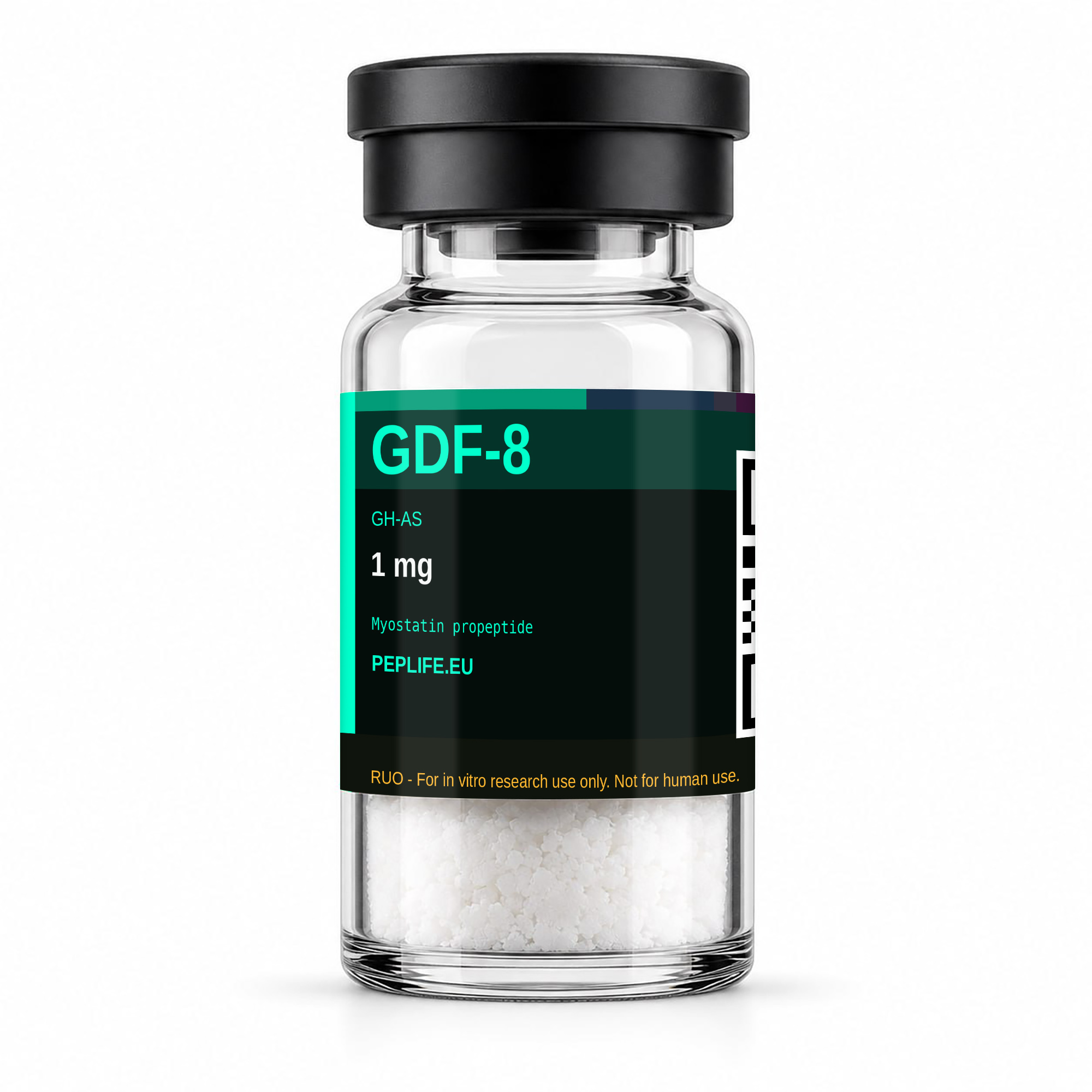
Myostatin (GDF-8) research revolves around a fascinating paradox: where most growth factors build up tissue, this protein does the opposite. Growth differentiation factor 8 acts as a natural brake on muscle growth — a so-called negative regulator. Since its discovery in 1997, myostatin has grown into one of the most studied targets in muscle biology, precisely because switching it off in animal models led to spectacular muscle gains. On this page, researchers set out what GDF-8 is, how it works mechanistically and what myostatin inhibition is scientifically studied for.
What is myostatin (GDF-8)?
Myostatin, also known as growth differentiation factor 8 (GDF-8), is a protein from the TGF-β superfamily (transforming growth factor beta). It was described in 1997 by McPherron, Lawler and Lee, who showed that mice without a functioning myostatin gene developed two to three times as much muscle mass — the famous “mighty mouse”. The protein is produced almost exclusively in skeletal muscle tissue and circulates as a latent complex that only becomes biologically active after activation. Functionally, myostatin behaves as a chalone: an endogenous substance that limits the growth of the tissue in which it is made. In this way, the body keeps muscle mass within certain limits.
The role of GDF-8 became especially clear through nature itself. Cattle breeds such as the Belgian Blue and the Piedmontese naturally carry loss-of-function mutations in the myostatin gene. The result is “double muscling”: animals with a strikingly heavy, muscular build. The same biology has been documented in whippets and, in a rare case from 2004, in a human child with a myostatin mutation. These natural experiments made myostatin a logical target for research into muscle loss.
How does myostatin (GDF-8) work? — the mechanism
Active myostatin binds to the activin type II receptor (ActRIIB) on the surface of muscle cells. This binding recruits a type I receptor (ALK4/ALK5), which sets an intracellular signalling cascade in motion: phosphorylation of the proteins Smad2 and Smad3. This Smad signal then inhibits muscle protein synthesis and suppresses the activity of myogenic transcription factors such as MyoD and myogenin. Satellite cells — the stem cells that make muscle repair and muscle growth possible — are also inhibited in their activation and division.
Interestingly, this signal works largely opposite to the anabolic IGF-1/PI3K/Akt pathway, which instead drives muscle protein synthesis. Researchers therefore often study myostatin in relation to the broader GH axis and to anabolic peptides such as IGF-1 LR3, to understand how the brake and accelerator of muscle growth interact. Because ActRIIB binds multiple TGF-β ligands (including activin and GDF-11), unravelling the exact selectivity is a recurring theme in the field.
What is myostatin (GDF-8) studied for?
The majority of the research does not focus on myostatin itself, but on myostatin inhibition: strategies to switch off the protein in order to study muscle preservation or muscle growth. In preclinical studies, the following research areas were explored, among others:
- Muscular dystrophy: in animal models of Duchenne (DMD) and related conditions, it was investigated whether blocking myostatin could slow muscle breakdown. Several antibody candidates (such as domagrozumab and apitegromab/SRK-015) went through clinical studies with mixed results.
- Sarcopenia & age-related muscle loss: researchers are studying whether myostatin inhibition can counteract age-related atrophy in preclinical models.
- Cachexia: severe muscle loss in diseases such as cancer and COPD is linked in studies to increased myostatin activity.
- Bone & skeleton: myostatin-deficient animal models showed not only more muscle but also effects on bone volume and fracture healing, which points to a link between muscle mass and skeletal shape.
- Metabolism: in mouse models, myostatin deficiency was accompanied by less fat accumulation, which opened up metabolic questions.
Important for a fair picture: many inhibitors that were promising preclinically did not achieve the desired functional improvement in phase 2/3 studies, and some decoy receptors caused non-muscle-related side effects. The field thereby illustrates how complex translation from animal model to human is — precisely why accurate laboratory research remains important.
Myostatin inhibitors: related research molecules
A whole family of inhibition strategies has arisen around GDF-8, which researchers study side by side. Follistatin-344 is an endogenous antagonist that sequesters myostatin (and related ligands) and showed substantial muscle growth in models. In addition, myostatin propeptides, neutralising antibodies and soluble ActRIIB decoy receptors are studied; the latter category produced striking increases in muscle mass within a few weeks in preclinical studies. For researchers who want to place the GH axis in a broader context, our pillar on growth hormone peptides additional background on how these pathways connect.
Myostatin (GDF-8) in laboratory research: handling & dissolving
GDF-8 is supplied as freeze-dried (lyophilised) powder and must be reconstituted before in-vitro use, usually with bacteriostatic or sterile water. Careful dissolving and cold storage are important for the stability of this protein. Researchers who want to look up the right liquid and method will find practical background in our pillar on reconstituting peptides and about which liquid you use to dissolve peptides. All operations take place exclusively in a laboratory environment.
Quality & purity
Every relevant batch is independently HPLC-tested by an external laboratory; the certificate of analysis (CoA) is publicly verifiable per batch. For research with proteins such as GDF-8, demonstrable identity and purity is essential, because impurities or degradation can directly affect the results. Peplife therefore emphasises transparent, batch-bound documentation so that researchers can verify their material before it is included in a protocol.
Frequently asked questions about myostatin (GDF-8)
What is the difference between myostatin and GDF-8?
There is no difference: GDF-8 (growth differentiation factor 8) is the official name of the protein commonly known as myostatin. Both terms refer to the same negative regulator of muscle growth from the TGF-β superfamily.
Why does switching off myostatin lead to more muscle?
Because myostatin normally inhibits muscle protein synthesis and satellite cell activity. When that brake is removed — as in knock-out mice and double-muscled cattle — the muscle tissue grows considerably more strongly in models. This is an observation from animal research, not an application in humans.
Is myostatin (GDF-8) the same as follistatin?
No. Follistatin is an endogenous antagonist that sequesters myostatin and thereby blocks its action. In research they are often studied together, but they are opposing players in the same pathway.
Is GDF-8 used to build muscle?
No. GDF-8 itself inhibits muscle growth; the research field focuses on the inhibit of myostatin. At Peplife, GDF-8 is supplied exclusively as reference and research material for in-vitro laboratory studies, not for use in humans or animals.
Why has myostatin research not yet been translated into approved therapies?
Despite promising animal models, various myostatin inhibitors did not achieve the desired functional results in clinical phase 2/3 studies, and some caused side effects through cross-reaction with related proteins. That makes careful basic research into the exact mechanism all the more relevant.
Read more & research at Peplife
- Research GDF-8 (Myostatin) at Peplife
- View all GH axis peptides
- Research Follistatin-344 at Peplife
- Research IGF-1 LR3 at Peplife
- Growth hormone peptides: the GH axis in research
Sources: McPherron, Lawler & Lee, Nature 1997 (GDF-8 knock-out mice) · Myostatin mutations in double-muscled cattle, PubMed 1997 · Myostatin (GDF-8) as a link between muscle mass and skeletal shape, PMC review · Myostatin Inhibitors review, J Bone Metab 2020
Research Use Only. All products are supplied exclusively for in vitro laboratory research. Not intended for diagnostic or therapeutic use in humans or animals, and not approved by the EMA or FDA.
GDF-8 (Myostatin) from Peplife is HPLC-tested by an external laboratory, with a per-batch verifiable CoA and discreet EU shipping.