




| Aliases | Hypocretin-1 / hypocretin-2 |
| Class | Neuropeptide (OX1R/OX2R) |
| Molecular weight (Da) | ~3561 (A) / ~2938 (B) |
| Half-life (indicative) | short (minutes) |
| Research status | Preclinical / RUO |
Research context (RUO): Orexin A and orexin B (also known as hypocretin-1 and hypocretin-2) are neuropeptides from the hypothalamus that are central in research to the regulation of wakefulness, the sleep-wake rhythm and appetite. Both are supplied by Peplife exclusively for in-vitro laboratory research (Research Use Only) — not for human or animal use.
Orexin research: the neuropeptides behind wakefulness
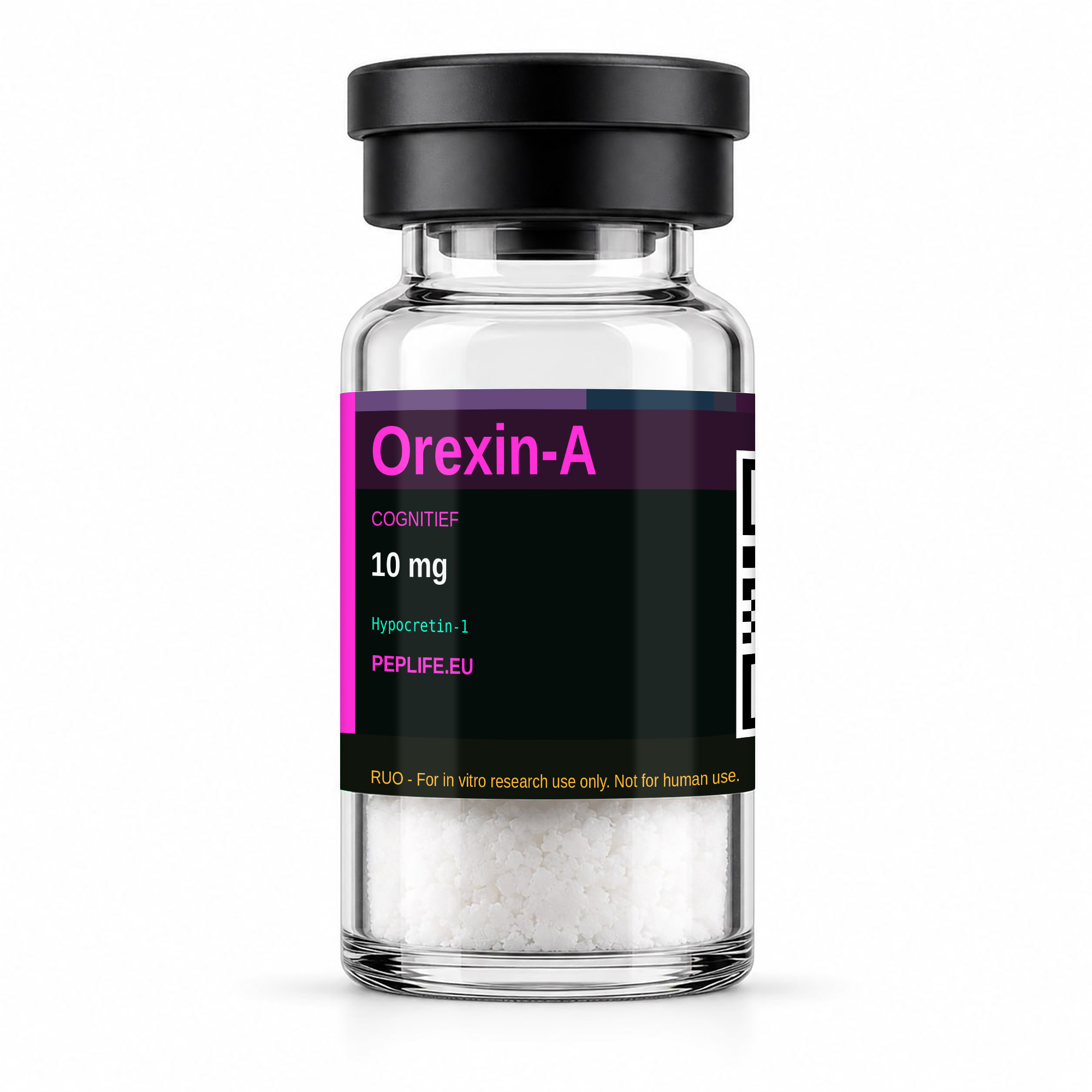
Orexin research revolves around two closely related neuropeptides — orexin A and orexin B — which since their discovery in 1998 have grown into one of the most studied links in the brain chemistry of sleep and alertness. Two research groups (the teams of Sakurai and of De Lecea) described the peptides almost simultaneously, which explains the double naming: “orexin” refers to the initially found role in appetite (from the Greek orexis), while “hypocretin” refers to their origin in the hypothalamus. They are exactly the same molecules. This pillar covers both variants, their mutual differences and what they are studied for in the laboratory.
What are orexin A and orexin B?
Orexin A and orexin B both arise from the same precursor protein, prepro-orexin, which is split into two active peptides by enzymatic cleavage. Yet they clearly differ in structure. Orexin A has 33 amino acids, carries a blocked (pyroglutamyl) N-terminus, an amidated C-terminus and two internal disulfide bonds between four cysteines — a compact, tightly folded structure. Orexin B is shorter at 28 amino acids, linear in shape and lacks those stabilising disulfide bonds; the two peptides share about 46% of their amino acid sequence. That structural difference translates into their behaviour in research: orexin A is usually considered the more stable and more broadly acting peptide, while orexin B is more selective in where it acts.
How do orexin A and B work? — the mechanism
Both peptides exert their effect via two G-protein-coupled receptors: the orexin-1 receptor (OX1R) and the orexin-2 receptor (OX2R). This is where the most important functional difference between A and B lies. Orexin A binds with almost equal affinity to both OX1R and OX2R. Orexin B on the other hand binds mainly to OX2R and is roughly five times less potent at OX1R. In model studies, this means that orexin A gives a broad signal, while orexin B offers researchers a means to study mainly the OX2R pathway.
The orexin-producing neurons are concentrated in the lateral hypothalamus, but their projections reach almost the entire brain. They project strongly to nuclei that drive wakefulness — such as the locus coeruleus (noradrenaline), the raphe nuclei (serotonin) and the tuberomammillary nucleus (histamine). In animal models, activating orexin neurons increased the likelihood of a transition from sleep to wakefulness, which positions the system as a stabilising “switch” that keeps the brain in the awake state.
What is orexin studied for?
Orexin research has broadened over the past two decades. The main research areas in which orexin A and B feature:
- Sleep-wake regulation: in preclinical studies, orexin is seen as a key regulator of the transition between sleep and wakefulness; disruption of the system was associated with fragmented sleep in genetically modified mice.
- Narcolepsy: post-mortem research showed degeneration of orexin neurons in the narcoleptic brain, and in patients with narcolepsy type 1 the orexin levels in the cerebrospinal fluid had dropped to undetectably low — one of the strongest associations in the neuropeptide literature.
- Appetite and energy metabolism: intracerebroventricular administration of the synthetic peptides induced feeding behaviour in animal models; more recent research shifts the emphasis to the role of orexin in energy expenditure and metabolism, not only in food intake.
- Wakefulness, motivation and reward: researchers study whether orexin signalling is involved in arousal, attention and motivational processes, partly because of the extensive projections to the reward system.
Orexin A vs orexin B: the difference summarised
In short, orexin research divides the two peptides as follows: orexin A is longer (33 amino acids), structurally more stable thanks to its disulfide bonds and acts on both receptors, which is why in studies it is often used as the “broadly acting” peptide. Orexin B is shorter (28 amino acids), linear and OX2R-selective, and is therefore interesting for research that specifically wants to isolate the OX2R pathway. Both are associated with the key functions of the system — a deficiency of the orexin signal, whether via the peptides or via receptor mutations, is associated with narcolepsy in model research.
Orexin A and B in laboratory research: handling & dissolving
As neuropeptides, orexin A and orexin B are usually supplied as freeze-dried (lyophilised) powder and reconstituted before in-vitro use, usually with bacteriostatic or sterile water. Peptides with disulfide bonds such as orexin A require careful handling to keep the folded structure intact; cool storage and avoiding repeated freeze-thaw cycles are standard laboratory practice. More background on preparing peptides is in our pillar reconstitute peptides and which liquid to dissolve peptides in.
Quality & purity
Every relevant batch of orexin A and orexin B is independently HPLC-tested by an external laboratory; the accompanying certificate of analysis (CoA) is publicly verifiable per batch. For research into neuropeptides this is essential: the biological activity strongly depends on the correct sequence and, for orexin A, on correctly formed disulfide bonds. Verifiable purity and identity are therefore a precondition for reproducible orexin research.
Frequently asked questions about orexin
What is the difference between orexin A and orexin B?
Orexin A has 33 amino acids, two disulfide bonds and binds to both OX1R and OX2R. Orexin B has 28 amino acids, is linear and binds mainly to OX2R. Both come from the same precursor protein (prepro-orexin) and share about 46% of their sequence.
Are orexin and hypocretin the same?
Yes. “Orexin” and “hypocretin” are two names for the same peptides, arising because two research groups described them independently around 1998. Orexin A = hypocretin-1 and orexin B = hypocretin-2.
What is the role of orexin in narcolepsy?
In research, narcolepsy type 1 is strongly associated with the loss of orexin-producing neurons; in affected patients, the orexin levels in the cerebrospinal fluid had dropped to undetectably low in studies. This is research information, not a medical application.
Why is it called “orexin”?
The name comes from the Greek orexis (appetite), because the peptides were initially linked to feeding behaviour. Later research emphasised their role in wakefulness and the sleep-wake rhythm.
What is orexin studied for in laboratories?
Researchers study orexin A and B in connection with, among other things, sleep-wake regulation, narcolepsy, appetite, energy metabolism and arousal/motivation. All applications at Peplife are exclusively in-vitro and RUO.
Which should I choose for my research — orexin A or B?
That depends on the research objective: orexin A acts on both receptors (broad signal), orexin B is OX2R-selective. Peplife offers both so that research protocols can select the right variant.
Read more & research at Peplife
- Research Orexin A at Peplife
- Research Orexin B at Peplife
- View all cognitive peptides
- Knowledge base: cognitive peptides — an overview
- DSIP research (delta sleep-inducing peptide)
- Research Selank
Sources: Sakurai — The regulation of sleep and wakefulness by orexin/hypocretin (PMC) · Orexin — overview (Wikipedia) · Orexin System: The Key for a Healthy Life (Frontiers in Physiology) · Orexin Deficiency in Narcolepsy (Brain and Behavior, 2025)
Research Use Only. All products are supplied exclusively for in vitro laboratory research. Not intended for diagnostic or therapeutic use in humans or animals, and not approved by the EMA or FDA.
Orexin A, HPLC-tested by an external laboratory with CoA per batch and discreet EU shipping.