




| Class | Nonapeptide hormone |
| Molecular weight (Da) | 1007.2 |
| Half-life (indicative) | ~1–6 min |
| Research status | Approved drug |
Research context (RUO): Oxytocin is an endogenous neuropeptide and hormone that is central to research into social bonding and behaviour. All oxytocin at Peplife is supplied exclusively for in-vitro laboratory research and is not intended for human or animal use.
Oxytocin research: the neuropeptide of social bonding
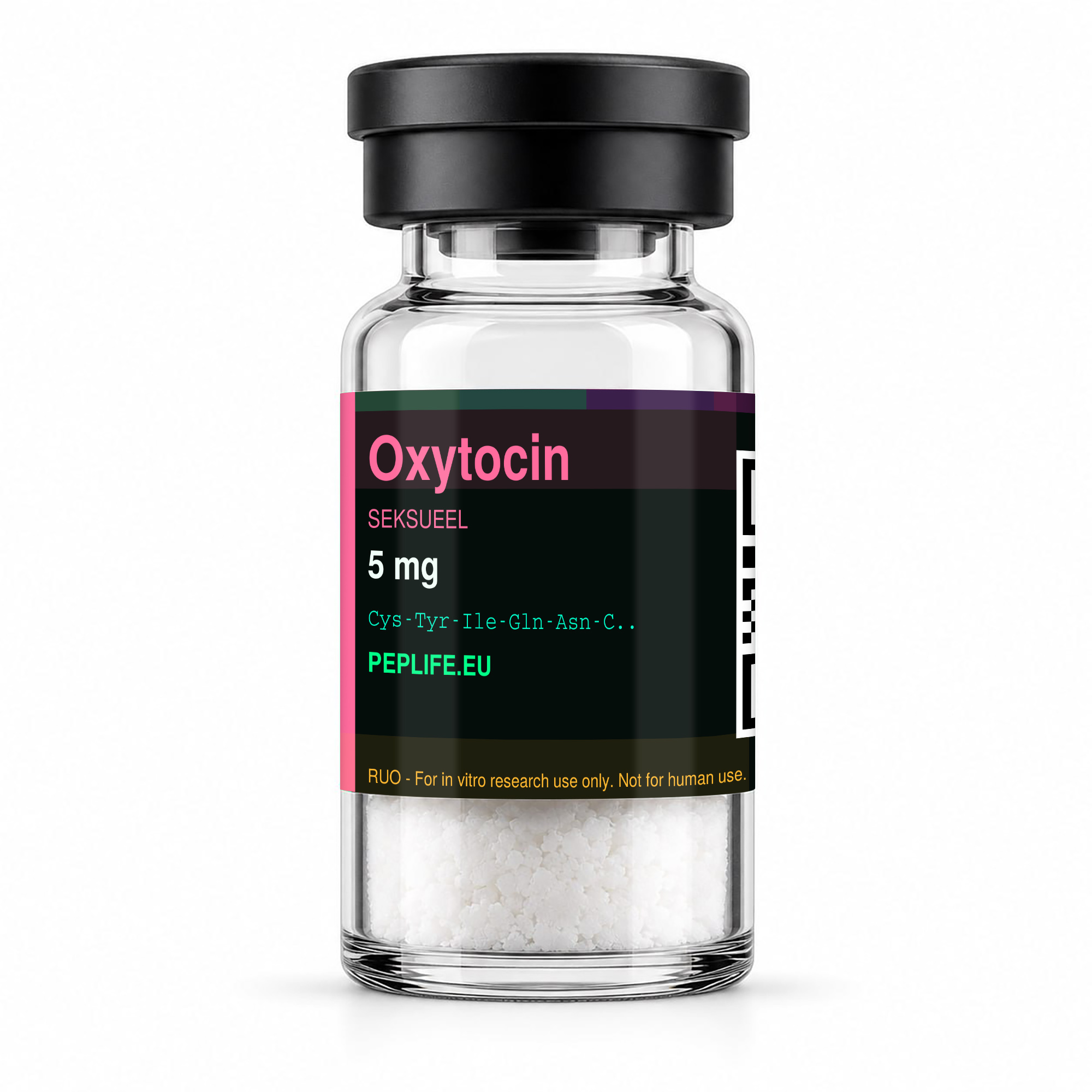
Oxytocin research is one of the most discussed chapters of modern neuroscience. Few molecules acquire so many nicknames: “cuddle hormone”, “love hormone”, “trust molecule”. Behind those popular terms lies a small but exceptionally influential peptide that researchers have used for decades to understand how the brain drives social behaviour, bonding and emotion recognition. In this article we set out what oxytocin is, how it works according to research, and what it is studied for in laboratories and clinical studies — always from a strictly research perspective.
What is oxytocin?
Oxytocin is a nonapeptide: a chain of only nine amino acids, with a characteristic disulfide bond that holds the molecular structure together. The molecular formula is C43H66N12O12S2 (PubChem CID 439302). In the body it is produced in the hypothalamus — specifically in the nucleus paraventricularis (PVN) and the nucleus supraopticus (SON) — and released into the bloodstream via the posterior lobe of the pituitary. Classically, oxytocin is known for its role in labour contractions and in milk let-down during breastfeeding. But those same hypothalamic neurons also project deep into the brain, where oxytocin influences social behaviour as a neuromodulator. That dual identity — peripheral hormone and central neuropeptide — makes oxytocin an exceptionally interesting research object.
How does oxytocin work? — the mechanism
Oxytocin exerts its effect via the oxytocin receptor (OXTR), a receptor that is expressed in specific brain regions. In neuroimaging research it has repeatedly been reported that oxytocin modulates activity in core regions for social behaviour, including the amygdala, the anterior cingulate cortex and the hypothalamus itself. In the influential review article by Meyer-Lindenberg et al. (Nature Reviews Neuroscience, 2011), oxytocin is described together with vasopressin as a “social neuropeptide”: studies with intranasally administered oxytocin reported improved emotion recognition, more eye contact towards the eyes, increased trust and prosocial behaviour, and reduced behavioural and hormonal responses to social stress. A recurring theme is that oxytocin appears to dampen the fear response in the amygdala while at the same time strengthening the processing of positive social signals. Genetic variants in the OXTR gene have been associated in imaging-genetics research with differences in the structure and function of these social brain circuits.
What is oxytocin studied for?
The research field around oxytocin is broad and still growing. The main directions, each attributed to the studies themselves:
- Social cognition and trust: in behavioural experiments, intranasal oxytocin was associated with increased interpersonal trust and better recognition of facial expressions.
- Social bonding and attachment: in animal models — particularly in prairie voles, which form lifelong pair bonds — the oxytocin system plays a key role in research into the neurobiology of bonding.
- Anxiety and social stress: researchers study whether oxytocin attenuates the physiological stress response and amygdala-driven fear.
- Neuropsychiatry: oxytocin is studied in the context of autism spectrum disorder, social anxiety, schizophrenia and borderline personality disorder, in which disrupted social processing is central.
- Maternal and reproductive behaviour: the classic role in labour contractions, milk let-down and mother-child behaviour remains an active research area.
Oxytocin research in neuropsychiatry: promising but nuanced
Precisely because the first findings were so promising, expectations grew that oxytocin could become a therapeutic target. The actual research, however, shows a more nuanced picture — exactly what sound science should do. The largest randomised study to date of intranasal oxytocin in children and adolescents with autism (Sikich et al., New England Journal of Medicine, 2021) included nearly 300 participants over more than six months. The conclusion: oxytocin was safe, but showed no significantly greater improvement in social functioning than placebo. Results like this do not make oxytocin less interesting — on the contrary, they show how important controlled laboratory and clinical research is to separate hype from evidence. Review articles on the role of oxytocin in psychiatric conditions therefore continue to describe the peptide as a valuable research tool for studying social brain circuits, regardless of the eventual clinical outcome.
Oxytocin in laboratory research: handling & dissolving
As a peptide, oxytocin is usually supplied as freeze-dried (lyophilised) powder that is reconstituted in a suitable liquid before it is used in a research setup. Which liquid and which concentration are appropriate depends on the research protocol. Our knowledge base has extensive background articles on reconstituting peptides and which liquid you use to dissolve a peptide — useful reference when setting up a laboratory experiment. Store lyophilised material cool and dry and limit freeze-thaw cycles after reconstitution.
Quality & purity
Every relevant batch is independently HPLC-tested by an external laboratory; the certificate of analysis (CoA) is publicly verifiable per batch. For neuropeptide research, purity is not a detail but a precondition: impurities or breakdown products can distort results and make experiments unreliable. Transparent batch documentation allows researchers to know what is really in the vial before a study starts. Read also why we sometimes reject a batch in why we rejected a batch.
Frequently asked questions about oxytocin
What exactly is oxytocin?
Oxytocin is an endogenous nonapeptide (nine amino acids) that functions both as a hormone and as a neuropeptide. It is produced in the hypothalamus and is closely linked in research to social bonding, trust and emotion processing.
Why is oxytocin called the “cuddle hormone”?
That nickname arises from research that associates oxytocin with social bonding, touch and prosocial behaviour. It is a popular term, not a scientific definition: the actual oxytocin research shows a more complex and more nuanced picture.
What does oxytocin research show about trust?
In behavioural experiments with intranasal oxytocin, researchers reported an increase in interpersonal trust and improved recognition of facial expressions. Later and larger studies nuanced the strength of these effects, which underlines the importance of replication.
Does oxytocin work for autism?
That is precisely what is being studied. The largest randomised study (NEJM, 2021) found that intranasal oxytocin was safe but not significantly better than placebo for social functioning. It remains an active and nuanced field of research.
How does oxytocin relate to PT-141 and kisspeptin?
All three are peptides that appear in research into social, sexual and reproductive behaviour, but with different mechanisms. Our pillar PT-141, kisspeptin and oxytocin compares them side by side.
May I use oxytocin?
No. Oxytocin at Peplife is supplied exclusively for in-vitro laboratory research (Research Use Only) and is not intended for human or animal use.
Read more & research at Peplife
- Research Oxytocin at Peplife
- View all sexually related peptides
- PT-141, kisspeptin and oxytocin compared
- Research PT-141 (Bremelanotide)
- Research Kisspeptin-10
Sources: PubChem — Oxytocin (CID 439302) · Meyer-Lindenberg et al., Nature Reviews Neuroscience 2011 · Sikich et al., NEJM 2021 — intranasal oxytocin in autism · Kirsch et al., oxytocin modulates neural circuitry for social cognition and fear
Research Use Only. All products are supplied exclusively for in vitro laboratory research. Not intended for diagnostic or therapeutic use in humans or animals, and not approved by the EMA or FDA.
HPLC-tested by an external laboratory, with a per-batch verifiable CoA and discreet shipping within the EU.