




| Class | Pan-ERR agonist |
| Molecular weight (Da) | 290.3 |
| Half-life (indicative) | ~31 min (in vitro) |
| Research status | Preclinical / RUO |
Research context (RUO): SLU-PP-332 is a synthetic ERR agonist (estrogen-related receptor) studied in preclinical research as a so-called exercise mimetic. This compound is supplied exclusively for in-vitro laboratory research and is not intended for human or animal use.
SLU-PP-332 research: the ERR agonist and exercise mimetic
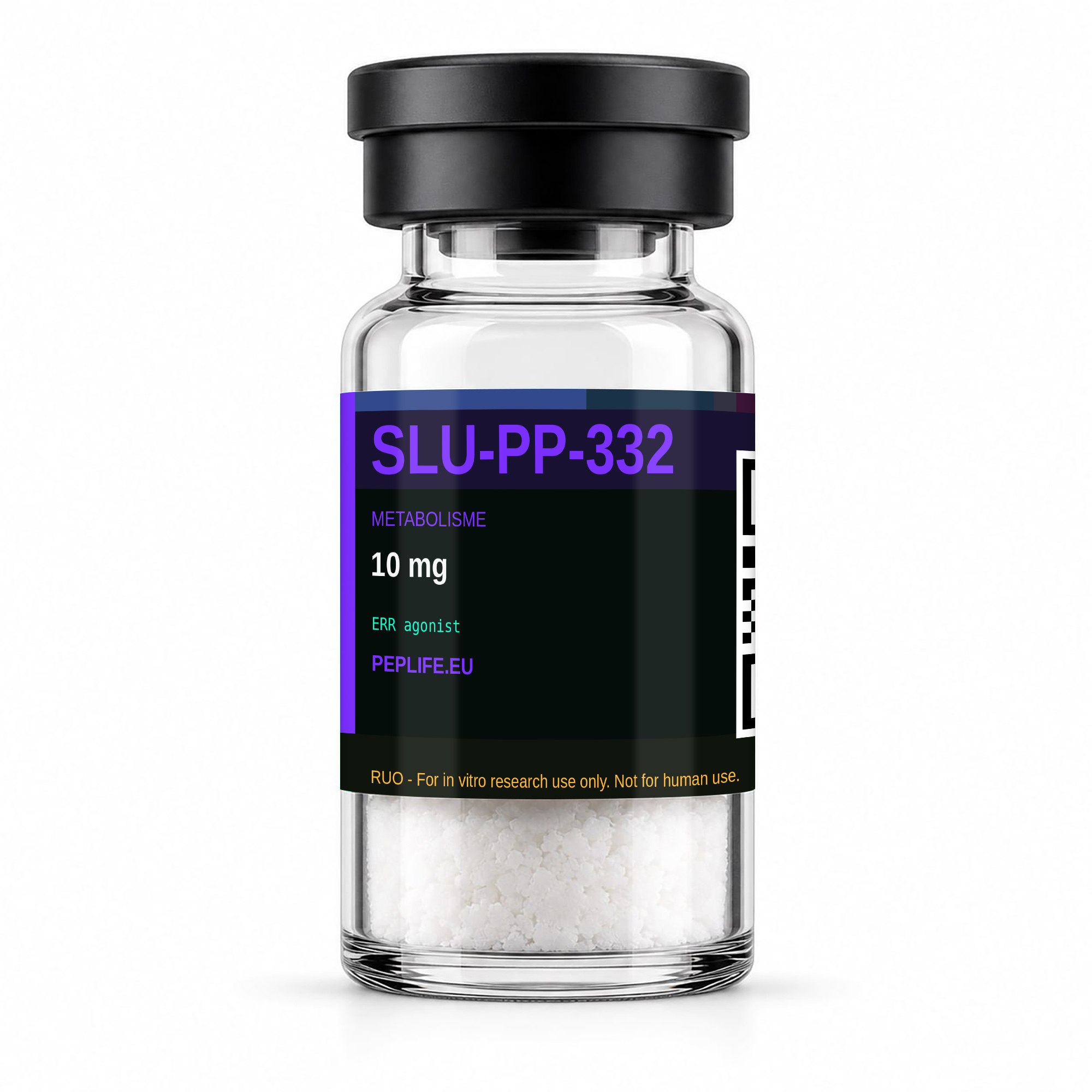
Research into SLU-PP-332 has attracted much attention in recent years because this small molecule showed effects in animal models that are normally associated with physical training — hence the nickname “exercise mimetic”. SLU-PP-332 is not a peptide but a synthetic agonist of the estrogen-related receptors (ERRs), a group of nuclear receptors that drive energy metabolism in muscle, heart and liver cells. In laboratory studies, scientists investigate whether activating these receptors can mimic part of the metabolic response to exercise, without actually training.
What is SLU-PP-332?
SLU-PP-332 is a synthetic research compound with the molecular formula C18H14N2O2 (CAS 303760-60-3). The compound was developed in the laboratory of professor Thomas Burris (Saint Louis University) as a chemical probe to study the biology of the estrogen-related receptors. Contrary to what the name suggests, ERRs have little to do with the hormone estrogen: they are “orphan receptors” that mainly regulate the number and activity of mitochondria — the cell's power plants. SLU-PP-332 acts as a pan-agonist on all three subtypes (ERRα, ERRβ and ERRγ), with the strongest activity on ERRα (reported EC50 around 98 nM). That ERRα activity in particular is central to the research into endurance.
How does SLU-PP-332 work? — the mechanism
During exercise, muscle cells switch to a programme that stimulates the production of mitochondria and favours fatty acids as fuel. The estrogen-related receptors are important switches in that programme. Researchers propose that SLU-PP-332 activates these switches pharmacologically: by activating ERRα, a network of genes is expressed in cell models that resembles the acute response to aerobic training. In the study by Billon and colleagues (2023) this was explicitly described as an “ERRα-dependent acute aerobic exercise response” — in models without functional ERRα the effect was largely absent, which supports the proposed mechanism of action. The consequence in these models was a shift of metabolism towards fatty-acid oxidation, comparable to a fasting or exercise state.
What is SLU-PP-332 studied for?
Research into SLU-PP-332 concentrates on two closely related themes: endurance and metabolic health. The main findings from animal models:
- Endurance: in the study by Billon et al. (2023, ACS Chemical Biology) treated mice ran considerably longer and further than control animals — an increase in running time of around 70% and a greater distance covered were reported, without any prior training.
- Fat burning and body composition: in follow-up research in mice with diet-induced obesity, researchers reported that treated animals put on considerably less fat mass and lost part of their body weight, while food intake and physical activity remained comparable — attributed to an increased fatty-acid oxidation.
- Metabolic syndrome: the article “A Synthetic ERR Agonist Alleviates Metabolic Syndrome” (Billon et al., 2023) describes that SLU-PP-332 counteracted features of metabolic syndrome in animal models, which makes it interesting for research into obesity and metabolic dysfunction.
- Muscle preservation and ageing: additional research explores whether targeting ERRs can influence age- or inactivity-related muscle loss in models.
It is important to emphasise that all these outcomes come from preclinical in-vitro and animal models. There is no clinical evidence in humans; SLU-PP-332 remains strictly a research compound.
SLU-PP-332 in laboratory research: handling & reconstitution
SLU-PP-332 is usually supplied as lyophilised powder or as a pre-mixed solution for use in cell-culture and biochemical assays. Because it is a lipophilic small molecule and not a peptide, dissolving it differs from most peptides in this shop: researchers usually reconstitute the compound in a solvent such as DMSO before diluting further in culture medium. The general laboratory principles around accurate weighing, sterile working and correct storage are covered in our pillar on reconstituting peptides. The specific reconstitution method depends on the research protocol and the chosen assay system.
Quality & purity
Every relevant batch is independently HPLC-tested by an external laboratory; the certificate of analysis (CoA) is publicly verifiable per batch. For a research compound like SLU-PP-332, demonstrated purity is essential: contaminants or a deviating identity can make assay results unreliable. Reproducible research starts with a raw material whose identity and purity are documented, which is why we publish the CoA transparently with the relevant batch.
Frequently asked questions about SLU-PP-332
Is SLU-PP-332 a peptide?
No. Unlike many products in this category, SLU-PP-332 is a synthetic small molecule (C18H14N2O2), not a peptide. It falls within the research into metabolic and GH-axis-related compounds because it acts on mitochondrial energy metabolism.
Why is SLU-PP-332 called an “exercise mimetic”?
Because in animal models it triggers a genetic and metabolic response that resembles the acute reaction to aerobic training. Researchers use the term to indicate that the compound mimics parts of the exercise programme; it is a research concept, not a proven property in humans.
What is the difference between SLU-PP-332, AICAR and 5-Amino-1MQ?
All three are studied in metabolism research, but via different routes. SLU-PP-332 activates ERR receptors; AICAR is being studied as an AMPK activator, and 5-Amino-1MQ as an NNMT inhibitor. They are sometimes compared in research into exercise mimetics and fat metabolism.
What do the main studies say about endurance?
In the study by Billon et al. (2023), treated mice ran longer and further than control animals, with reported increases in running time and distance. The effect was ERRα-dependent. These results apply exclusively to the animal models studied.
May I use SLU-PP-332 to lose weight or to perform?
No. SLU-PP-332 is supplied exclusively for in-vitro laboratory research. There is no approved human use and no clinical safety or dosing data in humans. Any use outside a research context falls outside what this compound is intended for.
How is SLU-PP-332 stored in the lab?
As a small molecule, the powder is usually stored cool, dry and dark; reconstituted solutions are handled according to the research protocol. The exact conditions depend on the solvent used and the design of the experiment.
Read more & research at Peplife
- Research SLU-PP-332 at Peplife
- View all GH axis peptides
- Research AICAR at Peplife
- Research 5-Amino-1MQ at Peplife
- MOTS-c research: the mitochondrial metabolic peptide
- Fat-loss peptides: what research shows
- 5-Amino-1MQ vs SLU-PP-332 vs AICAR
Sources: Billon et al., ACS Chemical Biology (2023) — ERRα-dependent exercise response · Billon et al. — A Synthetic ERR Agonist Alleviates Metabolic Syndrome · PubChem — SLU-PP-332 (C18H14N2O2) · Wikipedia — SLU-PP-332 overview
Research Use Only. All products are supplied exclusively for in vitro laboratory research. Not intended for diagnostic or therapeutic use in humans or animals, and not approved by the EMA or FDA.
HPLC-tested by an external laboratory, with publicly verifiable CoA per batch and discrete EU shipping.