




| Aliases | Acetyl-octapeptide-3 |
| Class | Cosmetic |
| Molecular weight (Da) | 1075.2 |
| Half-life (indicative) | topical |
| Research status | Cosmetic ingredient |
Research context (RUO): SNAP-8 (acetyl octapeptide-3) is a synthetic octapeptide studied in cosmetic research as an extended variant of Argireline. It is supplied exclusively for in-vitro laboratory research and is not intended for human or animal use.
SNAP-8 research: the octapeptide for expression lines
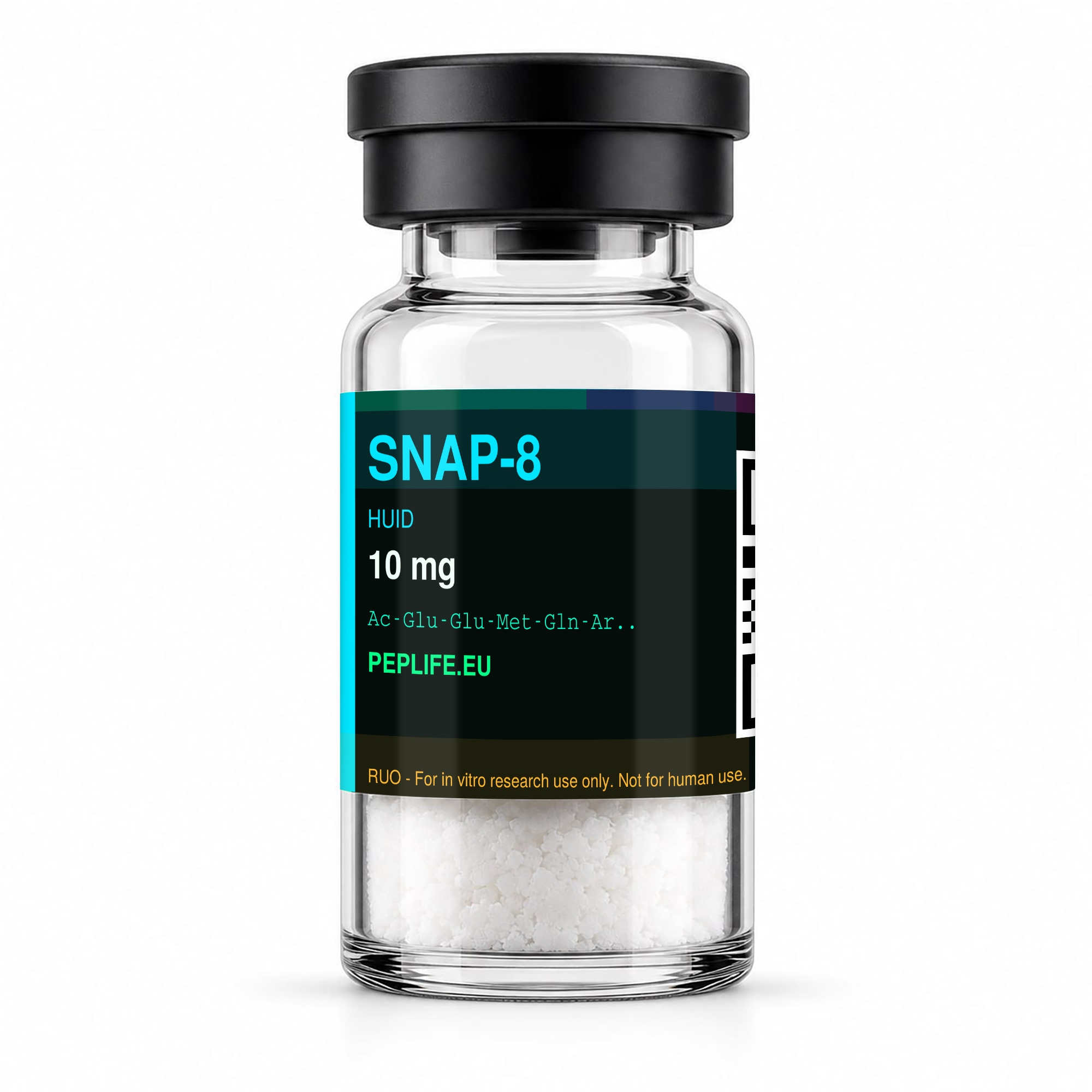
SNAP-8 research focuses on the question of how this octapeptide influences expression lines and dynamic wrinkles via the nerve-to-muscle signalling route in the skin. SNAP-8 is one of the most studied “botox-like” cosmetic peptides and is positioned by researchers as an extension of the better-known Argireline (acetyl hexapeptide-8). Where Argireline consists of six amino acids, SNAP-8 has eight — hence the name octapeptide. In this pillar we set out what SNAP-8 exactly is, how its mechanism of action is described in laboratory research and what it is scientifically studied for.
What is SNAP-8?
SNAP-8 is the trade name for acetyl octapeptide-3, also known as acetyl glutamyl heptapeptide-1. The amino-acid sequence is Ac-Glu-Glu-Met-Gln-Arg-Arg-Ala-Asp-NH2, in shortened notation EEMQRRAD. The name SNAP-8 refers to SNAP-25, a natural nerve protein whose N-terminal sequence is mimicked. The peptide is capped on one side with an acetyl group (Ac-) and on the other with an amide group (-NH2); these modifications change how the molecule behaves and how quickly enzymes break it down.
The interesting thing is the direct kinship with Argireline. Argireline (acetyl hexapeptide-8) has exactly the same starting sequence — EEMQRR — but is two amino acids shorter. SNAP-8 simply extends that chain with alanine and aspartic acid at the C-terminus. It is therefore not a fundamentally different molecule, but a structural extension of Argireline. In the analytical research by Kluczyk and colleagues (2021), SNAP-8 is explicitly described as an Argireline derivative that is “more effective in wrinkle improvement than Argireline”.
How does SNAP-8 work? — the mechanism
The proposed mechanism of action of SNAP-8 revolves around the so-called SNARE complex. SNARE is the protein machinery with which a nerve cell releases its chemical messengers, including the neurotransmitter acetylcholine. Acetylcholine is the signal that prompts muscle cells to contract. When a facial muscle contracts over and over, expression lines develop in the skin over time.
SNAP-8 mimics the N-terminal region of the natural SNAP-25 protein. In laboratory models the peptide therefore acts as a kind of competitive decoy: it occupies binding sites that are normally needed to assemble the three-component SNARE complex, thereby destabilising its formation. If the SNARE complex is assembled less efficiently, in theory less acetylcholine is released and the muscle contracts less forcefully. In controlled cell-culture studies, SNAP-8 reduced glutamate release by approximately 43% at a concentration of 1.5 mM.
Important to emphasise: this differs fundamentally from botulinum toxin (botox). Botox enzymatically cleaves the SNAP-25 protein, whereas SNAP-8 is described in research as a competitive, reversible modulator that inhibits complex formation without destroying the protein. The comparison with botox is therefore an analogy at the mechanistic level, not an equation.
What is SNAP-8 studied for?
SNAP-8 research concentrates almost entirely on the cosmetic science around skin ageing. The main areas of research:
- Expression lines and dynamic wrinkles: researchers study whether inhibiting acetylcholine release reduces the visibility of movement-related wrinkles (forehead, crow's feet) in topical formulations.
- Comparative peptide research: SNAP-8 is placed alongside Argireline to study whether the extended octapeptide structure leads to a stronger or more stable effect in in-vitro assays.
- Skin penetration and formulation: a recurring theme in reviews is the question of how well this kind of peptide penetrates the horny layer (stratum corneum) at all. Research into acetyl hexapeptide-8 showed that only a fraction of the applied peptide passed the horny layer, which directs attention to formulation techniques and molecular modification to improve permeation.
- Peptide stability: the acetyl and amide modifications are studied for their role in resistance to enzymatic degradation, which is relevant to shelf life in cosmetic matrices.
It is good to know that, despite a plausible mechanism, robust clinical confirmation of the neuromuscular anti-wrinkle effect in peer-reviewed literature remains limited. Reviews point out that observed skin improvements may partly be explained via other routes (such as hydration or collagen-related effects). That is precisely what makes SNAP-8 a fascinating subject for ongoing laboratory research.
SNAP-8 in laboratory research: handling & reconstitution
SNAP-8 is supplied as freeze-dried (lyophilised) powder that is reconstituted in a suitable liquid before use. Unlike many injectable research peptides, SNAP-8 in cosmetic research is usually a topically studied molecule, mostly dissolved in an aqueous or glycerine-like matrix. For the correct procedure around reconstitution, concentration calculation and storage, our pillar on reconstituting peptides a good starting point, together with the guide on which liquid you use to dissolve a peptide. Store the lyophilisate cool and dry; reconstituted solutions are stored refrigerated and protected from light.
Quality & purity
Every relevant batch of SNAP-8 is independently HPLC-tested by an external laboratory; the certificate of analysis (CoA) is publicly verifiable per batch. For peptides that serve as a reference or comparison compound in cosmetic research, purity is crucial: contaminants or degradation products can distort assay results. A verified CoA shows the exact identity, the salt content and the measured purity, so that research results remain reproducible. Read also why we rejected a batch for how our quality control works in practice.
Frequently asked questions about SNAP-8
What is the difference between SNAP-8 and Argireline?
Both share the same starting sequence EEMQRR. Argireline (acetyl hexapeptide-8) has six amino acids; SNAP-8 (acetyl octapeptide-3) extends that chain with two extra amino acids (alanine and aspartic acid) into an octapeptide. In cosmetic research, SNAP-8 is described as a structural extension said to be more effective in wrinkle improvement.
Why is it called SNAP-8?
The name refers to SNAP-25, the natural nerve protein whose N-terminal sequence is mimicked. The “8” refers to the number of amino acids (octapeptide). The official INCI name is acetyl octapeptide-3.
How is SNAP-8 compared with botox in research?
Both touch the same SNARE system, but in a different way. Botulinum toxin enzymatically cleaves the SNAP-25 protein; SNAP-8 is described in laboratory research as a competitive modulator that inhibits the formation of the SNARE complex. It is a mechanistic analogy, not an equivalence.
Is SNAP-8 studied for skin penetration?
Yes. An important research theme is how well hydrophilic peptides such as SNAP-8 penetrate the horny layer. Studies into related peptides examine molecular modification and formulation to improve permeation.
Is SNAP-8 the same as GHK-Cu?
No. GHK-Cu is a copper peptide studied in other research for collagen- and skin-repair-related processes, whereas SNAP-8 targets the neuromuscular (SNARE) route. Both fall under skin peptides but have a different mechanism; see our comparison of GHK-Cu and AHK-Cu.
May I use SNAP-8 on my skin?
No. All SNAP-8 supplied via Peplife is intended exclusively for in-vitro laboratory research (Research Use Only) and not for cosmetic, therapeutic or personal use.
Read more & research at Peplife
- Research SNAP-8 at Peplife
- View all skin peptides
- Compare GHK-Cu and AHK-Cu
- Research GHK-Cu at Peplife
- Research Melanotan II at Peplife
Sources: PubChem — Acetyl octapeptide-3 (CID 71587832) · Acetyl Hexapeptide-8 in Cosmeceuticals — A Review (PMC) · Kluczyk et al., Argireline peptide analysis (2021) · Enhanced Skin Permeation of Anti-wrinkle Peptides via Molecular Modification (PMC)
Research Use Only. All products are supplied exclusively for in vitro laboratory research. Not intended for diagnostic or therapeutic use in humans or animals, and not approved by the EMA or FDA.
SNAP-8 (acetyl octapeptide-3): HPLC-tested, CoA verifiable per batch, discrete EU shipping.