




| Aliases | N-acetyl-5-methoxytryptamine |
| Class | Indoleamine hormone (circadian) |
| Molecular weight (Da) | 232.3 |
| Half-life (indicative) | ~40–60 min |
| Research status | Supplement / cofactor |
Research context (RUO): Melatonin is the hormone that the pineal gland (epiphysis) produces at night and that drives the biological clock. It is offered here exclusively for in-vitro laboratory research and is not intended for human or animal use.
Melatonin research: the hormone of the circadian rhythm
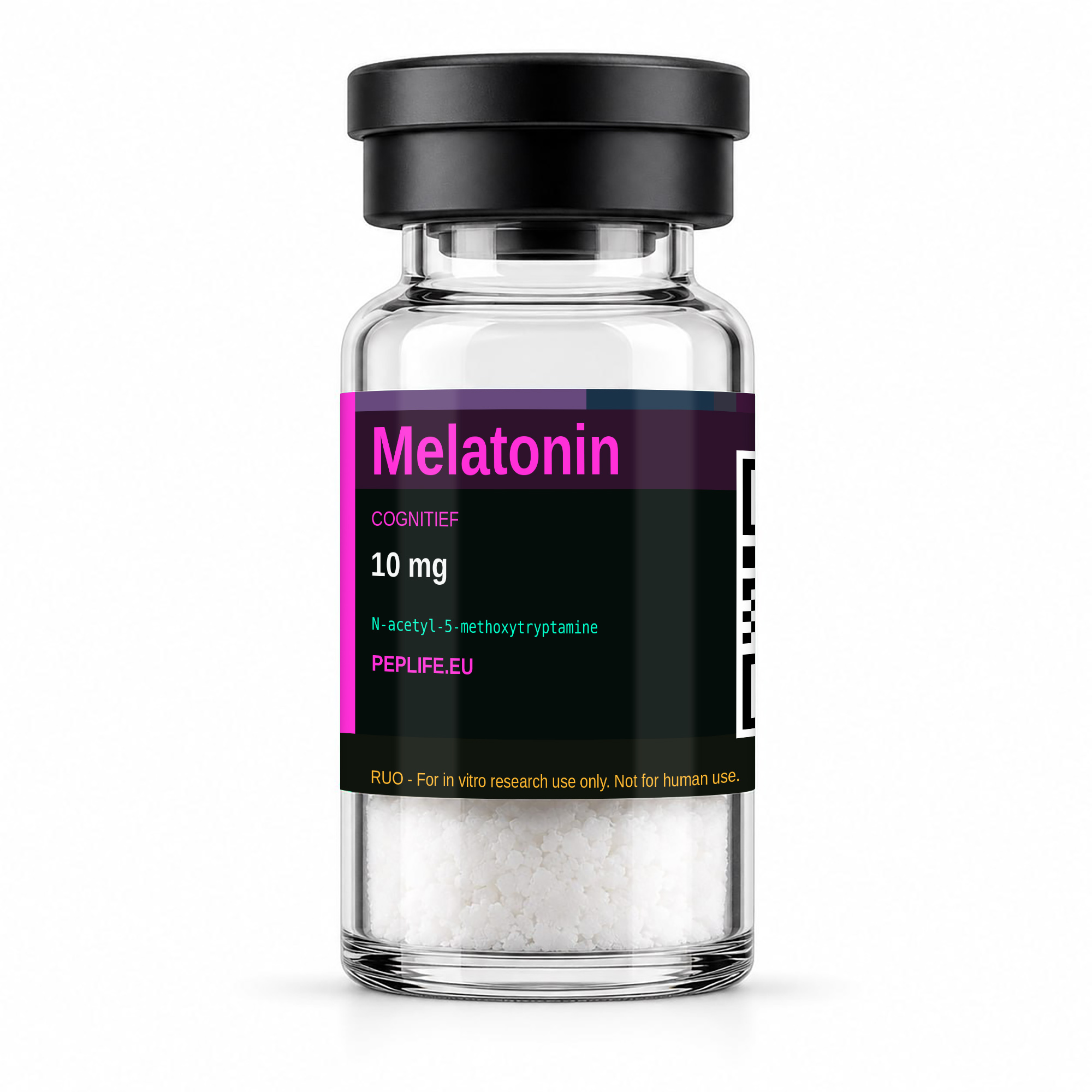
Melatonin research is central to almost every study of sleep, the biological clock and oxidative stress. Melatonin (chemically N-acetyl-5-methoxytryptamine, PubChem CID 896) is a small indoleamine molecule that the pineal gland in the brain produces as soon as it gets dark. Few endogenous molecules have been studied so broadly: from chronobiology and jet lag to the role of melatonin as an antioxidant and its involvement in ageing. In this article we set out what melatonin is, how it works and what researchers study it for — always within the boundaries of laboratory research.
What is melatonin?
Melatonin is a hormone derived from the amino acid tryptophan. Via the neurotransmitter serotonin, tryptophan is converted in the pineal gland in two enzymatic steps: first the enzyme AA-NAT (arylalkylamine N-acetyltransferase) turns serotonin into the intermediate N-acetylserotonin, after which a second enzyme (ASMT) converts it into melatonin. This production runs almost entirely on the rhythm of light and dark: during the day synthesis is at a standstill, at night it peaks. Because the molecule is soluble in both water and fat (amphipathic), melatonin spreads easily throughout the body and crosses cell membranes and the blood-brain barrier. That makes it an interesting object of study: it reaches virtually every tissue. In the lab, melatonin is therefore widely used as a reference substance and model molecule in chronobiology and cell biology.
How does melatonin work? — the mechanism
Melatonin works along two pathways that researchers clearly distinguish. The first is receptor-bound: melatonin binds to two G-protein-coupled receptors, MT1 and MT2, which are mainly expressed in the suprachiasmatic nucleus (SCN) — the central clock in the hypothalamus — and in the retina. Via MT1 the neuronal activity in the SCN is dampened, while MT2 is mainly involved in phase-shifting (advancing or delaying) the circadian rhythm. In this way melatonin functions as a chemical “darkness signal” that tells the biological clock what time it is.
The second track is receptor-independent: thanks to its structure, melatonin can directly neutralise reactive oxygen and nitrogen species (free radicals). In the classic review by Reiter and colleagues (Journal of Pineal Research, 2016), melatonin is described as an antioxidant that “under-promises but over-delivers”, partly because melatonin's breakdown products can themselves also scavenge radicals — a so-called radical-scavenging cascade. Important for an honest picture: more recent publications (including in 2024) place critical caveats on how relevant that scavenging is at physiological concentrations in living systems. That debate makes melatonin a fascinating and topical field of research.
What is melatonin studied for?
Around the keyword melatonin research, a broad spectrum of areas of study clusters together. The main directions recurring in the literature:
- Circadian rhythm & sleep: in chronobiological research, melatonin is used to study disrupted day-night rhythms, such as jet lag, shift work, delayed sleep phase syndrome and non-24-hour rhythm disorders. The endogenous melatonin peak occurs about 90–120 minutes before the usual bedtime — the so-called “dim light melatonin onset”, a widely used marker in sleep research.
- Antioxidant pathways: researchers study melatonin as a free-radical scavenger and as a protector of mitochondria against oxidative damage. In in-vitro models, melatonin was associated with lower lipid peroxidation.
- Ageing & longevity: because nocturnal melatonin release declines with age, models investigate whether this is linked to ageing processes. This area touches on the broader longevity peptides research.
- Neurobiology: the pineal gland and melatonin are studied in relation to neurodegeneration, including studies of the pineal gland in ageing and Alzheimer's disease.
- Metabolism & immune function: preclinical studies explore the role of melatonin in metabolic regulation and in the alignment between the biological clock and the immune system.
Melatonin in laboratory research: handling & dissolving
In research, melatonin is usually supplied as a powder or lyophilised in a vial and reconstituted into a solution before use. Because melatonin is moderately water-soluble, protocols often use a solvent such as ethanol or DMSO as an intermediate step, after which it is further diluted in an aqueous buffer. Careful, standardised dissolving is decisive for reproducible results. Read more about the choice of liquid and method in our pillar dissolving peptides — which liquid? and in reconstitute peptides. Melatonin is moreover light-sensitive; in the lab it is usually stored dark and refrigerated to limit degradation. A frequent point of comparison here is other sleep peptides.
Quality & purity
Every relevant batch is independently HPLC-tested by an external laboratory; the certificate of analysis (CoA) is publicly verifiable per batch. For melatonin as a reference and research substance, a demonstrably high purity is essential, because impurities can distort the results of antioxidant and receptor assays. This way researchers know exactly what is in the vial before an experiment starts.
Frequently asked questions about melatonin research
Is melatonin a peptide?
No. Melatonin is not a peptide but an indoleamine — a small hormone molecule derived from tryptophan/serotonin. Within the Peplife range it falls under the anti-aging category because the research field strongly overlaps with chronobiology and ageing.
Where is melatonin produced?
Primarily in the pineal gland (epiphysis) in the brain, driven by the biological clock in the suprachiasmatic nucleus. In addition, research describes melatonin production in other places, such as the retina and the gut, which points to multiple functions.
Why does light suppress melatonin?
Light — especially blue light around 460–480 nm — inhibits synthesis via the retinohypothalamic tract to the biological clock. This is why melatonin peaks in the dark and production is almost at a standstill during the day. This mechanism is the reason melatonin is the model molecule in circadian research.
What is the role of melatonin as an antioxidant?
In laboratory studies, melatonin neutralises reactive oxygen species, and its breakdown products can do so too. There is scientific debate about how large this effect is at natural concentrations in living systems — an active and current field of research.
May Peplife's melatonin be used outside the lab?
No. Everything is supplied exclusively as Research Use Only for in-vitro laboratory research. It is not intended for human or animal use and not diagnostic or therapeutic.
Why does melatonin decline with age?
Research describes that nocturnal melatonin release generally declines as the pineal gland ages and partially calcifies. Whether and how this is connected to ageing is studied among other things in longevity models.
Read more & research at Peplife
- Research Melatonin (RUO) at Peplife
- View all anti-aging peptides
- Longevity peptides: research into ageing
- Cognitive peptides: research into brain and rhythm
- Research Epitalon at Peplife
- DSIP (Delta Sleep-Inducing Peptide) research
- Research Pinealon at Peplife
Sources: PubChem — Melatonin (CID 896) · Endotext — Physiology of the Pineal Gland and Melatonin · Reiter et al. (2016), Journal of Pineal Research — Melatonin as an antioxidant · PubMed — Melatonin as a broad-spectrum antioxidant and free radical scavenger
Research Use Only. All products are supplied exclusively for in vitro laboratory research. Not intended for diagnostic or therapeutic use in humans or animals, and not approved by the EMA or FDA.
HPLC-tested by an external laboratory, CoA publicly verifiable per batch and discreet shipping within the EU.