




| Aliases | LY3437943 |
| Class | GIP/GLP-1/glucagon triagonist |
| Molecular weight (Da) | 4731.3 |
| Half-life (indicative) | ~6 d |
| Research status | In clinical research |
Research context (RUO): Retatrutide (LY3437943) is an experimental triple receptor agonist peptide studied in clinical research for weight and metabolism. It is supplied solely for in-vitro laboratory research — not for human use.
Retatrutide research: the triple agonist explained
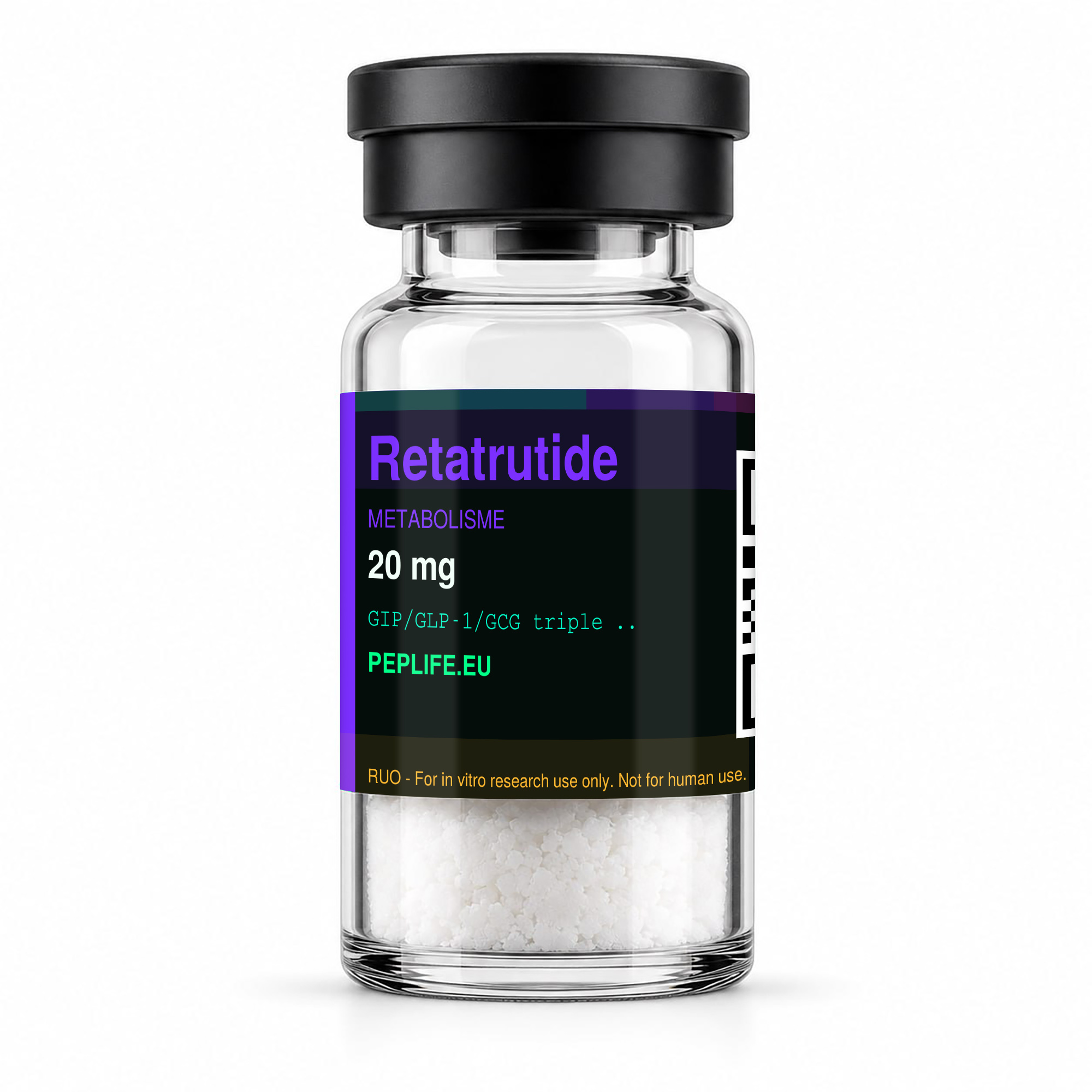
Retatrutide is currently one of the most discussed peptides in the metabolic research field. Where earlier agents activate one or two hormone routes, retatrutide acts on three at the same time. In phase 2 research it showed the largest weight reduction reported so far for an anti-obesity peptide — which is why researchers, media and the peptide community follow it closely.
What is retatrutide?
Retatrutide is a synthetic peptide developed by Eli Lilly under the codename LY3437943. It is a so-called triple agonist: it simultaneously mimics three of the body's own hormones. Chemically it is a modified peptide with a fatty-acid tail, which keeps it stable in solution for a long time and meant it was administered weekly in studies.
How does retatrutide work? — the mechanism
The strength of retatrutide lies in the combination of three receptors:
- GLP-1 receptor: plays a role in research in satiety and blood-sugar regulation — the same route as semaglutide.
- GIP receptor: influences the insulin response and fat metabolism; this route is also used by tirzepatide addressed.
- Glucagon receptor: this is the distinguishing element. In research the glucagon route is associated with an increased energy expenditure and with the breakdown of liver fat — a dimension that the dual agonists lack.
Because the glucagon component appears to raise energy expenditure in models while the GLP-1 and GIP routes influence appetite, researchers study retatrutide as an agent that addresses metabolism along several axes at once.
What is retatrutide studied for?
- Fat loss: in the phase 2 study by Jastreboff and colleagues (NEJM, 2023), at the highest dose after 48 weeks an average body-weight reduction of over 24% was reported — an outlier within this research field.
- Type 2 diabetes: in a separate phase 2 study it was studied for glucose regulation and HbA1c.
- Fatty liver (MASLD): researchers looked at the reduction of liver fat, partly due to the glucagon component.
- Metabolic health broadly: blood pressure, lipids and waist circumference were included as secondary outcomes.
Important: this concerns clinical research into the compound itself. Peplife supplies retatrutide exclusively as research material, not as a medicine.
Retatrutide in laboratory research: handling & reconstitution
Retatrutide is supplied as freeze-dried (lyophilised) powder and reconstituted for research with bacteriostatic water. How researchers do this step by step and sterile is described in our guide reconstitute peptides and which liquid you use to dissolve a peptide.
Quality & purity
Because retatrutide is a relatively complex peptide, purity is crucial for reliable research. Every relevant batch at Peplife is independently HPLC-tested by an independent external laboratory; the certificate of analysis (CoA) belongs to exactly the batch you receive and is publicly verifiable via the QR code on the label. You can read more about this in why we rejected a batch.
What the phase 2 trial showed
The phase 2 trial published in The New England Journal of Medicine in 2023 is still the key reference point for retatrutide. In it, 338 adults with obesity and without type 2 diabetes received a weekly subcutaneous injection or placebo for 48 weeks. Mean weight change rose sharply with the dose.
| Study group | Participants | Week 24 | Week 48 |
|---|---|---|---|
| 1 mg | 69 | minus 7.2 percent | minus 8.7 percent |
| 4 mg | 67 | minus 12.9 percent | minus 17.1 percent |
| 8 mg | 70 | minus 17.3 percent | minus 22.8 percent |
| 12 mg | 62 | minus 17.5 percent | minus 24.2 percent |
| Placebo | 70 | minus 1.6 percent | minus 2.1 percent |
These figures come from clinical research with participants under medical supervision. They say nothing about use outside that context and appear here purely as scientific background to an RUO reference substance.
Pharmacokinetics: half-life and dosing interval
Retatrutide showed a half-life of roughly six days in phase 1 research. That is why the study schedules use one injection per week: plasma levels stay relatively flat between two doses. For comparison: semaglutide sits at around seven days and tirzepatide at around five days. All phase 2 arms also used a titration schedule in which the dose was raised in four-week steps — in the research mainly to limit gastrointestinal complaints.
What have studies reported about tolerability?
The reported side effects were predominantly gastrointestinal: nausea, diarrhoea, vomiting and constipation. They occurred mainly during dose escalation and were usually mild to moderate. In the highest groups a slight increase in heart rate was also seen. These are observations from controlled clinical research and not product information.
Retatrutide alongside tirzepatide and semaglutide
The three substances are often mentioned in the same breath, but they differ in the number of receptors they act on. That difference explains most of the divergent study results.
| Peptide | Receptors | Strongest reported weight change |
|---|---|---|
| Semaglutide | GLP-1 | minus 13.7 percent after 72 weeks |
| Tirzepatide | GLP-1 + GIP | minus 20.2 percent after 72 weeks |
| Retatrutide | GLP-1 + GIP + glucagon | minus 24.2 percent after 48 weeks |
These numbers come from different studies with different durations and participant groups, so they are not directly comparable. For a fuller comparison see semaglutide vs tirzepatide and comparing GLP-1 peptides.
Frequently asked questions about retatrutide
What makes retatrutide different from semaglutide or tirzepatide?
Semaglutide activates one receptor (GLP-1), tirzepatide two (GLP-1 + GIP) and retatrutide three (GLP-1 + GIP + glucagon). That extra glucagon route is linked in research to higher energy expenditure. See also our comparison of GLP-1 peptides.
Is retatrutide approved yet?
No. Retatrutide is in clinical development and is not approved by the EMA or FDA. It is offered solely as a research substance.
How stable is retatrutide after reconstitution?
After reconstitution it is stored refrigerated in research. The long fatty-acid tail contributes to stability; concrete shelf life depends on storage conditions.
Does retatrutide belong in a research stack?
In the community it is sometimes studied in combination; our RETA TOWERbundle is aimed at this. Combinations are always part of a research protocol, not usage advice.
Read more & research at Peplife
- Research retatrutide at Peplife (HPLC-tested, CoA per batch)
- View all metabolism peptides
- Semaglutide vs tirzepatide
- comparing GLP-1 peptides
- Peptides being researched for fat loss
Sources: Jastreboff et al., NEJM 2023 — Retatrutide phase 2 · PubMed 37366315 · PubChem — Retatrutide
Research Use Only. All products are supplied exclusively for in vitro laboratory research. Not intended for diagnostic or therapeutic use in humans or animals, and not approved by the EMA or FDA.
Research-grade retatrutide — independently HPLC-tested by an external laboratory, CoA per batch, discreet EU shipping.