




| Aliases | Mounjaro, LY3298176 |
| Class | GIP/GLP-1 dual agonist |
| Molecular weight (Da) | 4813.5 |
| Half-life (indicative) | ~5 d |
| Research status | Approved drug |
Research context (RUO): Tirzepatide is a synthetic peptide studied in science as a dual GIP/GLP-1 receptor agonist for metabolism and body weight. It is supplied solely for in-vitro laboratory research and is not intended for human or animal use.
Tirzepatide research: the dual incretin peptide under the microscope
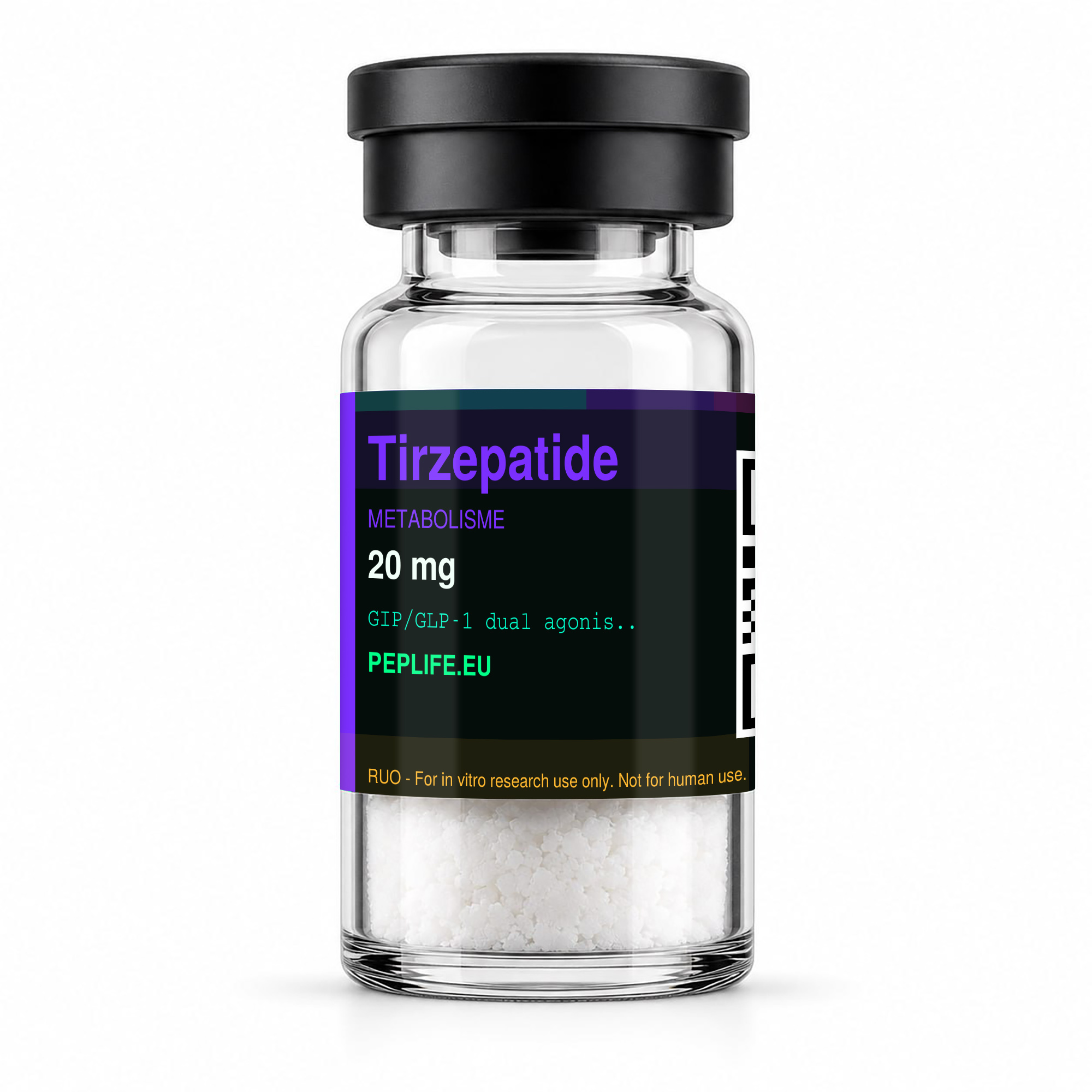
Tirzepatide research has grown in recent years into one of the most discussed chapters within metabolic peptide science. Tirzepatide (development name LY3298176, known under the brand names Mounjaro and Zepbound) is a synthetic peptide of 39 amino acids that acts on two incretin receptors at once. In large-scale clinical study programmes such as SURPASS and SURMOUNT, researchers reported outcomes on glucose regulation and body weight that drew the attention of the whole of endocrinology. This page summarises what the research shows — always attributed to the studies themselves.
What is tirzepatide?
Tirzepatide is a synthetic, linear peptide with the molecular formula C225H348N48O68 (PubChem CID 156588324). It is built as a single amino-acid chain with an attached fatty-acid tail (C20 diacid), which makes the molecule bind to albumin for longer in solution — a structural feature that enables a weekly dosing frequency in the research models. What is special about the molecule is that it is derived from the natural GIP sequence but modified so that it also activates the GLP-1 receptor. This leads researchers to classify tirzepatide as a “twincretin” or dual agonist, in contrast to single GLP-1 analogues such as semaglutide.
How does tirzepatide work? — the mechanism
Incretins are hormones that the gut releases after a meal. The two most important are GIP (glucose-dependent insulinotropic polypeptide) and GLP-1 (glucagon-like peptide-1). Both stimulate the release of insulin when blood sugar rises. In structural and pharmacological research — described among others in work on the way tirzepatide binds to the GIP and GLP-1 receptors — it was established that the peptide activates both receptors at once, with a stronger affinity for the GIP receptor. Researchers are studying whether it is precisely this dual activation that explains why larger effects on glucose and weight were observed in animal models and clinical studies than with activation of the GLP-1 receptor alone. The exact interplay between the two signalling routes is still the subject of ongoing mechanistic research.
What is tirzepatide studied for?
The research field around tirzepatide is broad. The most-studied areas:
- Glucose regulation (SURPASS programme): In SURPASS-2, a comparative study in 1,879 participants with type 2 diabetes (published in 2021), researchers reported HbA1c reductions of up to -2.30% in the 15 mg group, versus -1.86% for semaglutide 1 mg over 40 weeks.
- Body weight (SURMOUNT programme): In SURMOUNT-1 (2,539 participants, 72 weeks, published in 2022), researchers reported an average weight loss of 16.0%, 21.4% and 22.5% at the 5, 10 and 15 mg doses respectively, versus 2.4% in the placebo group.
- Comparative research: In the head-to-head study SURMOUNT-5 (751 participants, 2025), researchers recorded an average weight loss of -20.2% with tirzepatide versus -13.7% with semaglutide.
- Cardiometabolic markers: In several studies, alongside weight and glucose effects, researchers also reported changes in waist circumference, blood pressure and lipid profiles as secondary outcomes.
For a broader placement of these findings within the metabolic peptide class, the knowledge-base pillar comparing GLP-1 peptides a logical next step, and for the direct counterpart the pillar Semaglutide vs tirzepatide.
Tirzepatide in laboratory research: handling & dissolving
Tirzepatide is supplied as a freeze-dried (lyophilised) powder in a vial. In laboratory protocols the powder is reconstituted with bacteriostatic or sterile water before it is used in in-vitro experiments. The choice of reconstitution liquid and correct handling affect the stability of the peptide; background on this is in the pillars reconstitute peptides and dissolve peptide: which liquid. This information is intended solely for the laboratory context and does not constitute a dosing or usage instruction for humans or animals.
Quality & purity
For reliable research the purity of the peptide is decisive. Every relevant batch of tirzepatide is independently HPLC-tested by an external laboratory; the certificate of analysis (CoA) is publicly verifiable per batch. This allows a researcher to check the identity and purity of the material used before setting up an experiment — a precondition for reproducible in-vitro results. How strict this process is, is illustrated by the pillar why we rejected a batch.
Frequently asked questions about tirzepatide
What is the difference between tirzepatide and semaglutide?
Semaglutide is a single GLP-1 receptor agonist, whereas tirzepatide activates both the GLP-1 and the GIP receptor. In the comparative studies SURPASS-2 and SURMOUNT-5, researchers reported larger effects on glucose and weight with tirzepatide. An extensive comparison is in the pillar Semaglutide vs tirzepatide.
What does “dual agonist” mean?
It means that one molecule activates two different receptors — in this case the GIP and the GLP-1 receptor. Researchers are studying whether this dual activation explains why stronger metabolic effects were observed in studies than with single GLP-1 agonists.
How does tirzepatide relate to retatrutide?
Retatrutide is studied as a triple agonist (GIP, GLP-1 and glucagon) and thereby represents a next generation in the research. The background is in the pillar retatrutide research.
What is tirzepatide being researched for in the area of fat loss?
In the SURMOUNT studies, tirzepatide was studied for changes in body weight and fat mass; the broader context of metabolic peptides is in the pillar fat-loss peptides. All outcomes derive from clinical research and do not constitute a usage claim.
Is tirzepatide an approved drug?
As a pharmaceutical product, tirzepatide formulations are registered in various regions, but the material that Peplife supplies is intended solely for in-vitro laboratory research and is not approved for human or animal use.
Why is tirzepatide administered weekly in studies?
The attached fatty-acid tail binds to albumin, which keeps the peptide stable for longer in the research models. This allowed the clinical studies to work with a weekly administration schedule.
Read more & research at Peplife
- Research Tirzepatide at Peplife
- View all metabolism peptides
- Semaglutide vs tirzepatide — the comparison
- comparing GLP-1 peptides
- Retatrutide research — the triple agonist
- Fat-loss peptides in research
- Research Semaglutide at Peplife
Sources: PubChem — Tirzepatide (CID 156588324) · SURMOUNT-1 (NEJM, 2022) · SURPASS-2 (NEJM, 2021) — overview · SURMOUNT-5 (2025)
Research Use Only. All products are supplied exclusively for in vitro laboratory research. Not intended for diagnostic or therapeutic use in humans or animals, and not approved by the EMA or FDA.
HPLC-tested by an external laboratory, with CoA per batch and discreet EU shipping — tirzepatide for laboratory research.